
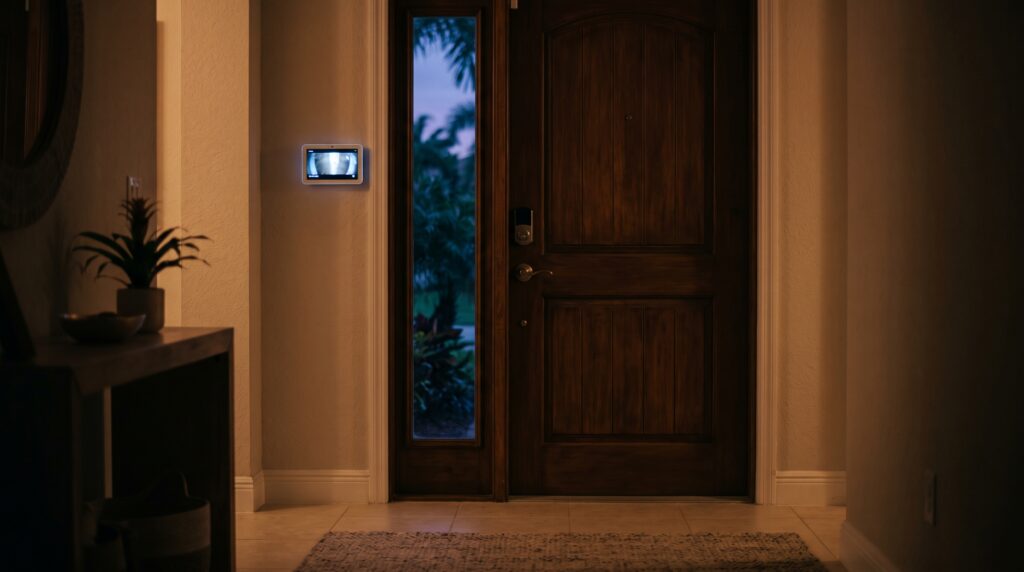
No. If police knock on your door in Florida without a warrant, you do not have to open it, let them in, or answer their questions. The U.S. Supreme Court has said that when officers knock without a warrant, the person inside “has no obligation to open the door or to speak.” Police can enter a home without a warrant in a few situations: you consent, there is a genuine emergency, they are in hot pursuit of a suspect, or they need to stop evidence from being destroyed right away. If officers say they have a search or arrest warrant, do not block the door. Different rules apply. Stay calm, do not physically resist, say you do not consent to a search, and call a lawyer.
At a glance:
- No warrant: you can keep the door closed, talk through the door, or say nothing. Police may knock, wait briefly, and then must leave unless they have another legal basis.
- Opening the door is not consent to enter. You can still refuse entry and refuse to answer questions.
- Warrantless entry is allowed with valid consent, in a genuine emergency, in hot pursuit, or to stop the destruction of evidence, and courts look at the facts of each case.
- The smell of marijuana at the door can help police get a warrant, but does not by itself let them come inside.
- With a search warrant: officers must announce their authority and purpose before forcing entry, but under a June 2026 Florida Supreme Court decision, a violation of that statute does not by itself get the evidence thrown out.
- Never use force against officers. Florida law says force against an officer acting in good faith is not justified, and a 2026 amendment defines good faith to cover an arrest, detention, or other act later found unlawful.
What to Do When Police Knock
- Keep the door closed. Speak through the door, a window, or a doorbell camera.
- Ask if they have a warrant. If they say no, you can tell them you do not want to talk and do not consent to a search. Be polite and brief.
- Do not step outside. If you stand in an open doorway, courts can treat you as being in a public place. In Santana, officers with probable cause to arrest a woman for a heroin sale approached her as she stood in her doorway, and the Court held she could not defeat “an arrest which has been set in motion in a public place” by retreating inside (United States v. Santana, 427 U.S. 38, 42-43 (1976)).
- Do not lie. Florida makes it a crime for a person who has been arrested or lawfully detained to give an officer a false name (Fla. Stat. § 901.36). It is also a crime for anyone to knowingly give false information to an officer conducting a felony or missing-person investigation with intent to mislead the officer (§ 837.055). Staying silent is not lying. If you speak, tell the truth.
- If they say they have a warrant, do not block the door or resist. Say clearly that you do not consent to any search, stay calm, and call a lawyer.
- Tell everyone in the home that no one should agree to a search or answer questions without a lawyer.
- Write down the time, names, badge numbers, agency, and what was said, and save any doorbell camera video.
What to Say Through the Door
Use these words. If officers say they have a warrant, do not keep the door shut against them: officers who announce their authority and purpose and are refused admittance may break in (Fla. Stat. §§ 933.09, 901.19).
- Ask: “Officer, do you have a warrant?”
- If they say no: “I do not consent to you entering or searching my home. I will not answer questions without a lawyer.” Then stop talking. You “may refuse to answer any questions at any time” (Kentucky v. King, 563 U.S. 452, 470 (2011)). Asking for a lawyer through a closed door does not by itself bar police from questioning you later. If you are arrested and police question you or are about to, say again, clearly, that you want a lawyer and will not answer questions. The Florida Supreme Court requires that request to come “either during custodial interrogation or when it is imminent” (Sapp v. State, 690 So. 2d 581, 585-86 (Fla. 1997)).
- If you already opened the door: “I do not want to talk. I am closing the door now.” A Florida appeals court held that after a 14-year-old babysitter refused to answer deputies’ questions, asked whether they had a warrant, and told them she did not want them to come in, the deputies, who had no warrant, “were required to permit J.H.M. to close the door” (J.H.M. v. State, 945 So. 2d 642, 643-44 (Fla. 2d DCA 2006)).
- If they say they have a warrant: “I will not resist. I do not consent to any search. Please show me the warrant and give me a copy.” Officers serving a search warrant must deliver a copy to the person named in it or, if that person is absent, to someone in charge of or living at the home (§ 933.11). An officer arresting someone on a warrant need not carry it, but on request must show it to the person arrested “as soon as practicable” (§ 901.16). Neither statute lets you keep officers out until you see the warrant.
The first consultation is free and confidential. Call (305) 774-7000.
Do I Have to Open the Door If Police Knock Without a Warrant?
No. Without a warrant, police at your door have the same rights as any visitor. They can walk up, knock, wait briefly, and then leave unless invited to stay. The U.S. Supreme Court put it this way: officers may “approach the home by the front path, knock promptly, wait briefly to be received, and then (absent invitation to linger longer) leave” (Florida v. Jardines, 569 U.S. 1, 8 (2013)). That case started in Miami-Dade, where police brought a drug dog to the front porch, and the Court held that was a “search” under the Fourth Amendment (id. at 11-12).
“When law enforcement officers who are not armed with a warrant knock on a door, they do no more than any private citizen might do. And whether the person who knocks on the door and requests the opportunity to speak is a police officer or a private citizen, the occupant has no obligation to open the door or to speak” (King, 563 U.S. at 469-70). Even if you open the door, you “need not allow the officers to enter the premises” (id. at 470).
Short answer on knock and talks: police can knock and ask to talk, but they cannot use pressure tactics to force you out of your home.
Miami-Dade’s appeals court has called a knock and talk “a legitimate investigative procedure so long as the encounter does not evolve into a constructive entry,” which happens when police “deploy overbearing tactics that essentially force the individual out of the home” (State v. Triana, 979 So. 2d 1039, 1043-44 (Fla. 3d DCA 2008)). Citing federal cases, the court said that “drawn weapons, coercive actions and demands, or raised voices by the police have been found to result in non-consensual encounters” (id. at 1044). In that case, four officers met the homeowner at his gate at about 9 p.m., drew no weapons, and made no coercive demands, and the court reversed an order that had suppressed the evidence (id. at 1044-45). Florida courts weigh the hour and the number of officers when deciding whether a person felt free to say no.
Police may not pull you out of your home without a warrant or a valid exception to the warrant requirement, and refusing an order to come out when officers have no legal basis to detain you is not resisting without violence. In a 2022 case, a man refused to come out for an hour and a half, then opened his door and refused an officer’s order to step outside. Officers grabbed him by the wrist and pulled him out, with no warrant and, by the officer’s testimony, no grounds to arrest. The appeals court held that removing him violated the Fourth Amendment, that his refusal to step out was “entirely consistent” with his constitutional rights, and that he was entitled to an acquittal (Seiracki v. State, No. 2D21-63, slip op. at 6-9 (Fla. 2d DCA Feb. 16, 2022); see also J.H.M., 945 So. 2d at 645).
When Can Police Enter a Home Without a Warrant in Florida?
Short answer: police need a warrant to enter your home unless you consent, there is a genuine emergency, they are chasing a fleeing suspect, or they must act right away to stop evidence from being destroyed.
The Fourth Amendment “has drawn a firm line at the entrance to the house,” and without exigent circumstances, “that threshold may not reasonably be crossed without a warrant” (Payton v. New York, 445 U.S. 573, 590 (1980)). Florida’s Constitution follows the U.S. Supreme Court’s search rulings (Fla. Const. art. I, § 12). The Florida Supreme Court has said that “a key ingredient of the exigency requirement is that the police lack time to secure a search warrant” (Riggs v. State, 918 So. 2d 274, 279 (Fla. 2005) (quoting Rolling v. State, 695 So. 2d 278, 293 (Fla. 1997))). The exceptions are:
- Consent. If you or another person with authority over the home agrees, police can come in. Consent must be voluntary, judged by all the circumstances, and police do not have to tell you that you can refuse (Schneckloth v. Bustamonte, 412 U.S. 218, 227, 231-32 (1973)).
- Emergency. Officers “may enter a home without a warrant to render emergency assistance to an injured occupant or to protect an occupant from imminent injury” (Brigham City v. Stuart, 547 U.S. 398, 403 (2006)). A Florida appeals court affirmed suppression in July 2026 where detectives claimed someone needed life-saving help, repeating that “[t]he exigent circumstances exception is not a shortcut by which police may circumvent the requirement of a search warrant” (State v. Ford, No. 2D2025-0324 (Fla. 2d DCA July 10, 2026) (quoting State v. Fultz, 189 So. 3d 155, 158 (Fla. 2d DCA 2016))).
- Hot pursuit. Police chasing a fleeing suspect may follow into a home in some cases. When the suspect is fleeing a misdemeanor, the U.S. Supreme Court held that the flight does not “always” justify warrantless entry, and courts decide case by case (Lange v. California, 594 U.S. 295, 313 (2021)).
- Destruction of evidence. “[E]xigent circumstances,” including “the need to prevent the destruction of evidence,” can allow a warrantless entry, so long as police did not create the exigency “by engaging or threatening to engage in conduct that violates the Fourth Amendment” (King, 563 U.S. at 455, 462).
There is no general “community caretaking” exception for homes. The U.S. Supreme Court held in 2021 that police cannot enter a home on that basis alone (Caniglia v. Strom, 593 U.S. 194, 196 (2021)). When police have probable cause for nothing more than a minor offense, such as the noncriminal traffic offense in that case, the Court has said a warrantless home entry based on exigent circumstances “should rarely be sanctioned” (Welsh v. Wisconsin, 466 U.S. 740, 753 (1984)).
What If Police Say They Smell Marijuana or See Something?
Smelling marijuana at the front door can help police get a warrant. It does not by itself let them come inside. The U.S. Supreme Court held long ago that “odors alone do not authorize a search without warrant” (Johnson v. United States, 333 U.S. 10, 13 (1948)). The Florida Supreme Court has held that even when officers smell burning cannabis, “probable cause itself is not sufficient to support a warrantless search” of a home (Hornblower v. State, 351 So. 2d 716, 718 (Fla. 1977)).
The same goes for something officers see. Officers may use what they see in plain view from a place where they have a legal right to be (Hornblower, 351 So. 2d at 718 n.1), but seeing contraband through an open door does not by itself let them walk in. In one case, after the resident opened the door, an officer saw four hand-rolled cigarettes inside and went in, and a Florida appeals court held that “[t]he sight of the cigarettes alone did not justify a warrantless entry” (Taylor v. State, 381 So. 2d 255, 255-56 (Fla. 5th DCA 1980)). If officers knock lawfully and then hear what sounds like evidence being destroyed, though, the destruction-of-evidence exception can apply (King, 563 U.S. at 470). Letting police in “in submission to authority” is not consent (Johnson, 333 U.S. at 13).
Can a Roommate or Family Member Let Police In?
Yes, in many cases. A person who shares the home can consent to a search of shared areas, and police can rely on someone who reasonably appears to have that authority (Illinois v. Rodriguez, 497 U.S. 177, 188 (1990)). But if you are physically present and expressly refuse, a co-occupant’s consent cannot justify the search as to you (Georgia v. Randolph, 547 U.S. 103, 120 (2006)). If police lawfully remove you, such as by arrest, a remaining occupant’s consent can still count (Fernandez v. California, 571 U.S. 292, 303 (2014)).
Letting officers in to talk is not consent to a search. In a Miami-Dade case, a wife let officers in narcotics raid jackets into the home at about 9 p.m. to talk; they then swept the house room to room without permission, and the Third District held her later consent to search involuntary and reversed the conviction (Gonzalez v. State, 578 So. 2d 729, 731-34 (Fla. 3d DCA 1991)). Consent that follows illegal police action is presumed tainted (Norman v. State, 379 So. 2d 643, 646-47 (Fla. 1980)). When a child lets police in, that consent needs clear and convincing proof that it was voluntary (Saavedra v. State, 622 So. 2d 952, 954 (Fla. 1993)).
What If Police Say They Have a Warrant?
Short answer: do not block the door or resist. Ask to see the warrant and for a copy, say you do not consent to any search, and call a lawyer.
An arrest warrant lets police enter the home where the suspect lives when there is reason to believe the suspect is inside (Payton, 445 U.S. at 603). To enter someone else’s home to look for that person, police need a search warrant unless there is consent or exigent circumstances (Steagald v. United States, 451 U.S. 204, 216 (1981)).
Florida law requires officers serving a search warrant to give “due notice of the officer’s authority and purpose” before breaking in, and it allows forced entry if they are refused admittance (Fla. Stat. § 933.09). A similar statute covers entry to make an arrest with a warrant, or a felony arrest without one (§ 901.19). When officers serve a search warrant, they must deliver a copy to the person named in it or, if that person is absent, to someone in charge of or living at the home, plus, when property is taken, “a written inventory of the property taken and receipt for the same” (§ 933.11). A search warrant may be served at night when the judge “expressly authorized” that in the warrant (§ 933.10). An officer who willfully exceeds his or her authority, or uses unnecessary severity, in executing a search warrant commits a second-degree misdemeanor (§ 933.17).
A knock-and-announce violation, by itself, does not get the evidence thrown out in Florida. On June 25, 2026, the Florida Supreme Court held that a violation of the search-warrant knock-and-announce statute, § 933.09, does not by itself require courts to throw out the evidence: “Because section 933.09 does not itself contain an exclusionary rule … we do not infer that the remedy of exclusion is available” (State v. Times, No. SC2024-0647, slip op. at 10 (Fla. June 25, 2026)). The court also receded from (partly overruled) State v. Cable, 51 So. 3d 434 (Fla. 2010), a decision that had required suppression for a violation of the arrest statute, § 901.19, to the extent Cable conflicts with Times. The U.S. Supreme Court had already held that the Fourth Amendment does not require suppression for a knock-and-announce violation (Hudson v. Michigan, 547 U.S. 586, 599 (2006)).
Can I Be Arrested for Refusing to Open the Door?
Refusing a warrantless entry is not a crime. Resisting an officer without violence requires that the officer was engaged in “the lawful execution of any legal duty” (Fla. Stat. § 843.02), and Florida appeals courts have reversed convictions for resisting without violence where officers pulled or tried to pull a person out of the home without a warrant or a valid exception (Seiracki; Espiet v. State, 797 So. 2d 598, 602-04 (Fla. 5th DCA 2001)).
Short answer on force: never use force against an officer at your door, even if you believe the entry is illegal.
Since 2008, Florida law has said a person is not justified in using force to resist an arrest by an officer, or an officer “engaged in the execution of a legal duty,” when the officer was acting in good faith. A 2026 law, effective June 16, 2026, extended that rule to “any arrest or detention,” replaced the legal-duty wording with an officer “engaged in the performance of his or her official duties,” and defined “acting in good faith” as making “sincere and reasonable efforts to comply with legal requirements, even if the arrest, detention, or other act is later found to have been unlawful” (Fla. Stat. § 776.051; ch. 2026-144, Laws of Fla.). The same law replaced “lawful execution of any legal duty” in the felony of resisting with violence with “engaged in the performance of his or her official duties” (§ 843.01(1)), and the battery-on-officer statute now covers an officer “engaged in the performance of his or her official duties” (§ 784.07(2)). Earlier decisions that reversed battery-on-officer convictions or juvenile adjudications after police unlawfully entered or blocked a home’s door, such as Taylor v. State, 740 So. 2d 89 (Fla. 1st DCA 1999), and J.H.M., relied on that “lawful” language and may no longer protect you. Challenge an unlawful entry later, in court, with a criminal defense lawyer.
For more on your rights with police, see our posts on whether police can search your car without a warrant, whether police can search your car for the smell of marijuana, whether you have to give police your phone passcode, recording the police in Florida, and our Miami-Dade Warrant Search guide.
This post reflects the 2026 Florida Statutes and court decisions through November 2026.
Sources: Fla. Const. art. I, § 12; Fla. Stat. §§ 776.051, 784.07, 837.055, 843.01, 843.02, 901.16, 901.19, 901.36, 933.09, 933.10, 933.11, 933.17 (2026); Ch. 2026-144, Laws of Fla.; Kentucky v. King, 563 U.S. 452 (2011); Florida v. Jardines, 569 U.S. 1 (2013); Johnson v. United States, 333 U.S. 10 (1948); Payton v. New York, 445 U.S. 573 (1980); Steagald v. United States, 451 U.S. 204 (1981); United States v. Santana, 427 U.S. 38 (1976); Welsh v. Wisconsin, 466 U.S. 740 (1984); Brigham City v. Stuart, 547 U.S. 398 (2006); Lange v. California, 594 U.S. 295 (2021); Caniglia v. Strom, 593 U.S. 194 (2021); Schneckloth v. Bustamonte, 412 U.S. 218 (1973); Illinois v. Rodriguez, 497 U.S. 177 (1990); Georgia v. Randolph, 547 U.S. 103 (2006); Fernandez v. California, 571 U.S. 292 (2014); Hudson v. Michigan, 547 U.S. 586 (2006); State v. Times, No. SC2024-0647 (Fla. June 25, 2026); State v. Cable, 51 So. 3d 434 (Fla. 2010); Riggs v. State, 918 So. 2d 274 (Fla. 2005); Rolling v. State, 695 So. 2d 278 (Fla. 1997); Hornblower v. State, 351 So. 2d 716 (Fla. 1977); Sapp v. State, 690 So. 2d 581 (Fla. 1997); Norman v. State, 379 So. 2d 643 (Fla. 1980); Saavedra v. State, 622 So. 2d 952 (Fla. 1993); State v. Triana, 979 So. 2d 1039 (Fla. 3d DCA 2008); Gonzalez v. State, 578 So. 2d 729 (Fla. 3d DCA 1991); Seiracki v. State, No. 2D21-63 (Fla. 2d DCA Feb. 16, 2022); J.H.M. v. State, 945 So. 2d 642 (Fla. 2d DCA 2006); Espiet v. State, 797 So. 2d 598 (Fla. 5th DCA 2001); Taylor v. State, 740 So. 2d 89 (Fla. 1st DCA 1999); Taylor v. State, 381 So. 2d 255 (Fla. 5th DCA 1980); State v. Ford, No. 2D2025-0324 (Fla. 2d DCA July 10, 2026); State v. Fultz, 189 So. 3d 155 (Fla. 2d DCA 2016).
Quick Answers
Do I have to open the door for police in Florida?
No, not if they do not have a warrant. The U.S. Supreme Court has said the person inside has no obligation to open the door or to speak. You can talk through the closed door or say nothing.
Can police enter my home without a warrant in Florida?
In limited situations: valid consent, a genuine emergency, hot pursuit of a fleeing suspect, or a need to stop evidence from being destroyed. There is no general community caretaking exception for homes, and courts decide emergencies and misdemeanor pursuits case by case.
If I open the door, can police come in?
No, not on that basis alone. Opening the door does not give consent to enter, and you can still refuse entry and refuse to answer questions. Police can still enter without consent if an exception applies, such as an emergency or a need to stop evidence from being destroyed, and standing in an open doorway can be treated as a public place for an arrest.
Do I have to step outside if police ask?
No. Police may not pull you out of your home without a warrant or a valid exception, and refusing an order to come out when officers have no legal basis to detain you is not resisting without violence. Standing in an open doorway, though, can be treated as a public place for an arrest.
Can police come in if they smell marijuana?
Not on the smell alone. The Florida Supreme Court has held that even when officers smell burning cannabis, probable cause by itself does not support a warrantless search of a home. The smell can help them get a warrant.
Can my roommate or a family member let police in?
A person who shares the home can consent to a search of shared areas. If you are physically present and expressly refuse, a co-occupant’s consent does not justify the search as to you, unless police have lawfully removed you, such as by arrest.
What should I do if police say they have a warrant?
Do not block the door or resist. Ask to see the warrant and for a copy, say you do not consent to any search, stay calm, and call a lawyer. Officers serving a search warrant must announce their authority and purpose before forcing entry and must deliver a copy to the person named in it or, if that person is absent, to someone in charge of or living at the home.
Can I be arrested for not opening the door?
Refusing a warrantless entry is not a crime, and resisting without violence requires that the officer was acting lawfully. Using force is different: Florida law says force against an officer acting in good faith is not justified, even if the arrest, detention, or other act is later found unlawful.
Do I have to give police my name at my door?
Not during a voluntary knock and talk. A Florida appeals court held that deputies had to let a 14-year-old girl close the door after she refused to answer their questions and asked whether they had a warrant. Lying is different: giving a false name after being arrested or lawfully detained is a crime, and so is knowingly giving false information to an officer conducting a felony or missing-person investigation with intent to mislead the officer.
The first consultation is free and confidential, with no obligation to retain.
Last updated: November 14, 2026.