
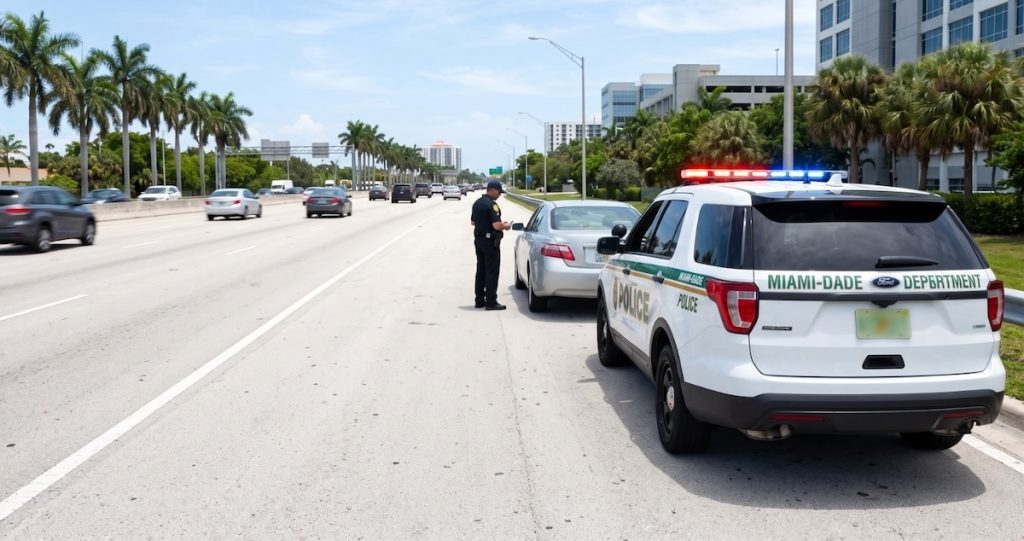
Do police need a warrant to search my car in Florida?
Sometimes, and the exceptions are broader than most people expect. The Fourth Amendment generally requires a warrant for a search, but courts have carved out several situations specific to vehicles where officers do not need one. Florida’s Constitution, Article I, Section 12, requires state courts to interpret these protections in conformity with the United States Supreme Court’s Fourth Amendment rulings, which is why federal case law controls the exceptions below.
- Consent: the driver agrees to the search.
- Plain view: an officer sees something illegal without needing to search.
- The automobile exception: probable cause to believe the vehicle contains evidence or contraband.
- Search incident to arrest: narrow circumstances tied to officer safety or evidence of the arrest offense.
- K9 sniff: during an already-lawful, ongoing stop, without extending it.
- Inventory search: a lawfully impounded vehicle, following standardized procedure.
Does giving consent waive the warrant requirement?
Yes. If a driver agrees to a search, no warrant is needed. Consent is not required, and declining does not imply wrongdoing. A simple, polite statement that consent is not given is enough.
Can police search my car if they see something in plain view?
Generally, yes. If an officer sees something illegal in plain view, sitting on the seat or visible through the window, no warrant is needed to seize it. The officer has to be lawfully positioned to see it, and the illegal nature of the item has to be immediately apparent, not something discovered only after further investigation.
What is the automobile exception to the warrant requirement?
If an officer has probable cause to believe a vehicle contains evidence of a crime or contraband, the vehicle can generally be searched without a warrant under what courts call the automobile exception. This is one of the more litigated exceptions, since what counts as probable cause is fact-specific and often challengeable.
Can police search my car after an arrest?
Only in narrower circumstances than many people assume. Under Arizona v. Gant, 556 U.S. 332 (2009), police may search the passenger compartment of a vehicle incident to an arrest only if the arrestee is unsecured and within reaching distance of the vehicle at the time of the search, or if it is reasonable to believe the vehicle contains evidence of the offense for which the person was arrested. A search conducted after someone is handcuffed and secured in a patrol car often will not meet either condition.
Can a K9 unit extend a traffic stop to sniff for drugs?
Not without independent reasonable suspicion. Under Illinois v. Caballes, 543 U.S. 405 (2005), a dog sniff conducted during an already-lawful, still-ongoing traffic stop is not a search. But under Rodriguez v. United States, 575 U.S. 348 (2015), police cannot extend a stop beyond the time reasonably needed to handle the traffic violation just to bring in a dog, unless there is separate reasonable suspicion to justify the delay.
Can police search my car if it gets impounded?
Yes, through what is called an inventory search. Under South Dakota v. Opperman, 428 U.S. 364 (1976), police may search a lawfully impounded vehicle without a warrant as part of routine, standardized procedure, separate from any criminal investigation. That exception has real limits: in Florida v. Wells, 495 U.S. 1 (1990), a case that began in Florida, the Supreme Court held that opening a locked container during an inventory search violates the Fourth Amendment unless the department has standardized criteria for when closed containers get opened.
Can an unlawful search still affect the case later?
Yes. If a search happened without a valid basis, evidence found during it can sometimes be challenged and excluded from the case. This is not automatic. It requires a motion under Fla. R. Crim. P. 3.190(g) and a hearing where the circumstances of the search are examined closely. In Miami-Dade, these motions are heard in the Eleventh Judicial Circuit. See our Legal Terms Glossary for more on the exclusionary rule and related doctrines.
What should I do during a car search?
Do not physically resist a search, even one believed to be unlawful. State clearly that consent is not given, and let any dispute about the legality of the search happen in court, not on the roadside.
If this happened to you
Whether a search in a specific case was valid depends heavily on the facts. That is worth a real review, not a guess. See our DUI and Traffic Defense page if the search happened during a traffic stop specifically.
The first consultation is free and confidential, with no obligation to retain.