
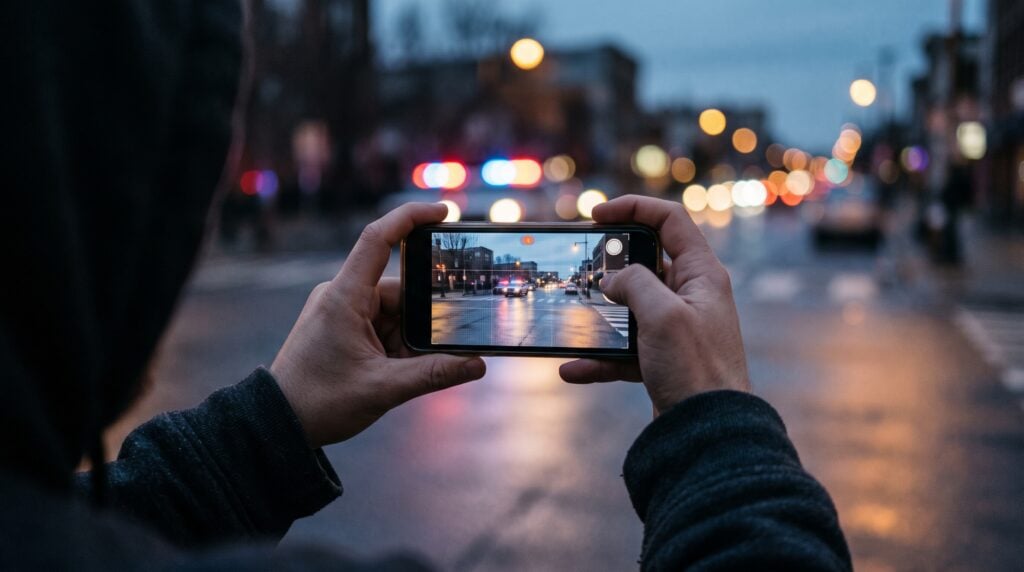
Yes. In Florida you can record police officers doing their jobs in public, with video and sound. The federal appeals court covering Florida and Florida appeals courts have both recognized that right. What gets people arrested is what they do while recording: staying close after an officer warns them back, physically getting in the way, or refusing a lawful order. Since January 1, 2025, it is also a crime to stay within 25 feet of a first responder after a warning if you intend to interfere, threaten, or harass.
How to Record Police Without Getting Arrested
- Set up before you get close. Turn the phone sideways, start recording early, and keep it running without stopping and starting. Say the date, time, and location out loud at the start.
- Stand back. If an officer tells you not to come closer, stay more than 25 feet away. A phone camera zooms well at that distance.
- Keep a copy off the phone. Turn on automatic cloud backup before you need it. Livestreaming is another way to keep a copy if the phone is taken or damaged.
- Note names and numbers. Write down or say on the recording the officers’ badge numbers, patrol car numbers, and agency, plus the names and phone numbers of other witnesses.
- Keep your hands and body out of it. Do not touch, block, or follow an officer, and do not step between officers and the person they are dealing with.
- If told to move back, keep it short. Step back as directed and say calmly, “I’m stepping back. I’m not interfering.” Do not argue the law at the scene and do not physically resist. Shouting at officers who are working gives them a reason to treat you as part of the scene.
- If told to stop filming, know where you are. On public property, an order to stop filming is not a lawful order, and you do not have to stop. Step back if told to move, and keep recording from there. On private property, such as a store or someone’s home, the property owner decides whether you can record. If the owner tells you to stop or to leave, do it.
- Be careful with other people’s private conversations. Openly recording officers on duty in public is lawful. Secretly recording a private conversation between other civilians can raise problems under Florida’s wiretap law.
- Do not hand over or unlock your phone. If an officer demands the phone, say you do not consent, do not physically resist, and do not unlock it.
- Never delete the video, even part of it. Back it up as soon as you can, keep the original file unedited, and send a copy to a criminal defense lawyer if you or anyone else is charged. Talk to the lawyer before posting it if charges are involved.
Recording Your Traffic Stop
You can record officers at your car window. They are on duty, on a public road, so the wiretap law does not require their consent. Mount the phone or set it on the dash before the officer walks up. Keep your hands visible and follow instructions, including an order to step out of the car. You can tell the officer you are recording; the law does not require you to. For what to expect at a stop, see our post on getting pulled over for DUI in Florida.
Already Recorded and Worried?
Do not delete anything. Back the video up to cloud storage or another device now and keep the original unedited. If an officer took your phone, write down the officer’s name, badge number, agency, and the time and place while you remember them. If you were arrested or charged, or someone you filmed was, call a criminal defense lawyer before you talk about the video with police or post it. Call (305) 774-7000.
Your Right to Record Police
The Eleventh Circuit, the federal appeals court for Florida, held in 2000 that people have “a First Amendment right, subject to reasonable time, manner and place restrictions, to photograph or videotape police conduct” (Smith v. City of Cumming, 212 F.3d 1332 (11th Cir. 2000)). In plain terms, the right is real, and officers can still set reasonable limits on where and how you record. In 2024, Florida’s Fifth District Court of Appeal said that “[i]t has previously been established that there is a First Amendment right to record police officers conducting their official duties in public” (Waite v. State, Fla. 5th DCA 2024).
The right has limits. Officers can control a scene, and courts have not drawn exact lines for how close a person can be at an active crash or arrest. At a fatal crash on I-95 in Martin County, a deputy took a bystander’s phone. The Eleventh Circuit ruled the deputy could not be held liable on the bystander’s First Amendment claim, because the rule was not clear enough at that kind of scene (Crocker v. Beatty, 11th Cir. 2021). In an earlier ruling in the same case, the court held that taking the phone without a warrant was unconstitutional, as explained below.
Does Florida’s Two-Party Consent Law Apply to Police?
Florida requires every party’s consent to record a private conversation. Recording a private in-person conversation without consent, which the statute calls intercepting an “oral communication,” is a third-degree felony (Fla. Stat. § 934.03). The statute defines that term as one “uttered by a person exhibiting an expectation that such communication is not subject to interception under circumstances justifying such expectation” (§ 934.02(2)). That means the speaker has to show they expect privacy, in a setting where that expectation is reasonable.
Officers doing their jobs do not meet that test:
- On a public sidewalk. A mother recorded officers on a shopping-center sidewalk where her son was being held for trespassing, and she was arrested for intercepting oral communications and for obstruction. The Fourth District held both arrests lacked probable cause, meaning the officers had no lawful basis to make them. As a matter of law, the officers could not have had the expectation of privacy the wiretap law requires, and her words and actions did not obstruct the officers in their duties (Ford v. City of Boynton Beach, 323 So. 3d 215 (Fla. 4th DCA 2021)).
- On official calls. A man secretly recorded phone calls with sheriff’s deputies about official business, and the State charged the calls as oral communications. The Fifth District reversed the trial court’s refusal to dismiss all five felony charges, holding that “it cannot be said that any of the deputies exhibited a reasonable expectation of privacy that society is willing to recognize” (Waite v. State, 2024). His convictions for battery on an officer and resisting with violence, from the arrest itself, were affirmed. A concurring judge wrote that phone calls are wire communications, the statute’s category for calls, and that secretly recording them can still be charged under § 934.03. Do not secretly record phone calls with police.
- In a police chief’s office. A citizen secretly recorded a meeting in the Homestead police chief’s office, and the Miami-Dade State Attorney’s Office threatened him with a felony prosecution. The Eleventh Circuit held “McDonough did not violate § 934.03,” noting that “the Legislature did not want expectations of privacy to count that remained unexpressed” (McDonough v. Fernandez-Rundle, 862 F.3d 1314 (11th Cir. 2017)). Privacy the speaker never showed does not count.
The same rule works against you in a patrol car. Police can record you in the back of a patrol car, because a person there has no reasonable expectation of privacy (State v. Smith, 641 So. 2d 849 (Fla. 1994)). Assume anything you say there is recorded.
The 25-Foot Rule
The 25-foot law does not ban recording. It requires a warning from the officer, and then the intent to interfere, threaten, or harass. If you are warned, step back past 25 feet and keep recording.
The law, Fla. Stat. § 843.31, took effect January 1, 2025. It makes it a crime for a person, “after receiving a verbal warning not to approach” from a first responder engaged in lawful duties, to “knowingly and willfully violate such warning and approach or remain within 25 feet of the first responder” with intent to:
- “Impede or interfere with the first responder’s ability to perform such duty”;
- “Threaten the first responder with physical harm”; or
- “Harass the first responder.”
“First responder” covers law enforcement officers, correctional probation officers, firefighters, and emergency medical care providers. A violation is a second-degree misdemeanor. The law has no exception for people who are recording or for the press.
In practice, the officer at the scene decides whether you are interfering, and the question of your intent gets sorted out later in court. We have found no Florida appeals court decision on the law yet. Federal courts have blocked enforcement of the original 25-foot laws in Indiana and Louisiana as too vague. Neither of those laws required the intent to interfere, threaten, or harass that Florida’s does.
When Recording Turns Into an Arrest
Charges come from conduct. In the Florida cases discussed here, people who recorded police were arrested for or threatened with wiretap charges, obstruction, or resisting an officer without violence (Fla. Stat. § 843.02). To prove resisting without violence, the State must show the officer was carrying out a lawful duty and that the person obstructed or resisted it.
- Words alone are not enough. Florida’s Third District Court of Appeal, which covers Miami-Dade, has held that “[w]ords alone generally cannot support a charge of obstruction of justice” (State v. Dennis, 684 So. 2d 848 (Fla. 3d DCA 1996)).
- Physical conduct changes it. Courts have held that, “with limited exceptions, physical conduct must accompany offensive words to support a conviction” (Francis v. State, 736 So. 2d 97 (Fla. 4th DCA 1999)). Blocking an officer, refusing to step back when lawfully ordered, or grabbing for property is the kind of conduct that can lead to charges.
Can Police Take Your Phone or Make You Delete the Video?
Police need a warrant to search your phone (Riley v. California, 2014). Taking a bystander’s phone is limited too. At a Florida crash scene, a deputy seized a bystander’s iPhone after he photographed the scene. The Eleventh Circuit held that “the seizure of personal property is per se unreasonable when not pursuant to a warrant issued upon probable cause,” and rejected the idea that the nature of phones lets police take them “from any person, in any place, at any time” (Crocker v. Beatty, 886 F.3d 1132 (11th Cir. 2018)). Taking his phone without a warrant violated the Fourth Amendment.
Do not delete a recording, even if an officer tells you to. We have found no Florida or Eleventh Circuit decision squarely on an officer ordering someone to delete a recording. If police are investigating the event you recorded, erasing the video to keep it from them can be charged as tampering with evidence, a third-degree felony under Fla. Stat. § 918.13. If police ask for your passcode, see our post on whether you have to give police your phone passcode.
Recording in Court
Courtrooms are different, even though they are public buildings. An Eleventh Judicial Circuit (Miami-Dade) order bars anyone from photographing, filming, or audio recording a remote court proceeding without the judge’s prior approval, and judges control recording in their courtrooms. Ask the judge before you record anything in court.
For more on your rights with police, see whether police must read you your rights and what to do if you are arrested in Miami-Dade County. If police come to your home, see whether you have to open the door for police in Florida.
Sources: Fla. Stat. §§ 843.31, 843.02, 934.02, 934.03, 918.13; Chapter 2024-85, Laws of Florida (SB 184); Smith v. City of Cumming, 212 F.3d 1332 (11th Cir. 2000); McDonough v. Fernandez-Rundle, 862 F.3d 1314 (11th Cir. 2017); Crocker v. Beatty, 886 F.3d 1132 (11th Cir. 2018), and No. 18-14682 (11th Cir. Apr. 20, 2021); Waite v. State, No. 5D2023-1354 (Fla. 5th DCA Aug. 16, 2024); Ford v. City of Boynton Beach, 323 So. 3d 215 (Fla. 4th DCA 2021); State v. Smith, 641 So. 2d 849 (Fla. 1994); State v. Dennis, 684 So. 2d 848 (Fla. 3d DCA 1996); Francis v. State, 736 So. 2d 97 (Fla. 4th DCA 1999); Riley v. California, 573 U.S. 373 (2014); Eleventh Judicial Circuit Administrative Order 20-07.
Quick Answers
Is it legal to record the police in Florida?
Yes. You can record officers doing their jobs in public, with video and sound. The Eleventh Circuit, the federal appeals court for Florida, recognized a First Amendment right to record police in 2000. Officers can still set reasonable limits on where and how you record.
Does Florida’s two-party consent law stop me from recording police?
No. Florida’s wiretap law protects conversations where the speaker shows an expectation of privacy. Courts have held that officers performing their duties in public have none, so their consent is not needed. Secretly recording a phone call with an officer is different: a Florida appeals judge has written that it can still be charged, so do not do it.
What is Florida’s 25-foot law?
Since January 1, 2025, Fla. Stat. § 843.31 makes it a second-degree misdemeanor to approach or stay within 25 feet of a first responder after a verbal warning, with intent to interfere with their duties, threaten them, or harass them. It does not ban recording.
Can I be arrested for recording police?
Openly recording police doing their jobs in public is not a crime. Arrests come from conduct around it, such as staying close after a warning, blocking an officer, or refusing a lawful order. Florida’s Third District has held that words alone generally cannot support an obstruction charge.
Can police take my phone if I record them?
Police need a warrant to search your phone. The Eleventh Circuit has held that seizing a bystander’s phone without a warrant violated the Fourth Amendment in a Florida case. If an officer demands it, say you do not consent, do not unlock it, and do not physically resist.
Can police make me delete my video?
We have found no Florida or Eleventh Circuit decision on an officer ordering someone to delete a recording. Do not delete the video. Erasing it to keep it from an investigation can be charged as tampering with evidence. Back it up right away.
Do I have to stop filming if police tell me to?
On public property, no. An order to stop filming there is not a lawful order. You can keep recording, and you should step back if an officer tells you to move. On private property, the property owner decides whether you can record, so if the owner tells you to stop or leave, do it.
Can I record my traffic stop in Florida?
Yes. Officers at your car window are on duty on a public road. Set the phone up before the officer arrives, keep your hands visible, and follow instructions. You do not have to tell the officer you are recording.
What should I do with my video after recording police?
Do not delete it. Back it up to cloud storage or another device right away, keep the original file unedited, write down badge and car numbers, and send a copy to a criminal defense lawyer if anyone is charged.
If you were arrested or your phone was taken while recording police, call us. The first consultation is free and confidential, with no obligation to retain.
Last updated: November 14, 2026.