
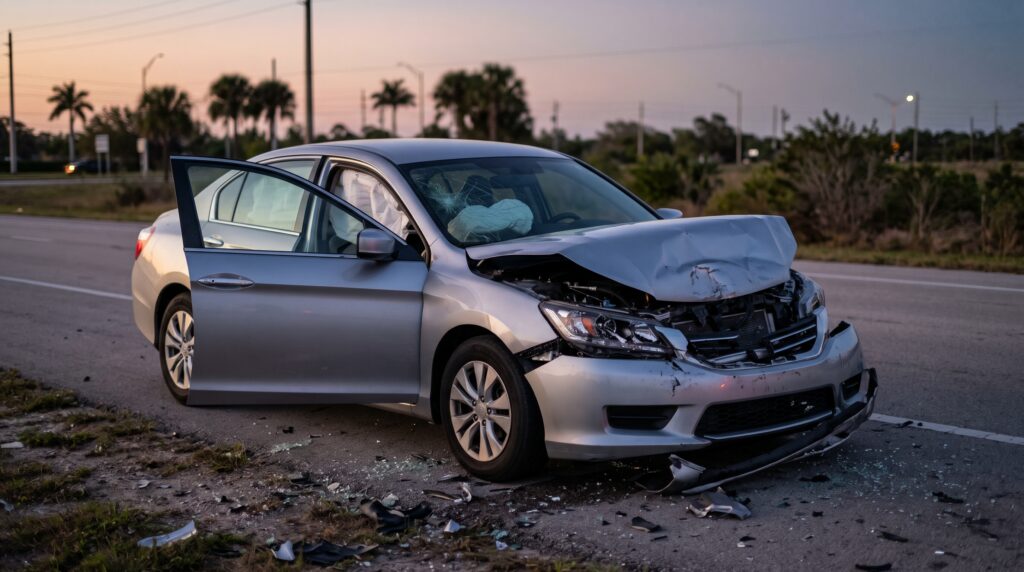
Florida has no formula for valuing a car accident case. The value turns on whether your injury is permanent (Fla. Stat. § 627.737(2)), your share of fault (§ 768.81), what your medical care cost and who paid for it (§ 768.0427), how much insurance covers the crash, and whether you file within 2 years (§ 95.11(5)(a)). Your personal injury protection (PIP) insurance, the coverage Florida requires on every registered car, pays first, up to $10,000, no matter who caused the crash. You can recover pain and suffering from the at-fault driver when the injury meets that permanent injury threshold. Your award goes down by your share of fault, and in lawsuits filed after March 24, 2023, you recover nothing if you are more than 50% at fault. For crashes after March 24, 2023, you have 2 years to file a lawsuit. No average figure or online calculator can value your case, and no lawyer should put a number on it without reviewing your records.
At a glance: the Florida rules that set the value of a car accident case
| Factor | Florida rule | Law |
|---|---|---|
| PIP | Pays 80% of reasonable medical expenses if initial care is within 14 days, and 60% of lost income, up to $10,000 in total | § 627.736(1) |
| Pain and suffering | Requires a permanent injury, a meaningful and permanent loss of an important bodily function, meaningful and permanent scarring or disfigurement, or death | § 627.737(2) |
| Fault | Award reduced by your percentage of fault; no recovery above 50% in lawsuits filed after March 24, 2023 | § 768.81 |
| Medical bills | For paid bills, a jury sees the amount paid, not the amount billed, in lawsuits filed after March 24, 2023 | § 768.0427 |
| Insurance | The at-fault driver’s coverage and your uninsured motorist coverage set the practical limit; an insurer must disclose its limits within 30 days of a written request | §§ 627.727, 627.4137 |
| Deadline | 2 years for crashes after March 24, 2023 | § 95.11(5)(a) |
| Take-home amount | Fees, costs, and repayment rights come out of the settlement before you receive your share | Rule 4-1.5; § 409.910 |
How Are Car Accident Settlements Calculated in Florida?
Florida has no settlement formula, no official calculator, and no multiplier written into its statutes. A claim against the at-fault driver is built from these pieces of Florida law:
- Economic damages, meaning money losses you can add up from bills and pay stubs: “past lost income and future lost income reduced to present value” and “medical and funeral expenses” (§ 768.81(1)(b)), including future care a doctor says you will need.
- Noneconomic damages, meaning pain, suffering, mental anguish, and inconvenience, available when the injury meets the permanent injury threshold (§ 627.737(2)).
- Minus PIP benefits paid or payable, which cannot be recovered twice (§ 627.736(3)).
- Minus your share of fault, with no recovery above 50% in lawsuits filed after March 24, 2023 (§ 768.81(2), (6)).
- Limited in practice by the insurance available, including your uninsured motorist coverage (§ 627.727).
If the case goes to trial, the jury decides the amount for pain and suffering. Florida’s standard jury instruction tells jurors: “There is no exact standard for measuring such damage. The amount should be fair and just in the light of the evidence” (Fla. Std. Jury Instr. (Civ.) 501.2(a)). Settlement talks turn on what a jury could award.
Is There an Average Car Accident Settlement in Florida?
Florida publishes no official average settlement. In 2024, Florida recorded 381,423 crashes, 246,426 injuries, and 3,098 deaths, and Miami-Dade County alone had 60,000 crashes, 29,359 injuries, and 272 deaths (Florida Department of Highway Safety and Motor Vehicles, Traffic Crash Facts Annual Report 2024). No single figure describes that range of injuries, fault findings, and insurance limits.
Florida Bar rules also prohibit lawyer advertising that a prospective client can reasonably read as predicting or guaranteeing success or a particular result (Rule 4-7.13(b)(1), Rules Regulating The Florida Bar). What a lawyer can do is review your records and explain how each rule below applies to you.
What Your PIP Insurance Pays First
Florida is a no-fault state. Every owner of a car registered in Florida must carry PIP (Fla. Stat. § 627.733). After a crash, your PIP pays first, no matter who caused it, up to “a limit of $10,000 in medical and disability benefits and $5,000 in death benefits” (§ 627.736(1)).
- Medical expenses: “Eighty percent of all reasonable expenses for medically necessary” care, if you receive initial care “within 14 days after the motor vehicle accident” (§ 627.736(1)(a)).
- Lost income: “Sixty percent of any loss of gross income and loss of earning capacity” from being unable to work (§ 627.736(1)(b)).
- Emergency medical condition: reimbursement “is limited to $2,500” if a qualifying provider determines you did not have an emergency medical condition (§ 627.736(1)(a)4.).
Amounts PIP pays, or would pay, cannot be recovered again from the at-fault driver (§ 627.736(3)). PIP remains Florida law as of November 2026. Bills to repeal it, HB 1181 in 2025 and HB 769 and SB 522 in 2026, did not pass.
When Can You Recover for Pain and Suffering in Florida?
Lawyers call this rule the tort threshold. A tort is a civil wrong, such as careless driving, that you can sue over, and the threshold is the level of injury you must show before you can recover pain and suffering. Against the at-fault driver, you can recover damages “for pain, suffering, mental anguish, and inconvenience” when the injury “consists in whole or in part of” one of the following (§ 627.737(2)):
- A meaningful and permanent loss of an important bodily function.
- “Permanent injury within a reasonable degree of medical probability, other than scarring or disfigurement.”
- Meaningful and permanent scarring or disfigurement.
- Death.
Whether an injury is permanent is a medical question, which is why records from your treating doctors carry so much weight. The same threshold applies to an uninsured motorist claim against your insurer (§ 627.727(7)). Without meeting it, a claim against the at-fault driver is limited to economic losses that PIP does not cover.
The first consultation is free and confidential. Call (305) 774-7000.
How Fault Changes What You Recover
Florida uses modified comparative negligence, a rule that cuts what you recover by your share of the blame. Your share of fault “diminishes proportionately the amount awarded as economic and noneconomic damages” (§ 768.81(2)). If a jury finds you 20% at fault, your award goes down by 20%. In lawsuits filed after March 24, 2023, a person found more than 50% at fault for his or her injury cannot recover any damages (§ 768.81(6); ch. 2023-15, § 30, Laws of Fla.).
Each defendant is generally liable for its percentage of fault, not for the whole judgment (§ 768.81(3)). Under Florida’s dangerous instrumentality doctrine, a rule made by the courts, a car’s owner can also be held responsible for a driver the owner allowed to use the car, and Florida law limits that liability for rental companies and people who lend a car (§ 324.021(9)(b)). Insurers look hard for anything that shifts blame to you, such as speed, phone use, or a missed signal, so collect photos, video, and witness names early.
How Medical Bills Are Counted Now
In lawsuits filed after March 24, 2023, Florida limits what a jury hears about medical bills. For bills that have been paid, the evidence is limited to the amount paid, whatever the source of payment (§ 768.0427(2)(a)). For unpaid bills, the evidence can include the following (§ 768.0427(2)(b)):
- If you have health insurance, what that insurance would pay.
- If you have no health insurance, or have Medicare or Medicaid, “120 percent of the Medicare reimbursement rate,” or “170 percent of the applicable state Medicaid rate” where no Medicare rate applies.
- The reasonable amounts billed.
Treatment under a letter of protection, where a provider agrees to wait for payment from the settlement or judgment, must be disclosed, including whether your lawyer referred you (§ 768.0427(3)). What was paid on your bills, and what insurance would pay, now carries more weight in valuing a claim than the full amount a hospital charged.
Insurance Limits: The Practical Ceiling
A case can be worth more on paper than the insurance available to pay it. To register a car, Florida requires PIP and $10,000 of property damage liability coverage (§§ 627.733, 324.022). Florida does not require bodily injury liability coverage, the insurance that pays for injuries a driver causes to others, to register a car. A driver without it who is in a reported crash can have his or her license and registrations suspended, and a liability policy must have limits of at least $10,000 per person and $20,000 per crash to prevent that (§§ 324.021(7), 324.051(2)). A driver found guilty of DUI, or who pleads guilty or no contest to it, must carry $100,000 per person, $300,000 per crash, and $50,000 for property damage for at least 3 years (§ 324.023). Some drivers carry low limits or none.
- Finding the limits: an insurer must provide a sworn statement of its policy limits within 30 days of a claimant’s written request (§ 627.4137).
- Your uninsured motorist coverage: this is the part of your policy that pays when the at-fault driver has no insurance or too little. A Florida auto policy that includes bodily injury liability coverage must also include it. The exception is when a named insured, a person named as an insured on the policy, rejected it or chose lower limits in writing (§ 627.727(1)). Florida law does not require a policy with PIP and property damage coverage alone to include it. Check your policy and the policies of relatives you live with.
- Before settling with the at-fault driver: if the settlement would not fully pay your claim and you have underinsured motorist coverage, “written notice of the proposed settlement must be submitted by certified or registered mail” to that insurer, which then has 30 days to respond (§ 627.727(6)(a)). Skipping this step can put underinsured motorist benefits at risk. Our post on what to tell your insurance company before you settle explains the notice, the 30 days, and what happens if you already signed.
- Bad faith: an insurer that does not make a good-faith effort to settle a claim within its limits, when it could and should have, can be held liable for the full judgment against its insured. Since 2023, negligence alone, meaning carelessness, is not enough to make an insurer’s conduct bad faith. An insurer that offers the lesser of its limits or the amount demanded within 90 days after receiving a claim with enough supporting evidence cannot be sued for bad faith. Claimants and their lawyers must also act in good faith in giving information, making demands, and setting deadlines (§ 624.155(1)(b)1., (4), (5)).
What Is a Minor Car Accident Claim Worth in Florida?
For an injury that heals without permanent effects, Florida law limits what you can recover from the at-fault driver. PIP pays first, and payment for medical care is limited to $2,500 if a provider finds no emergency medical condition (§ 627.736(1)(a)4.). Without a permanent injury, there is no recovery for pain and suffering (§ 627.737(2)). What remains is the economic loss PIP does not pay, such as the 20% of medical bills and 40% of lost income PIP leaves uncovered, and losses above the $10,000 PIP limit. Damage to your car is a separate property damage claim against the at-fault driver’s liability coverage, which must be at least $10,000 (§ 324.022), or against your collision coverage if you carry it.
Other Damages and Punitive Damages
Florida sets no general dollar cap on pain and suffering in a car accident case against a private driver. Claims against a government agency are capped at $200,000 per person and $300,000 per incident (§ 768.28(5)). The liability of a rental company or a person who lends a car for someone else’s driving is also limited (§ 324.021(9)(b)).
Punitive damages are extra damages meant to punish a defendant for extreme conduct and discourage it. They require proof “based on clear and convincing evidence” that the defendant was “personally guilty of intentional misconduct or gross negligence” (§ 768.72(2)). They are generally capped at three times compensatory damages (the damages that repay your losses) or $500,000, whichever is greater (§ 768.73). The cap does not apply to a defendant whose normal faculties were impaired by alcohol or drugs, or whose blood or breath alcohol level was 0.08 or higher (§ 768.736). Punitive damages are rare in car cases, with exceptions such as some drunk-driving crashes.
What Comes Out of a Settlement
The settlement amount and the amount you take home are different numbers. Before you receive your share, the settlement pays:
- The attorney’s fee and case costs, under a written contingency fee agreement. With a contingency fee, the lawyer is paid a percentage of what you recover and charges no fee if you recover nothing. At this firm, if there is no recovery, you owe no attorney fee and no case costs. Florida Bar rules cap personal injury contingency fees (Rule 4-1.5(f)(4)(B), Rules Regulating The Florida Bar). See how contingency fees work at this firm.
- Repayment to anyone with a right to it, such as Medicaid (Fla. Stat. § 409.910), Medicare (42 U.S.C. § 1395y(b)(2)), or a health plan whose terms give it a right to be repaid from an injury recovery.
Your PIP insurer has no lien on your injury recovery, so nothing goes back to PIP from the settlement (§ 627.736(3)). Florida Bar rules require your lawyer to give you a written closing statement listing the fee, the costs, and every payment made from the settlement (Rule 4-1.5(f)(1)). Ask any lawyer you talk to for a written estimate of what comes out before you sign a settlement.
How Settlement Offers Can Shift Attorney’s Fees
Either side can serve a formal offer of judgment or proposal for settlement. If a defendant’s offer is rejected and the judgment is at least 25% less than the offer, the defendant can recover reasonable costs and attorney’s fees from the date the offer was served. If a plaintiff’s offer is rejected and the judgment is at least 25% more than the offer, the plaintiff can recover them (§ 768.79). A lawyer weighs this rule before rejecting or making an offer.
Will My Car Accident Case Go to Trial?
Most Florida injury cases end without a trial. In the 2024-25 court year, Florida circuit courts closed 80,366 auto and other negligence cases, and 505 of them were closed by a jury, according to the Florida Office of the State Courts Administrator (Statistical Reference Guide, FY 2024-25, ch. 4). The court system counts a case as closed by a jury once the jury is sworn, so not every one of those 505 cases reached a verdict.
If a lawsuit is filed, Florida’s civil rules move it toward a trial date from the start:
- A case management order within 120 days of filing sets deadlines and a projected trial period, and the order must say its deadlines “will be strictly enforced unless changed by court order” (Fla. R. Civ. P. 1.200(d)). Motions to delay trial “are disfavored and should rarely be granted” (Rule 1.460(a)).
- Discovery, the exchange of evidence, includes initial disclosures such as insurance policies, depositions (sworn questioning under oath before a court reporter), and an examination of the injured person by a doctor the defense chooses (Rules 1.280(a), 1.310, 1.360).
- Mediation, a settlement meeting run by a neutral mediator, must be ordered when one party asks for it in a civil case for money damages (§ 44.102(2)(a)). In Miami-Dade, the standard case management order states: “Parties must mediate by the Court’s deadline.” An insurance company representative with settlement authority must attend, and no one is required to settle (Rule 1.720(b), (c)).
- Trial, if the case does not settle, is to a jury of six in a Florida civil case (§ 69.071). Florida’s court rules treat 18 months from service as a presumptively reasonable time to finish a civil jury case (Fla. R. Gen. Prac. & Jud. Admin. 2.250(a)(1)(B)).
Whether a case settles or goes to trial is the client’s decision, made with a lawyer’s advice.
Can You Settle a Car Accident Claim Without a Lawyer?
Yes. Florida law does not require a lawyer to make an injury claim. You file the PIP claim with your insurer yourself, and you can ask the at-fault driver’s insurer in writing for a sworn statement of its policy limits (§ 627.4137). Before you sign a release, know that it ends your claim against everyone it covers, which can include people it does not name. Medicaid, Medicare, and some health plans have a right to repayment from the settlement. If you have underinsured motorist coverage, Florida law requires written notice of the proposed settlement to that insurer, by certified or registered mail, before you release the at-fault driver (§ 627.727(6)(a)). The 2-year filing deadline keeps running while you negotiate.
How Long Do You Have to File?
The deadline for “An action founded on negligence” is 2 years (Fla. Stat. § 95.11(5)(a)). That 2-year limit came from HB 837, a 2023 law that rewrote many Florida injury rules. It applies to “causes of action accruing after the effective date of this act,” which was March 24, 2023 (ch. 2023-15, § 28, Laws of Fla.). A claim against your uninsured or underinsured motorist insurer is a contract claim with a 5-year limit counted from the date of the accident (§ 95.11(2)(b); Woodall v. Travelers Indem. Co., 699 So. 2d 1361 (Fla. 1997)). Missing a deadline ends the claim, so do not wait for treatment to finish before talking to a lawyer.
Is a Car Accident Settlement Taxable?
In most cases the part of a settlement paid for a physical injury is not taxable. Federal law excludes from income “the amount of any damages (other than punitive damages) received (whether by suit or agreement and whether as lump sums or as periodic payments) on account of personal physical injuries or physical sickness” (26 U.S.C. § 104(a)(2)). Punitive damages are taxable. Ask a tax professional about your settlement.
What You Can Do Now to Protect the Value of Your Claim
- Get medical care within 14 days. PIP medical benefits depend on it.
- Follow your treatment plan and keep every record, bill, and receipt.
- Do not give the other driver’s insurer a recorded statement before talking to a lawyer. See our post on recorded statements to insurance adjusters.
- Do not accept a quick offer before you know whether the injury is permanent. See signs an insurance company is lowballing your claim.
- Stay off social media about the crash and your injuries.
- Find your auto policy and check whether you have uninsured or underinsured motorist coverage. If you do, notify that insurer in writing before you settle with the at-fault driver.
For more, see our guides on what to do after a car accident in Florida, what happens if you were partly at fault, Florida’s statute of limitations, and our car accident practice page.
This post is general information, not a prediction of any result.
Sources
- Fla. Stat. §§ 95.11, 324.021, 324.022, 324.023, 324.051, 409.910, 624.155, 627.4137, 627.727, 627.733, 627.736, 627.737, 768.0427, 768.28, 768.72, 768.73, 768.736, 768.79, 768.81, 44.102, 69.071 (2026)
- Woodall v. Travelers Indem. Co., 699 So. 2d 1361 (Fla. 1997)
- Ch. 2023-15, Laws of Fla. (HB 837)
- Fla. R. Civ. P. 1.200, 1.280, 1.310, 1.360, 1.460 and 1.720; Fla. R. Gen. Prac. & Jud. Admin. 2.250
- Fla. Std. Jury Instr. (Civ.) 501.2
- Eleventh Judicial Circuit Admin. Order 24-20
- 26 U.S.C. § 104(a)(2)
- 42 U.S.C. § 1395y(b)(2)
- Rules Regulating The Florida Bar, Rules 4-1.5 and 4-7.13
- Florida Department of Highway Safety and Motor Vehicles, Traffic Crash Facts Annual Report 2024
- Florida Office of the State Courts Administrator, Statistical Reference Guide FY 2024-25
Last updated: November 14, 2026.
Quick Answers
How much is my car accident case worth in Florida?
The value of a Florida car accident case depends on how serious the injury is and whether it is permanent, your share of fault, what your medical bills were and who paid them, the insurance available, and filing on time. No one can give an honest number without reviewing your records.
Is there a car accident settlement calculator for Florida?
No Florida statute or court uses a calculator or multiplier. Florida law builds a claim from economic damages, pain and suffering if the injury meets the permanent injury threshold, minus PIP benefits and your share of fault, limited by the insurance available.
What is the average car accident settlement in Florida?
Florida publishes no official average settlement. Results turn on whether the injury is permanent, your share of fault, what was paid for medical care, and the insurance available.
How is pain and suffering calculated in Florida?
No Florida statute sets a formula or multiplier for pain and suffering. If the case goes to trial, Florida’s standard jury instruction tells jurors there is no exact standard for measuring such damage and that the amount should be fair and just in the light of the evidence. The award is reduced by any share of fault on your part. Settlement talks turn on what a jury could award.
What does PIP pay after a car accident in Florida?
Your PIP pays 80% of reasonable medical expenses, if you get initial care within 14 days, and 60% of lost income, up to $10,000 in total. Reimbursement is limited to $2,500 if a provider determines you did not have an emergency medical condition.
Can I get pain and suffering after a car accident in Florida?
Yes, from the at-fault driver, if the injury meets Florida’s threshold: a meaningful and permanent loss of an important bodily function, a permanent injury within a reasonable degree of medical probability, meaningful and permanent scarring or disfigurement, or death.
How much is a minor car accident worth in Florida?
Without a permanent injury, Florida law bars recovery for pain and suffering from the at-fault driver. PIP pays first, and what remains is the economic loss PIP does not cover, plus a separate claim for damage to your car.
What if I was partly at fault?
Your Florida recovery is reduced by your percentage of fault. In lawsuits filed after March 24, 2023, you recover nothing if you are more than 50% at fault.
Do medical bills determine the value of my case?
Medical bills count, but in Florida lawsuits filed after March 24, 2023, a jury sees the amount paid for bills that have been paid, not the amount billed. For unpaid bills, the evidence includes what health insurance would pay, and treatment under a letter of protection must be disclosed.
What if the other driver has no insurance?
Your PIP still pays first, up to $10,000, no matter who caused the crash. Beyond that, your uninsured motorist coverage may pay if your policy includes bodily injury liability coverage and no named insured rejected uninsured motorist coverage in writing. A policy held by a relative you live with may also apply. Check your policy and talk to a lawyer before you give your insurer a statement.
Should I accept the insurance company’s first settlement offer?
Do not accept a first offer before you know whether your doctors consider the injury permanent, how much insurance covers the crash, and who has a right to be repaid from the settlement. Settling means signing a release. A signed release ends your claim against everyone it covers, and a release written broadly enough can cover people it does not name, even if your injury turns out worse than you thought. If you have underinsured motorist coverage and the settlement will not cover your full claim, Florida law requires written notice to that insurer before you settle.
Will my car accident case go to trial in Florida?
Most Florida car accident cases never reach a jury. In the 2024-25 court year, Florida circuit courts closed 80,366 auto and other negligence cases, and 505 were closed by a jury. If a lawsuit is filed, the court sets a projected trial period, and mediation is required before trial in Miami-Dade.
Can I settle a car accident claim in Florida without a lawyer?
Yes. Florida law does not require a lawyer to make an injury claim. Before you sign a release, know that it can end your claim against people it does not name, that Medicaid, Medicare, and some health plans can be repaid from the settlement, and that the 2-year deadline keeps running.
How long does a car accident settlement take in Florida?
Florida law sets no deadline for settling an injury claim. A claim is hard to value until your doctors can say whether the injury is permanent, so many claims wait until treatment ends. A PIP payment is overdue if the insurer does not pay within 30 days after receiving written notice of a covered loss and its amount, unless the insurer has reasonable proof it is not responsible. An insurer must disclose its policy limits within 30 days of a written request. A lawsuit must be filed within 2 years for crashes after March 24, 2023.
How much does a car accident lawyer cost in Florida?
Car accident lawyers in Florida commonly work on a contingency fee, a percentage of what you recover, with no fee if there is no recovery. Fee agreements differ on whether the client owes case costs after a loss. At this firm, if there is no recovery, you owe no attorney fee and no case costs. Without court approval, Florida Bar rules limit the fee to 33 1/3% of a recovery up to $1 million if the case resolves before the defendant answers the lawsuit, and 40% of a recovery up to $1 million after that through judgment. Lower percentages apply above $1 million, and the rules allow an added 5% if an appeal or post-judgment relief is needed. The agreement must be in writing, you must receive a written statement of client’s rights, and you can cancel the contract in writing within 3 business days of signing without owing a fee for work done in that time.
How long do I have to file a car accident claim in Florida?
You have 2 years to file a negligence lawsuit for a Florida crash that happened after March 24, 2023. Crashes before that date fall under the earlier 4-year deadline. Talk to a lawyer well before the deadline.
Is a car accident settlement taxable?
In most cases the injury part of a car accident settlement is not taxable: federal law excludes damages received for personal physical injuries from income (26 U.S.C. § 104(a)(2)). Punitive damages are taxable.
The first consultation is free and confidential, with no obligation to retain.