Criminal Defense

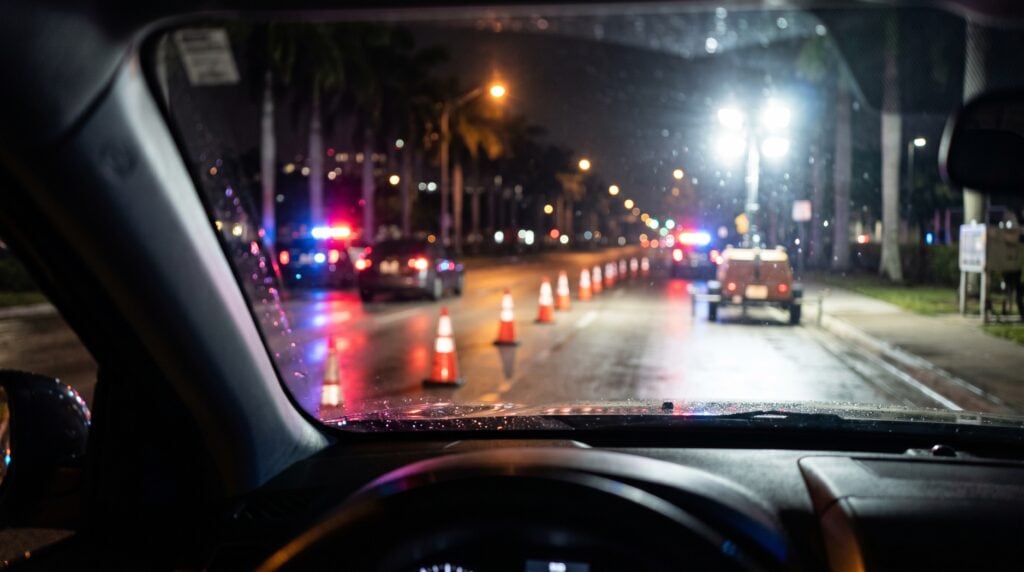
Traffic cones and a light tower marking a nighttime sobriety checkpoint lane on a palm-lined Florida road, seen through a windshield

DUI Checkpoints in Miami-Dade Over Thanksgiving and the Holidays: Are They Legal, and What Do You Have to Do?

Yes. DUI checkpoints are legal in Florida if police write the plan before the checkpoint starts and follow it (State v. Jones, 483 So. 2d 433, 438 (Fla. 1986)). At a Miami-Dade checkpoint you must hand over your license, registration, and proof of insurance (Fla. Stat. §§ 322.15(1), 320.0605(1)(a), 316.646(2)). You do not have to
DUI Checkpoints in Miami-Dade Over Thanksgiving and the Holidays: Are They Legal, and What Do You Have to Do? Read More »

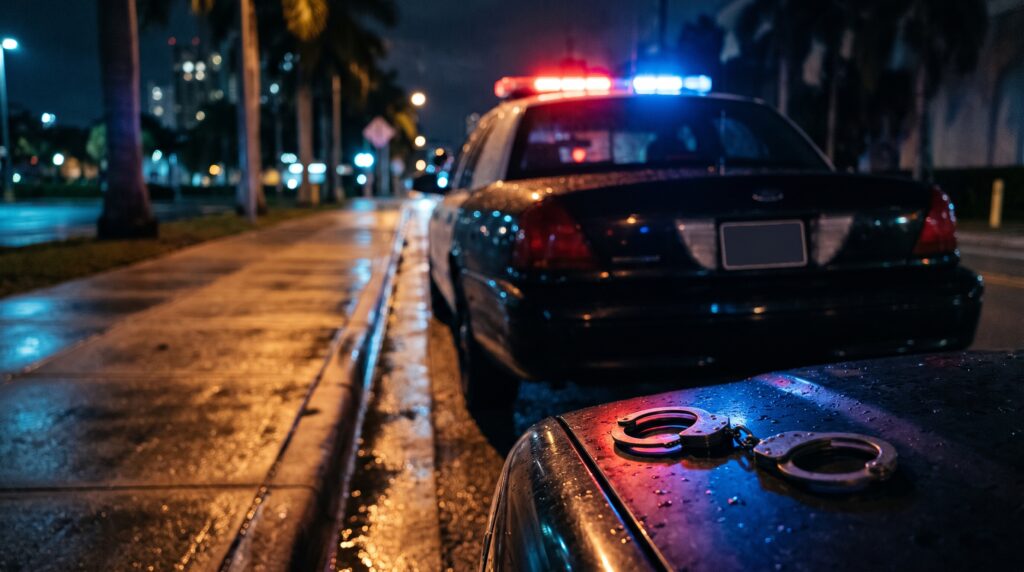
Open handcuffs on the trunk of a police cruiser with its lights on along a wet Miami street at night

Resisting Arrest Without Violence in Florida: What the State Has to Prove

Resisting an officer without violence is a first-degree misdemeanor in Florida, punishable by up to 1 year in jail and a fine of up to $1,000 (Fla. Stat. §§ 843.02, 775.082(4)(a), 775.083(1)(d)). The State must prove the officer was lawfully executing a legal duty, that you knew he or she was an officer, and that

Resisting Arrest Without Violence in Florida: What the State Has to Prove Read More »

A dark sedan stopped on the shoulder of a Miami road at dusk with patrol lights reflecting on wet pavement

Driving on a Suspended License in Florida: Misdemeanor or Felony?

In Florida, knowingly driving on a suspended license is a second-degree misdemeanor the first time, a first-degree misdemeanor after that, and a third-degree felony in a narrow set of repeat cases (Fla. Stat. § 322.34(2)). Without knowledge, it is a civil moving violation (§ 322.34(1)). Driving as a habitual traffic offender is a felony (§

Driving on a Suspended License in Florida: Misdemeanor or Felony? Read More »

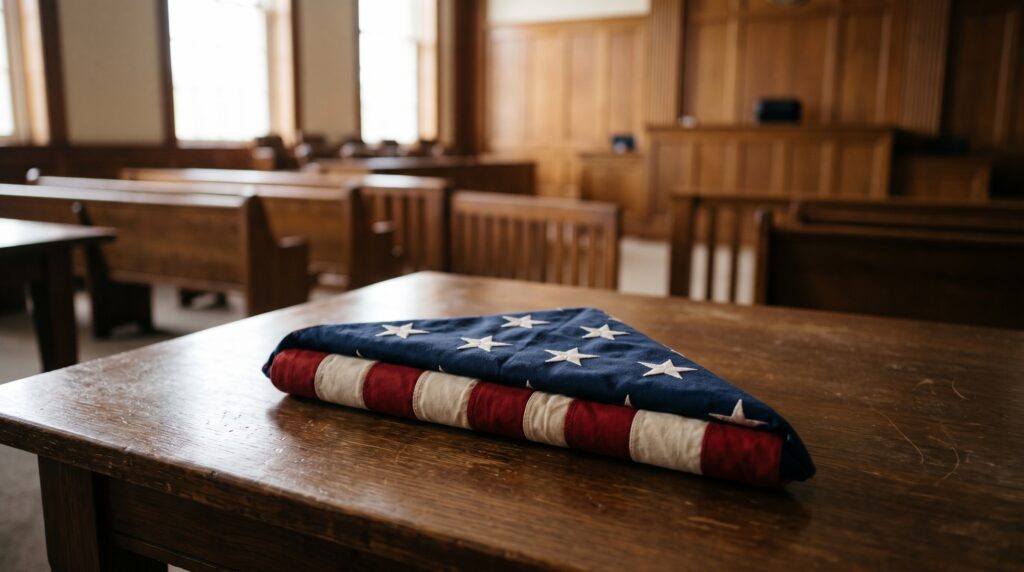
A folded American flag on a wooden courtroom table in soft light

Florida Veterans Treatment Court: What HB 199 Changed in 2026

If you are a veteran or servicemember charged with a crime in Florida, a judge now decides whether you get into veterans treatment court. Before July 1, 2026, the State Attorney’s Office made that call. A new law, HB 199 (Chapter 2026-128, Laws of Florida), gave it to the court, which decides with the program’s

Florida Veterans Treatment Court: What HB 199 Changed in 2026 Read More »

Call (305) 774-7000 Free Consultation