
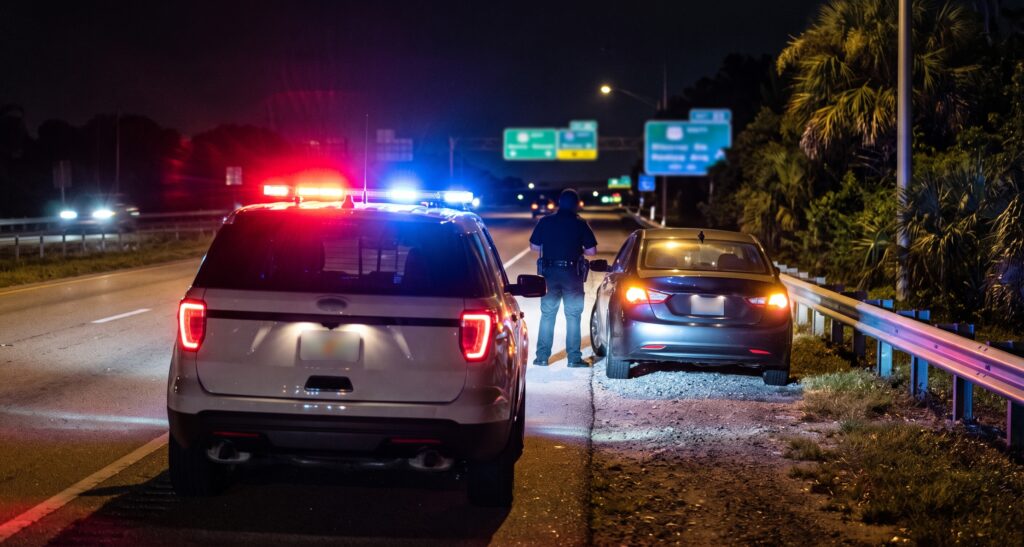
The Florida statute on habitual traffic offenders is section 322.264. A driver becomes a habitual traffic offender (HTO) with three convictions for listed serious offenses, or 15 convictions for moving violations that carry points, within 5 years (Fla. Stat. § 322.264). The Department of Highway Safety and Motor Vehicles (DHSMV), the state agency that issues and revokes driver licenses, then revokes the license for at least 5 years (§ 322.27(5)(a)). This guide explains the statute, the HTO revocation, the hardship license, and the ways to seek reversal of habitual traffic offender status in Florida, along with how Isaiah’s Law changed the list in 2026.
Since July 1, 2026, Isaiah’s Law (CS/HB 35, ch. 2026-53, Laws of Fla.) counts driving without a valid license under Fla. Stat. § 322.03 toward habitual traffic offender status (§ 322.264(1)(g)). Three convictions for qualifying offenses within 5 years bring a license revocation of at least 5 years (§ 322.27(5)(a)), and driving while designated a habitual traffic offender is a third-degree felony, punishable by up to 5 years in prison (§ 322.34(5)). Anyone in Miami-Dade with more than one unlicensed-driving ticket should know where they stand before the next citation.
| Path to HTO status | Convictions within 5 years | Qualifying offenses | Statute |
|---|---|---|---|
| Serious offenses | 3 or more, from separate acts, in any combination | Manslaughter from operating a vehicle; DUI; a felony committed with a vehicle; driving while suspended or revoked; failing to stop and render aid after a crash with death or injury; driving a commercial vehicle while disqualified; driving without a valid license (§ 322.03), added by Isaiah’s Law | § 322.264(1)(a)-(g) |
| Moving violations | 15 | Moving traffic offenses that carry points under § 322.27, including the offenses above | § 322.264(2) |
| Result: the department revokes the license, with no relicensing for at least 5 years except as § 322.271 allows (§ 322.27(5)(a)). | |||
Habitual Traffic Offender Florida Statute: What Section 322.264 Says
Section 322.264 counts the convictions on the driver record that DHSMV keeps. A driver reaches HTO status in either of two ways within any 5-year period.
- Three serious offenses. Three or more convictions, from separate acts, for any mix of these offenses: manslaughter from driving a vehicle; DUI (§ 316.193); a felony committed with a vehicle; driving while the license is suspended or revoked; leaving a crash with death or injury without stopping to give aid; driving a commercial vehicle while disqualified; and driving without a valid license under § 322.03, added by Isaiah’s Law on July 1, 2026 (§ 322.264(1)(a)-(g)).
- Fifteen moving violations. Fifteen convictions for moving violations that carry points under § 322.27, counting the serious offenses above (§ 322.264(2)).
Convictions under federal law or the law of another state or country count the same way when the offense is similar to one on the Florida list. A conviction that already led to a suspension or revocation still counts toward HTO status (§ 322.264).
HTO Revocation: At Least 5 Years Without a Regular License
DHSMV must revoke the license of a driver designated a habitual traffic offender. The driver cannot be relicensed for at least 5 years from the date of revocation, except through the hardship process in § 322.271 (§ 322.27(5)(a)). The HTO revocation is an administrative action by DHSMV. It is separate from any sentence a judge imposed in the underlying cases.
Driving as a Habitual Traffic Offender Is a Third-Degree Felony
A person designated a habitual traffic offender who drives any motor vehicle on Florida roads commits a third-degree felony (§ 322.34(5)). A third-degree felony carries up to 5 years in prison and a fine of up to $5,000 (§§ 775.082(3)(e), 775.083(1)(c)). A regular suspended-license case is far lower: a first knowing offense is a second-degree misdemeanor (§ 322.34(2)(a)). Our guide to driving on a suspended license in Florida covers those cases.
The felony applies to every person with the HTO designation, including a person who never held a valid driver license. A driver with no valid license who has been designated a habitual traffic offender and keeps driving faces the same felony charge.
Hardship License for a Habitual Traffic Offender
A habitual traffic offender may petition DHSMV 12 months after the date of revocation for a driving privilege restricted to business or employment purposes (§ 322.271(1)(b)). DHSMV reviews the driver’s qualification, fitness, and need to drive, and holds an administrative hearing under chapter 120 of the Florida Statutes.
- A business-purposes license allows the driving needed to keep a livelihood: to and from work, on-the-job driving, school, church, and medical visits (§ 322.271(1)(c)1.).
- An employment-purposes license allows driving to and from work and the on-the-job driving an employer requires (§ 322.271(1)(c)2.).
- DHSMV requires proof of the approved driver training course, or the DUI program course and evaluation when a DUI is involved, and may ask for letters of recommendation (§ 322.271(2)(a)).
- A driver who breaks the restrictions loses the hardship privilege and cannot get any driving privilege for the rest of the 5-year period (§ 322.271(1)(b)). Our guide on license suspension points and the hardship license covers drivers suspended for points.
Reversal of Habitual Traffic Offender Status in Florida
An HTO designation rests on the convictions in the DHSMV record. Reversal means showing the designation was wrong, or removing a conviction it counted. Florida law provides these routes.
Petition for writ of certiorari in circuit court
A DHSMV order revoking a license can be reviewed by a petition for writ of certiorari in the circuit court of the county where the driver lives (§ 322.31). Certiorari asks a higher court to review the agency’s order for legal error. The petition must be filed within 30 days of rendition of the order (Fla. R. App. P. 9.100(c)(1)). Missing that deadline closes this route.
Show cause petition to DHSMV
A driver whose license is revoked as a habitual traffic offender may petition DHSMV to show cause why the license should not be revoked (§ 322.27(5)(a)). Record errors belong here: a conviction that belongs to someone else, two citations from one act counted as separate offenses, or a conviction outside the 5-year window.
Removing the HTO designation after a third suspended-license conviction
Some revocations come from a third conviction for driving while suspended or revoked. When the driver provides proof of compliance for an offense listed in § 318.14(10)(a)1.-5., such as a license suspended for an unpaid ticket or unpaid child support that is later reinstated, the clerk of court must send DHSMV an amended disposition that removes the HTO designation (§ 322.27(5)(b)).
Vacating an underlying conviction
A conviction that is set aside no longer belongs in the count. If a qualifying conviction is vacated, the record may drop below three serious offenses or 15 moving violations, and the driver can ask DHSMV to remove the designation (§§ 322.264, 322.27(5)(a)). The court remedy depends on the type of case.
- Criminal traffic cases, such as DUI or knowingly driving while suspended, follow the Florida Rules of Criminal Procedure (Fla. R. Traf. Ct. 6.160). A motion to vacate a plea or judgment under Rule 3.850 can raise grounds such as a plea that was not voluntary. In most cases it must be filed within 2 years after the judgment and sentence become final (Fla. R. Crim. P. 3.850(a)-(b)).
- Civil traffic infractions follow Part IV of the Florida Rules of Traffic Court. A motion for a new hearing must be made within 10 days of the finding, or up to 30 days if the judge or hearing officer allows (Fla. R. Traf. Ct. 6.540(a)).
What the Florida Rules of Traffic Court say about HTO status
No rule in the Florida Rules of Traffic Court sets out a procedure to reverse habitual traffic offender status. The designation is a DHSMV action under chapter 322, so the challenge goes through the routes above. Two traffic court rules still matter. A clerk election under § 318.14(10), where adjudication is withheld, is not a conviction under chapter 322 (Fla. R. Traf. Ct. 6.291(d), 6.560). Rule 6.490 lets a judge or hearing officer correct an illegal penalty or reduce a legal one, but it does not reach the DHSMV designation.
How Andre Handles Habitual Traffic Offender Cases
Andre A. Rouviere has been a member of The Florida Bar since 1989 and has handled more than 1,000 criminal cases, plus about 250 DUI cases. A client review on our Testimonials page describes his work on that client’s DUI and habitual driving cases. Every case turns on its record and facts, and no lawyer can promise a result. A review starts with the DHSMV driving record, the date of each conviction, and how each case ended. When a DUI is one of the counted convictions, see our Miami DUI lawyer page.
Related Guides
- Driving on a suspended license in Florida
- First DUI in Florida: license suspension and what happens
- Pulled over for DUI in Florida: what happens next
- Trenton’s Law and breath test refusal in Florida
- Florida traffic ticket points
Answers to Your Questions
What is a habitual traffic offender in Florida?
A habitual traffic offender, commonly shortened to HTO, is defined under Fla. Stat. § 322.264 as a person who accumulates three or more convictions of specified offenses, arising from separate acts, within a five-year period. The qualifying offenses include vehicular manslaughter, DUI, any felony committed with a vehicle, driving on a suspended or revoked license, and failing to stop and render aid after a crash causing death or injury. A person also becomes a habitual traffic offender with 15 convictions for moving violations that carry points within 5 years (§ 322.264(2)).
What did Isaiah’s Law add to the habitual traffic offender list?
Isaiah’s Law adds driving a motor vehicle without a valid license, a violation of Fla. Stat. § 322.03, to the offenses that count toward HTO status. That offense was not on the list before July 1, 2026. Three separate convictions for driving without a valid license, within a five-year window, can now trigger the same five-year revocation that DUI and vehicular manslaughter have long carried.
How is driving without a valid license different from driving on a suspended license?
Driving without a valid license means driving with no valid license at all, while driving on a suspended license means driving after the state took away a license the person held. Driving while a license is suspended or revoked has counted toward HTO status for years. Driving without a valid license under § 322.03 covers a different group: people who never held a valid Florida license, let a license lapse, or are otherwise unlicensed, as opposed to someone whose license was actively suspended or revoked. Isaiah’s Law closes that gap.
What happens once someone is designated a habitual traffic offender?
The Department of Highway Safety and Motor Vehicles revokes the license for a minimum of five years from the date of revocation (Fla. Stat. § 322.27(5)(a)), with driving permitted in the limited circumstances under § 322.271. Driving after an HTO revocation is a third-degree felony under § 322.34(5). That felony exposure is far higher than the traffic offenses that caused the designation in the first place.
How do I get a reversal of habitual traffic offender status in Florida?
Reversal of habitual traffic offender status in Florida goes through DHSMV or the circuit court, not through a traffic court rule. A driver can file a petition for writ of certiorari in the circuit court of the county where the driver lives within 30 days of the DHSMV order (§ 322.31; Fla. R. App. P. 9.100(c)(1)), petition DHSMV to show cause why the license should not be revoked (§ 322.27(5)(a)), or vacate one of the counted convictions so the record no longer meets § 322.264. After a third suspended-license conviction tied to an offense listed in § 318.14(10)(a)1.-5., proof of compliance requires the clerk to send an amended disposition that removes the designation (§ 322.27(5)(b)).
Can a habitual traffic offender get a hardship license in Florida?
Yes. A habitual traffic offender may petition DHSMV 12 months after the revocation date for a license restricted to business or employment purposes (§ 322.271(1)(b)). DHSMV holds a hearing and requires the approved driver training course or DUI program. A driver who violates the restrictions loses all driving privileges for the rest of the 5-year period.
What if a habitual traffic offender has no valid driver license in Florida?
The felony in § 322.34(5) applies to any person designated a habitual traffic offender who drives, whether or not that person ever held a valid license. Convictions for driving without a valid license under § 322.03 have also counted toward the three offenses that create HTO status since July 1, 2026 (§ 322.264(1)(g)).
Does a withheld adjudication count toward habitual traffic offender status?
A withheld adjudication counts toward habitual traffic offender status in most cases, but a clerk-election withhold for driving without a valid license does not (Fla. Stat. § 318.14(10)-(11)). In Raulerson v. State, 763 So. 2d 285 (Fla. 2000), the Florida Supreme Court held that a driving-while-license-suspended offense counts as a conviction even when adjudication is withheld, and an appeals court applied that rule to habitual traffic offender revocations in Department of Highway Safety & Motor Vehicles v. Rosenthal, 908 So. 2d 602 (Fla. 2d DCA 2005). There is an exception that matters for Isaiah’s Law. A driver without a commercial license who is cited for driving without a valid license under § 322.03 may be able to enter a no contest plea and show the clerk proof of a valid license, and adjudication is then withheld (Fla. Stat. § 318.14(10)). A withhold under § 318.14 is not a conviction (§ 318.14(11)). A driver may use that election once in any 12-month period and no more than three times in total. See our full Legal Terms Glossary for how a withhold of adjudication differs from other case outcomes.
When did Isaiah’s Law take effect, and who does it affect?
Isaiah’s Law took effect July 1, 2026, as part of Chapter 2026-53, Laws of Florida, after Governor DeSantis approved CS/HB 35 on April 24, 2026. It affects anyone accumulating convictions for driving without a valid license in Florida, in addition to any other HTO-qualifying offenses already on their record. Chapter 2026-53 does not say whether driving-without-a-license convictions entered before July 1, 2026 count toward the three, so anyone who receives a designation notice built on older convictions should have it reviewed.
What should I do if I am facing a charge that could push me toward habitual traffic offender status?
Treat a new citation for driving without a valid license, or any HTO-qualifying offense, as more serious than a routine traffic ticket. A five-year license revocation changes how someone gets to work, school, and court. See our DUI and Traffic Defense page for how these cases are handled in Miami-Dade.
The first consultation is free and confidential, with no obligation to retain. Calling early in a case tends to create more options than calling late.
Sources
- Ch. 2026-53, Laws of Fla. (HB 35, Isaiah’s Law)
- Fla. Stat. § 322.264 (2026)
- Fla. Stat. § 322.03 (2026)
- Fla. Stat. § 322.271 (2026)
- Fla. Stat. § 322.34 (2026)
- Fla. Stat. § 318.14 (2026)
- Raulerson v. State, 763 So. 2d 285 (Fla. 2000)
- Department of Highway Safety & Motor Vehicles v. Rosenthal, 908 So. 2d 602 (Fla. 2d DCA 2005)
- Fla. Stat. § 322.27 (2026)
- Fla. Stat. § 322.31 (2026)
- Fla. Stat. § 775.082 (2026) and § 775.083 (2026)
- Florida Rules of Traffic Court (Jan. 1, 2026), Rules 6.160, 6.291, 6.490, 6.540, 6.560
- Florida Rules of Court: Fla. R. App. P. 9.100 and Fla. R. Crim. P. 3.850
Last updated: .