
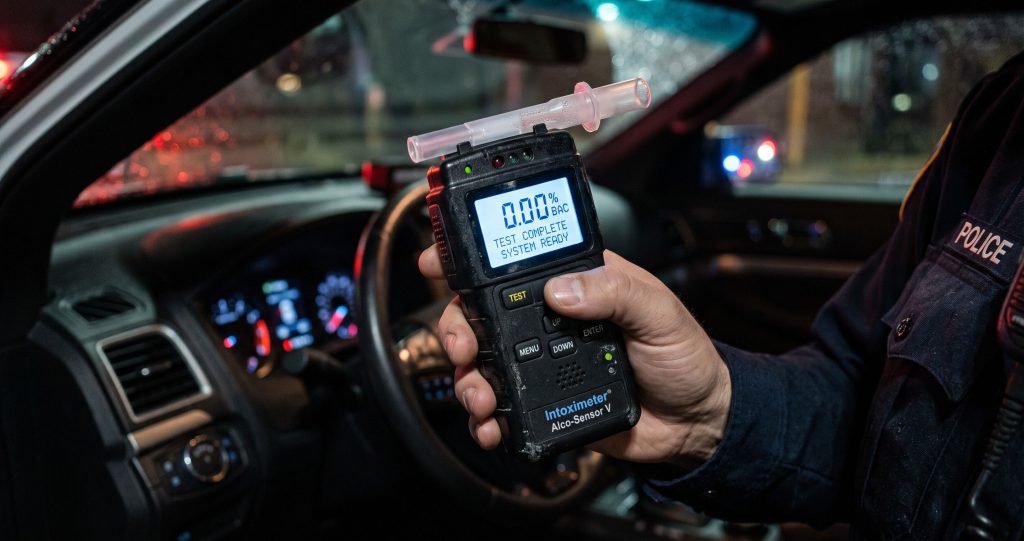
Yes. Since October 1, 2025, refusing a lawful breath or urine test after a DUI arrest in Florida is a crime the first time: a second-degree misdemeanor punishable by up to 60 days in jail and a fine of up to $500 (Fla. Stat. § 316.1939(1); § 775.082(4)(b); § 775.083(1)(e)). A refusal by someone with a prior refusal suspension or a prior boating refusal fine is a first-degree misdemeanor, and the 1-year license suspension (18 months for a repeat refusal) still applies. Our guide on refusing a field sobriety test in Florida explains the different rules for the roadside exercises.
| Refusal history | Criminal charge | Maximum jail and fine | Administrative license suspension |
|---|---|---|---|
| First refusal | Misdemeanor of the second degree (§ 316.1939(1)(e)) | 60 days and $500 (§ 775.082(4)(b); § 775.083(1)(e)) | 1 year (§ 322.2615(1)(b)1.a.) |
| Refusal after a prior refusal suspension, or after a prior boating refusal fine under § 327.35215 | Misdemeanor of the first degree (§ 316.1939(1)(d), (e)) | 1 year and $1,000 (§ 775.082(4)(a); § 775.083(1)(d)) | 18 months when the license was previously suspended for a refusal (§ 322.2615(1)(b)1.a.) |
| The criminal refusal charge and the license suspension run separately; the outcome of one does not decide the other (§ 316.1939(2), (3)). | |||
Answers to Your Questions
What does Trenton’s Law change in Florida?
It makes a first refusal to take a breath or urine test after a lawful DUI arrest a second-degree misdemeanor, in addition to the license suspension. House Bill 687, known as Trenton’s Law and codified as Chapter 2025-121, Laws of Florida, took effect October 1, 2025, and amended Fla. Stat. § 316.1932 and § 316.1939. Before this law, a criminal charge required a second or later refusal.
- First refusal, before October 1, 2025: administrative license suspension alone, no criminal charge.
- First refusal, on or after October 1, 2025: a second-degree misdemeanor, up to 60 days in jail and a fine of up to $500, in addition to the license suspension.
- Second or subsequent refusal: unchanged, a first-degree misdemeanor, up to one year in jail and a fine of up to $1,000.
- Repeat DUI manslaughter: reclassified from a second-degree felony (15-year maximum) to a first-degree felony.
Did the license suspension periods change too?
No. The Department of Highway Safety and Motor Vehicles still suspends the license for 1 year for a first refusal and 18 months for a second or subsequent refusal (Fla. Stat. § 322.2615(1)(b)1.a.). What changed is that a first refusal now also carries a separate criminal charge, stacked alongside that suspension rather than replacing it.
Does Trenton’s Law apply to boating under the influence too?
In part. Trenton’s Law made BUI manslaughter a first-degree felony when the person has a prior conviction for BUI manslaughter, DUI manslaughter, vehicular homicide, or vessel homicide, matching the DUI manslaughter change discussed below. It did not change the boating refusal rules. A first refusal after a BUI arrest is still a $500 civil penalty under Fla. Stat. § 327.35215, and a refusal by someone previously fined or suspended for refusing remains a first-degree misdemeanor under Fla. Stat. § 327.359.
What changed for repeat DUI manslaughter convictions under Trenton’s Law?
DUI manslaughter is now a first-degree felony when the driver has a prior conviction for DUI manslaughter, BUI manslaughter, vehicular homicide, or vessel homicide (Fla. Stat. § 316.193(3)(c)3.c.). Without such a prior conviction, DUI manslaughter is a second-degree felony with a maximum of 15 years, unless the driver knew or should have known of the crash and failed to give information and render aid, which also makes it a first-degree felony (Fla. Stat. § 316.193(3)(c)3.b.). Every DUI manslaughter conviction carries a 4-year mandatory minimum prison term. A first-degree felony carries up to 30 years in prison (Fla. Stat. § 775.082(3)(b)1.).
Does the refusal charge go away if the DUI charge is dropped or I am found not guilty?
No. Refusal is a separate crime under Fla. Stat. § 316.1939, so a driver can be acquitted of DUI, or have that charge dismissed, and still be convicted of refusal. The statute also keeps the criminal refusal case and the license suspension apart: the outcome of one does not decide the other (§ 316.1939(2), (3)).
Does an officer have to warn me about the criminal exposure for refusal?
Yes. To convict, the State must prove the officer told you that refusing would suspend your license for 1 year, or 18 months for a repeat refusal, and that a refusal is a misdemeanor, and that you refused after being told (Fla. Stat. § 316.1939(1)(c)-(e)). If an officer relies on an outdated warning card or fails to give this warning, that gap can be directly challenged as part of the defense. The refusal charge also depends on the underlying stop and arrest being lawful in the first place, a separate and sometimes stronger point to examine.
What should I do if I am facing a refusal charge under this law?
Act on two fronts right away. You have 10 days after the notice of suspension is issued to request a formal or informal review of the license suspension with the Department of Highway Safety and Motor Vehicles (Fla. Stat. § 322.2615(1)(b)3.). The criminal refusal charge needs a close look at whether the officer gave the warning correctly, whether the stop and arrest were lawful, and how the refusal charge interacts with any DUI charge. See our page on what to expect after a first DUI arrest in Florida for the broader process, and our Miami DUI lawyer for how these cases are handled locally, and our Legal Terms Glossary for related DUI terms like actual physical control.
The first consultation is free and confidential, with no obligation to retain.
For representation after a DUI arrest, see the firm’s Miami DUI lawyer and Coral Gables DUI lawyer pages.
Sources
- Ch. 2025-121, Laws of Fla. (HB 687, Trenton’s Law)
- Fla. Stat. § 316.1932 (2026)
- Fla. Stat. § 316.1939 (2026)
- Fla. Stat. § 327.35215 (2026)
- Fla. Stat. § 327.359 (2026)
Last updated: .