
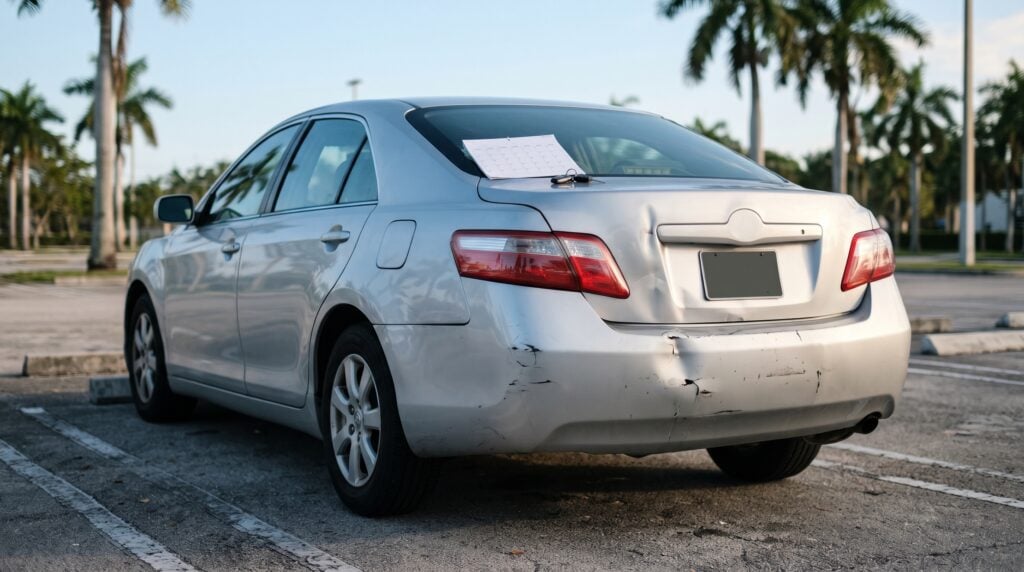
Yes. In Florida, your personal injury protection (PIP) insurance pays medical benefits after a car accident if you receive initial care from a qualified provider within 14 days (Fla. Stat. § 627.736(1)(a)). Miss that window and PIP will not pay those bills. Some injuries take hours or days to show symptoms, so feeling fine is no reason to wait.
At a glance: Florida’s 14-day PIP rule
| Rule | What it means for you | Law |
|---|---|---|
| 14-day window | PIP medical benefits depend on initial care within 14 days after the crash | § 627.736(1)(a) |
| Who can see you first | A medical or osteopathic doctor, a dentist, a chiropractor, a qualifying advanced practice registered nurse, a hospital or qualifying hospital facility, or an ambulance crew | § 627.736(1)(a)1. |
| Emergency medical condition found | Medical benefits up to $10,000, if the finding comes from a medical or osteopathic doctor, a dentist, a physician assistant, or an advanced practice registered nurse | § 627.736(1)(a)3. |
| No emergency medical condition found | Medical benefits limited to $2,500 | § 627.736(1)(a)4. |
| What PIP pays | 80% of reasonable medical expenses and 60% of lost income, up to $10,000 in total | § 627.736(1)(a), (b) |
| Pain and suffering | Requires a permanent injury or another injury that meets Florida’s threshold | § 627.737(2) |
| Deadline to sue | 2 years for a negligence lawsuit over a crash after March 24, 2023 | § 95.11(5)(a) |
What Is Florida’s 14-Day Rule?
Florida’s 14-day rule says PIP pays medical benefits when the injured person “receives initial services and care pursuant to subparagraph 1. within 14 days after the motor vehicle accident” (§ 627.736(1)(a)). PIP is the part of your car insurance that pays your medical bills and lost income no matter who caused the crash. The PIP on your car covers you, and if you do not have a car, the PIP of a relative you live with may cover you (§ 627.736(4)(e)).
PIP is still the law. Bills to repeal Florida’s no-fault law were filed in 2025 (HB 1181 and SB 1256) and in 2026 (HB 769 and SB 522), and all four died in committee. The 14-day rule applies to crashes in Florida today.
The 14 days run from the date of the crash. If your first visit to a qualified provider comes after that window closes, PIP does not reimburse your medical care. Go well before day 14 so a scheduling delay does not cost you coverage. A visit to a provider who is not on the statute’s list does not start your coverage either, which is why the next section matters.
Who Can Provide Your First Visit?
Your first visit must be with a provider the statute names. Under § 627.736(1)(a)1., initial services and care must be “lawfully provided, supervised, ordered, or prescribed” by one of these:
- A medical doctor or osteopathic doctor (licensed under chapter 458 or 459).
- A dentist (chapter 466).
- A chiropractic physician (chapter 460).
- An advanced practice registered nurse registered for autonomous practice under § 464.0123.
- A hospital, or care “provided in a hospital or in a facility that owns, or is wholly owned by, a hospital.”
- An ambulance or emergency medical services provider “which provides emergency transportation and treatment” (licensed under part III of chapter 401).
After that first visit, follow-up care must come on referral from one of those providers and must be “consistent with the underlying medical diagnosis” (§ 627.736(1)(a)2.). PIP medical benefits do not cover massage therapy or acupuncture, no matter who provides it (§ 627.736(1)(a)5.).
What Is an Emergency Medical Condition, and Why Does It Matter?
An emergency medical condition finding decides whether your PIP medical benefits can reach $10,000 or stop at $2,500. Florida defines an emergency medical condition as “a medical condition manifesting itself by acute symptoms of sufficient severity, which may include severe pain, such that the absence of immediate medical attention could reasonably be expected to result in” serious jeopardy to the patient’s health, serious impairment to bodily functions, or serious dysfunction of a bodily organ or part (§ 627.732(16)).
- Up to $10,000: when a medical or osteopathic doctor, a dentist, a physician assistant, or an advanced practice registered nurse “has determined that the injured person had an emergency medical condition” (§ 627.736(1)(a)3.).
- Limited to $2,500: when a provider on the initial care or follow-up care list “determines that the injured person did not have an emergency medical condition” (§ 627.736(1)(a)4.).
A chiropractor can provide your first visit, but a chiropractor is not on the list of providers who can make the finding that opens the $10,000 limit. A chiropractor is on the list of providers whose finding of no emergency medical condition caps benefits at $2,500. The statute does not say what happens when no provider makes either finding. Ask the provider who evaluates you to write down the finding, whatever it is.
How Much Does PIP Pay?
PIP pays 80% of reasonable medical expenses and 60% of lost income, up to a combined $10,000 (§ 627.736(1)). The statute covers “Eighty percent of all reasonable expenses for medically necessary medical, surgical, X-ray, dental, and rehabilitative services” (§ 627.736(1)(a)), and “Sixty percent of any loss of gross income and loss of earning capacity per individual from inability to work proximately caused by the injury” (§ 627.736(1)(b)). Lost income benefits “must be paid at least every 2 weeks” (§ 627.736(1)(b)).
PIP benefits are overdue if the insurer does not pay within 30 days after it receives written notice of the covered loss and the amount (§ 627.736(4)(b)). Report the crash to your insurer and send in bills as they come.
The first consultation is free and confidential. Call (305) 774-7000.
Why You Can Feel Fine and Still Be Hurt
Some crash injuries do not cause symptoms right away, so feeling fine on the day of the crash does not mean you were not hurt. The Centers for Disease Control and Prevention says “Some mild TBI and concussion symptoms may appear right away, while others may not appear for hours or days after the injury.” A mild traumatic brain injury, or TBI, is the medical term that includes a concussion. Pain from other injuries can also appear or grow after the day of the crash.
This post is not medical advice, and a lawyer cannot tell you whether you are hurt. A qualified provider can. Get evaluated by one within 14 days, tell the provider you were in a car crash, and describe every symptom, even ones that seem minor. If symptoms appear or get worse later, go back and say so. Call 911 in an emergency.
How Insurers Use Gaps in Treatment
A gap in treatment is a stretch of days or weeks with no medical care, and insurers use gaps to argue that your injury was minor or was not caused by the crash. An adjuster reading your records may point to a late first visit, missed appointments, or weeks between visits and argue that something else caused your pain, or that you healed and stopped going.
Florida’s PIP law gives the insurer tools to test your treatment. The insurer can require you to attend a mental or physical examination by a physician, and the insurer pays the full cost (§ 627.736(7)(a)). It can stop paying your treating physician after it gets a valid report from a Florida physician licensed under the same chapter as your treating physician “stating that treatment was not reasonable, related, or necessary” (§ 627.736(7)(a)). A record with gaps gives that physician more room to reach that conclusion.
The same records follow you into an injury claim against the driver who caused the crash. The other driver’s insurer will read them to decide what to offer. See signs an insurance company is lowballing your claim, and before you talk to any adjuster, read our post on recorded statements to insurance adjusters.
When Can You Recover Pain and Suffering?
You can recover pain and suffering from the driver who caused the crash when your injury meets Florida’s permanent injury threshold in § 627.737(2). Florida law allows damages “for pain, suffering, mental anguish, and inconvenience” in a claim against an insured driver when the injury includes:
- A “Significant and permanent loss of an important bodily function.”
- A “Permanent injury within a reasonable degree of medical probability, other than scarring or disfigurement.”
- “Significant and permanent scarring or disfigurement.”
- Death.
Proving a permanent injury depends on medical evidence, and that evidence starts with the first visit. A record that begins weeks after the crash, or that has long gaps, gives the defense a reason to dispute that the crash caused the injury. See how much a car accident case is worth in Florida.
How Long Do You Have to File a Lawsuit?
Florida gives you 2 years to file a negligence lawsuit after a car accident (§ 95.11(5)(a)). That 2-year deadline applies to claims that arose after March 24, 2023, the day the 2023 tort reform law took effect (ch. 2023-15, § 28, Laws of Fla.). Crashes on or before that date keep the earlier 4-year deadline. See our Florida statute of limitations guide. The 14-day PIP window and the 2-year lawsuit deadline are separate rules. Meeting one does not satisfy the other, and talking with an insurer does not stop either clock.
Fault also matters in a lawsuit. Under Florida’s modified comparative fault rule, your damages go down by your percentage of fault, and in cases filed after March 24, 2023, if you are found more than 50 percent at fault for your injury, you recover nothing (§ 768.81(2), (6)). See what to do if you were partly at fault.
Deadlines are running from the day of the crash. To talk through yours, call (305) 774-7000.
What to Do This Week
- Get evaluated by a qualified provider within 14 days of the crash, even if you feel fine. Use a provider on the statute’s list, such as a hospital emergency room, a qualifying hospital facility, or a medical doctor.
- Tell the provider you were in a car crash and describe every symptom, including headaches, stiffness, dizziness, or trouble sleeping.
- Ask about the emergency medical condition finding and ask that it be written in your records.
- Keep every appointment and follow up on any referral. If you stop treatment, write down why.
- Report the crash to your insurer and send bills in writing.
- Keep a short daily note of your symptoms, missed work, and tasks you could not do.
- Do not give a recorded statement to the other driver’s insurer before you talk to a lawyer.
For the full checklist, see what to do after a car accident in Florida and our Miami car accident lawyer page.
This post reflects the 2026 Florida Statutes as of November 2026. It is general information, not medical advice and not a prediction of any result.
Quick Answers
Do I need to see a doctor after a car accident in Florida if I feel fine?
To keep PIP medical benefits, yes. Florida’s PIP law pays medical benefits if you receive initial care from a qualified provider within 14 days after the crash. Some injuries, such as concussions, can take hours or days to show symptoms, so get evaluated by a qualified provider.
What happens if I see a doctor after 14 days?
PIP will not pay your medical benefits. The statute ties PIP medical benefits to initial care from a qualified provider within 14 days after the crash, and a late first visit does not restart the clock. A claim against the driver who caused the crash is a separate matter with a 2-year deadline, so a missed PIP window does not end that claim.
Does a chiropractor count for the 14-day rule?
Yes. A chiropractic physician can provide initial care under the statute. A chiropractor cannot make the emergency medical condition finding that opens the $10,000 limit, which must come from a medical or osteopathic doctor, a dentist, a physician assistant, or an advanced practice registered nurse.
Does urgent care count for the 14-day rule?
It depends on who treats you. The visit counts if a medical or osteopathic doctor, a dentist, a chiropractor, or a qualifying advanced practice registered nurse provides, supervises, orders, or prescribes the care, or if the center qualifies as a hospital facility under the statute. Call the center before you go and ask who will see you.
What is the difference between the $10,000 and $2,500 PIP limits?
PIP medical benefits can reach $10,000 when a medical or osteopathic doctor, a dentist, a physician assistant, or an advanced practice registered nurse determines you had an emergency medical condition. They are limited to $2,500 when a provider determines you did not. Ask the provider who evaluates you to write the finding in your records.
How much does PIP pay in Florida?
PIP pays 80% of reasonable medical expenses and 60% of lost income, up to $10,000 in total, no matter who caused the crash. Medical benefits stop at $2,500 if a provider finds no emergency medical condition. PIP also pays a $5,000 death benefit. It does not pay for massage therapy or acupuncture.
Did Florida repeal PIP?
No. Bills to repeal Florida’s no-fault law were filed in 2025 (HB 1181 and SB 1256) and in 2026 (HB 769 and SB 522), and all four died in committee. As of November 2026, Florida drivers still carry PIP, and the 14-day rule for initial medical care still applies after a crash.
Can a gap in treatment hurt my claim?
Yes. Insurers use gaps to argue that an injury was minor or was not caused by the crash. A PIP insurer can also stop paying your treating physician after a valid report from a Florida physician that the treatment was not reasonable, related, or necessary.
Can I get pain and suffering after a car accident in Florida?
Yes, from the driver who caused the crash, if your injury meets the threshold in § 627.737(2): a “Significant and permanent loss of an important bodily function,” a “Permanent injury within a reasonable degree of medical probability, other than scarring or disfigurement,” “Significant and permanent scarring or disfigurement,” or death. PIP does not pay pain and suffering. Medical records that start early help prove a permanent injury.
How long do I have to file a car accident lawsuit in Florida?
Two years for a negligence lawsuit when the crash happened after March 24, 2023, the day the 2023 tort reform law took effect. Crashes on or before that date keep the earlier 4-year deadline. Talking with an insurance company does not pause the deadline, and the 14-day PIP window is a separate rule.
The first consultation is free and confidential, with no obligation to retain. Spanish is spoken at the office. If there is no recovery, you owe no attorney fee and no case costs.
Sources
- Fla. Stat. §§ 95.11, 627.732, 627.736, 627.737 (2026)
- Fla. Stat. § 768.81 (2026)
- Florida Senate bill histories: HB 1181 (2025), SB 1256 (2025), HB 769 (2026), SB 522 (2026)
- Ch. 2023-15, Laws of Fla.
- Centers for Disease Control and Prevention, Symptoms of Mild TBI and Concussion
Last updated: November 15, 2026.