
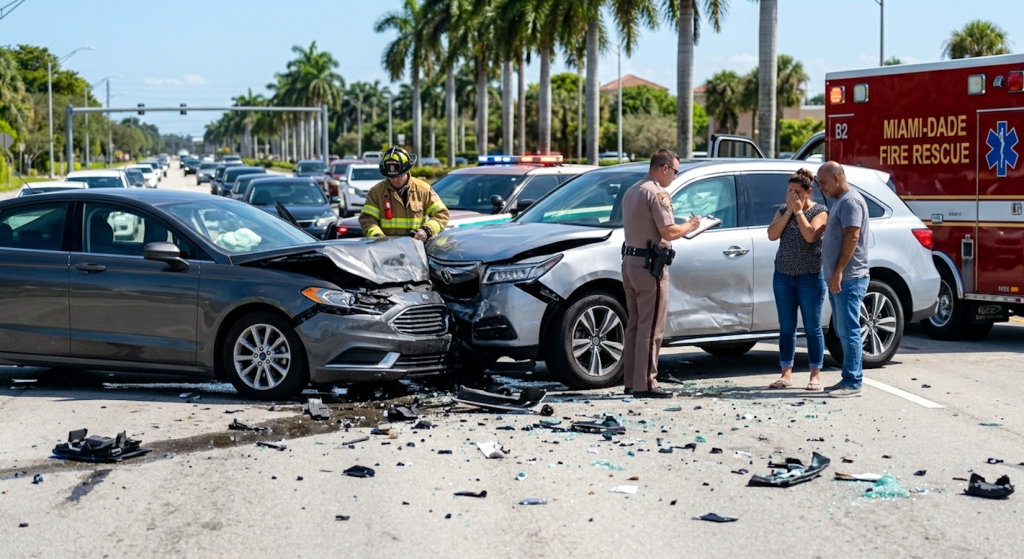
A car accident in Florida happens in seconds. The aftermath lasts months. The decisions you make in the first 72 hours commonly decide whether your insurance claim succeeds, your medical care gets paid for, and your case holds up if it ever needs a lawyer.
This guide walks through what to do at the scene, in the days that follow, and in the weeks after. Florida has quirks. The state’s no-fault insurance system, comparative negligence rules, and tight statute of limitations all affect what you should do and when.
Frequently Asked Questions
What should I do at the scene of a car accident in Florida?
Your priorities at the scene, in order:
- Check yourself and others for injuries. If anyone is hurt or unresponsive, call 911 immediately. Even minor accidents can produce serious injuries that adrenaline masks for hours.
- Move to safety if possible. If your vehicle can be moved and is creating a hazard, get it to the shoulder. If it cannot be moved, turn on hazard lights and stay clear of traffic.
- Call the police. In Florida, you are required to report a crash that involves injury, death, or estimated property damage of $2,000 or more. The property damage threshold was $500 until October 1, 2026, when SB 488 raised it. When in doubt, call. A police report becomes important documentation later.
- Do not admit fault. This is one of the most important things to remember. Do not say “I’m sorry,” do not say “I didn’t see you,” do not speculate about who caused the accident. Anything you say can be used by the other driver’s insurance company to reduce your claim.
What should I document after a car accident?
Use your phone to capture as much as possible:
- Photos of all vehicles involved, from multiple angles
- Photos of any visible injuries
- Photos of the road, weather conditions, traffic signals, and skid marks
- Photos of license plates and the other driver’s insurance card
- Names and phone numbers of any witnesses
- The badge number and contact info of any responding officer
Even if you think the accident was minor, document it. What looks minor at the scene can turn into a serious medical issue or an insurance dispute weeks later.
Should I get medical attention even if I feel fine?
This is the step people skip most commonly, and it is the most important.
Adrenaline masks pain. Whiplash, concussions, and soft tissue injuries commonly do not show symptoms for 24 to 72 hours. Internal injuries can be silent for days. By the time you feel the pain, you may have lost the documentation that connects it to the accident.
Florida law also requires you to seek medical attention within 14 days of an accident to qualify for full Personal Injury Protection (PIP) benefits. Wait longer than 14 days, and you may lose access to up to $10,000 in coverage you paid for.
If anything feels wrong, go to an urgent care or emergency room the same day. If nothing feels wrong, schedule a follow-up with your doctor within a week. Tell every provider that the visit relates to the accident.
How does Florida’s no-fault insurance system work?
Florida is a no-fault state. This means that after most accidents, your own auto insurance pays for your medical expenses and lost wages, regardless of who caused the accident. Every driver in Florida is required to carry at least $10,000 in PIP coverage.
A few things this means in practice:
- You file your initial medical claim with your own insurance, not the other driver’s
- You can sue the at-fault driver in cases involving serious injury, permanent injury, or notable scarring alone
- Property damage claims work differently from medical claims
- PIP covers 80% of your medical bills and 60% of lost wages, up to your policy limit
The no-fault system is more complicated than this summary, and the threshold for suing the other driver is one of the most disputed questions in Florida personal injury law. If your injuries are anything beyond minor, talk to an attorney before deciding how to handle your claim.
What should I know before talking to insurance companies?
Within hours of your accident, you will probably get a call. Sometimes it will be your own insurance company. Sometimes it will be the other driver’s insurance company. Both calls deserve careful handling.
Your own insurance company
You have a contractual duty to cooperate with your own insurer. Report the accident promptly. Provide basic facts. Do not exaggerate. Do not minimize.
The other driver’s insurance company
You have no duty to talk to the other driver’s insurer. You can politely decline. The adjuster’s job is to settle the claim for as little as possible. Anything you say to them can be used to reduce or deny your claim.
Common tactics from opposing adjusters:
- Asking for a recorded statement (you do not have to give one)
- Requesting your full medical history (you do not have to provide it)
- Offering quick settlement before you know your full medical situation
- Asking suggestive questions designed to elicit “I’m fine” type answers
If you are unsure how to handle these calls, talk to an attorney first. Most personal injury attorneys offer free consultations.
What are the 14-day rule and the 2-year rule?
Two Florida deadlines carry the most weight:
- 14 days for medical care. To preserve your full PIP benefits, you must receive medical care within 14 days of the accident.
- Two years to file a lawsuit (for accidents on or after March 24, 2023). Florida shortened the personal injury statute of limitations from four years to two. Older accidents may still fall under the four-year rule. See our full Florida Statute of Limitations guide for the complete breakdown. Either way, do not assume you have all the time in the world.
If you wait too long, you lose your right to recover, regardless of how clear the other driver’s fault was.
When should I call an attorney after a car accident?
Not every accident needs an attorney. A minor fender-bender with no injuries and clear fault may resolve through insurance without legal help.
Talk to a personal injury attorney if any of these apply:
- Anyone was injured, even minor injuries that may worsen
- Fault is disputed
- The other driver was uninsured or underinsured
- The insurance company is delaying, denying, or offering a low settlement
- You are losing income from missed work
- The accident involved a commercial vehicle, rideshare, or government vehicle
- You feel pressured to sign anything
Most attorneys offer free initial consultations and work on contingency, meaning you pay nothing unless they recover money for you.
What should I avoid doing after a car accident?
A few common actions after an accident can end up working against a claim.
- Do not post about the accident on social media. Photos of you smiling or active can be used to dispute injury claims.
- Do not sign anything from the other driver’s insurer without a lawyer reviewing it. Releases and quick settlements commonly end your right to further compensation.
- Do not ignore symptoms. Pain that appears days later is real, and untreated injuries get worse.
- Do not skip follow-up appointments. Gaps in treatment are used by insurers to argue you were not truly hurt.
What should I do if I need help after a car accident?
The Law Offices of Andre A. Rouviere has handled personal injury cases in Miami-Dade County since 1992. Andre Rouviere personally reviews every case at the firm. Initial consultations are free, and we work on contingency for personal injury claims.
If you or a family member has been in a car accident, contact us at (305) 774-7000 or visit our contact page to schedule a consultation.