
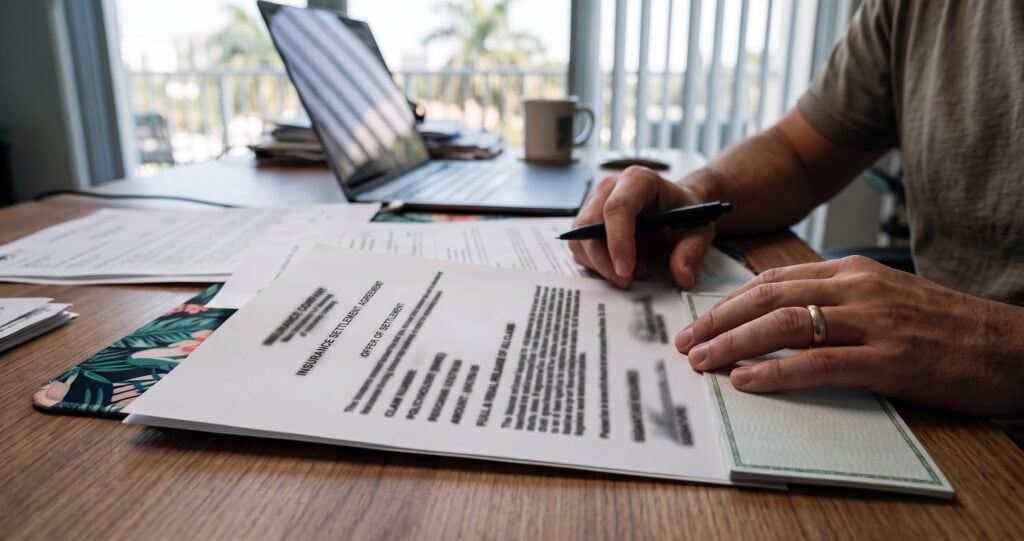
An insurance company is lowballing your claim when it makes an offer before your treatment ends, pushes for a recorded statement, asks for your entire medical history, ignores future care, rushes you to sign a release, or keeps disputing fault that a police report makes clear. Florida gives you 2 years to file a negligence lawsuit for injuries after March 24, 2023 (Fla. Stat. § 95.11(5)(a)), so a fast offer does not call for a fast answer. Adjusters are paid to resolve claims for as little as the company can defend, whether the claim involves a car accident, a slip and fall, or another injury covered by a liability policy. Here is how to recognize each tactic.
The first offer comes fast, before treatment is finished
An early offer, particularly one that arrives before you have finished medical treatment or even fully understand the extent of an injury, is rarely generous. Adjusters know that people under financial pressure are more prone to accept a quick number. Treat a fast offer as a reason to slow down.
They ask for a recorded statement right away
You are not required to give a recorded statement to the other driver’s insurance company. Adjusters are trained to ask questions in ways that produce answers useful to minimizing your claim, even when the questions sound routine or friendly.
They request your full medical history, not just records related to the accident
A request for your complete medical history, rather than records tied to the injury at issue, is commonly a search for a prior condition. Adjusters use that history to argue the current injury is not new, or not as serious as claimed.
The offer does not account for ongoing treatment or future care
A settlement that covers bills to date alone, without accounting for ongoing or reasonably anticipated treatment, can leave you responsible for costs that have not happened yet. Settlements are generally final, so an offer that leaves out future care leaves you paying for that care yourself. For a claim your insurer has paid short, see our page on underpaid insurance claims.
They repeatedly ask you to sign something quickly
Pressure to sign a release or settlement quickly, especially paired with language suggesting the offer will disappear, is a negotiating tactic. A fair offer generally does not require rushing you into accepting it.
They dispute liability despite a clear police report
If a police report and the physical evidence point clearly to fault, but the insurance company keeps disputing liability without a real basis, that resistance is a negotiating strategy. Florida treats denying claims without a reasonable investigation as an unfair claim settlement practice when an insurer does it as a general business practice (Fla. Stat. § 626.9541(1)(i)3.d.).
Sources
Last updated: .
Answers to Your Questions
Is there an actual Florida law that prohibits these tactics, or is this just industry practice?
Yes. Florida’s Unfair Insurance Trade Practices Act, Fla. Stat. § 626.9541(1)(i), lists unfair claim settlement practices, including failing to adopt standards for properly investigating claims and denying claims without a reasonable investigation, when an insurer does them with enough frequency to show a general business practice. A separate statute, Fla. Stat. § 624.155(4)(a), bars a bad faith action against a liability insurer that tenders the lesser of its policy limits or the amount demanded within 90 days after receiving “actual notice of a claim which is accompanied by sufficient evidence to support the amount of the claim.” A demand backed by complete evidence is what starts that clock.
Does getting a lawyer involved make the insurance company angry or slow things down?
Involving an attorney generally speeds up a stalled claim rather than slowing it down, since adjusters know a represented claimant is more prone to pursue litigation if the offer stays unreasonable. It does not affect the underlying facts of the claim.
What if I already gave a recorded statement before realizing this could hurt my case?
A prior recorded statement does not end the claim. An attorney reviewing the statement alongside the rest of the case can address particular answers that need context or clarification as the claim moves forward.
Can I still negotiate after I have already received a settlement offer?
Yes, you can counter any offer you have not accepted. An initial offer opens the negotiation, and answering a low number with records and bills is a normal part of the claims process. You can also ask the at-fault driver’s insurer in writing to disclose its policy limits; it must answer under oath within 30 days (Fla. Stat. § 627.4137(1)).
What happens if I already accepted a lowball settlement?
A signed settlement and release generally ends the claim, which is why the review belongs before you sign. In limited situations involving fraud or misrepresentation by the insurer, a signed release may be challenged, though this is the exception rather than the rule.
How long does it take to get a fair offer instead of a lowball one?
No Florida statute requires the at-fault driver’s insurer to make an offer by a set date, so timing depends on how much documentation exists and how the insurer responds to pushback. PIP works differently: your no-fault insurer must pay PIP benefits within 30 days after receiving written notice of a covered loss and its amount, or the benefits are overdue (Fla. Stat. § 627.736(4)(b)). Claims with complete medical records and a clear liability picture generally resolve faster than ones still waiting on ongoing treatment to conclude.
Does it cost anything to have an attorney review an offer before I accept it?
No. Personal injury cases are handled on contingency, meaning that if there is no recovery, you owe no attorney fee and no case costs, and the initial consultation and offer review are free. If there is a recovery, the fee is a percentage of it, and case costs the firm advanced are repaid from it.
What to do if this sounds familiar
These tactics say nothing about the merit of your claim. They show that the process is adversarial even when the adjuster sounds friendly. Reviewing an offer with an attorney before accepting it costs nothing and can reveal whether the number reflects the value of the claim. Our post on how much a car accident case is worth in Florida walks through the Florida rules that set that value. See our full guide on insurance disputes for how coverage and denial issues get resolved after a claim is filed.
How I approach this
I represent injured clients in negotiations with insurance carriers and I am prepared to litigate when an offer does not reflect what the case is worth. Personal injury cases are handled on contingency, meaning that if there is no recovery, you owe no attorney fee and no case costs. Our posts on giving an insurance adjuster a recorded statement and telling your insurer before you settle cover the questions clients ask next.
Initial consultations are free and confidential, with no obligation to retain. Calling early in a case tends to create more options than calling late.