
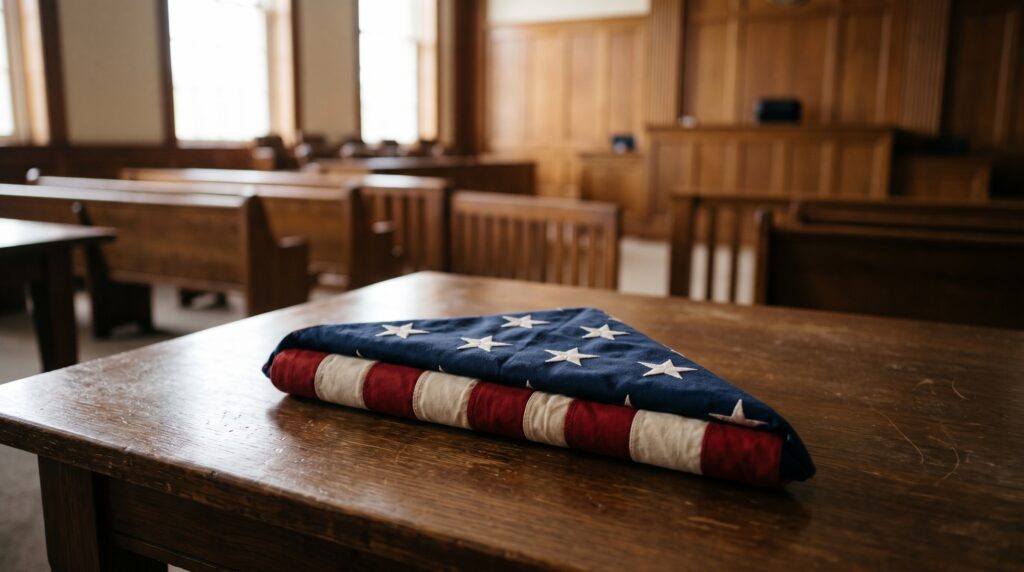
If you are a veteran or servicemember charged with a crime in Florida, a judge now decides whether you get into veterans treatment court. Before July 1, 2026, the State Attorney’s Office made that call. A new law, HB 199 (Chapter 2026-128, Laws of Florida), gave it to the court, which decides with the program’s treatment team. The change covers felony and misdemeanor cases. If you finish the program before trial, the court dismisses the charges. For a nonviolent felony committed on or after July 1, 2026, a judge can also order the program as part of a sentence.
What Changed on July 1, 2026
- Before: a defendant had to “submit an application to the state attorney,” and the State Attorney decided eligibility and approved admission.
- Now: the judge decides. A defendant may participate “if he or she is approved by the court, in consultation with the multidisciplinary team,” meaning the program’s treatment team, and meets the eligibility rules in Fla. Stat. § 394.47891(8). The court must consider any recommendation of the State Attorney and of any law enforcement agency involved in investigating or arresting the defendant.
- New at sentencing: a judge can now order veterans treatment court as part of a sentence for a nonviolent felony committed on or after July 1, 2026. That option is explained below.
You can still be admitted “at any stage of a criminal proceeding,” so a case that is already open can be considered.
Who Qualifies
The eligibility rules did not change. You must meet each of these:
- Military service. A veteran is “a person who has served in the military.” A servicemember includes active and reserve members of the armed forces, the Florida National Guard, current or former Department of Defense contractors, and current or former military members of a foreign allied country.
- A service-related condition. A service-related mental health condition, traumatic brain injury, substance use disorder, or psychological problem, or military sexual trauma.
- A good fit for the program. The judge must find that your participation serves the interest of justice and benefits you and the community.
To decide whether the program is a good fit, the judge looks at:
- the offense, the defendant, and any victim, including what the victim recommends
- criminal history and any earlier treatment court participation
- whether the defendant’s needs are more than the program can handle
- the effect on the community
- what law enforcement and the State Attorney recommend
- whether restitution will be paid
- mitigating circumstances
- anything else reasonably related to the case
Felonies: the pretrial felony program under Fla. Stat. § 948.08(7) excludes the serious violent and sex offenses listed in § 948.06(8)(c), such as murder, kidnapping, robbery, and sexual battery.
Misdemeanors: the same admission and eligibility rules apply under § 948.16(2)(a), so the judge decides misdemeanor cases too.
Dishonorable discharge: HB 199 left this decision where it was. Whether a veteran with a dishonorable discharge may take part is up to the chief judge and the State Attorney of the circuit, who have “exclusive authority” under § 394.47891(3)(d).
What Happens When You Finish
At the end of the pretrial program, the judge reviews the recommendations of the program administrator and the State Attorney and decides in writing whether you completed it. If you did, the law requires dismissal. For felonies, § 948.08(7)(c) says “the court shall dismiss the charges upon a finding that the defendant has successfully completed” the program, and § 948.16(4) says the same for misdemeanors.
A person whose felony or misdemeanor charges are dismissed after completing the pretrial veterans program may, if otherwise eligible, have the arrest record of the dismissed charges expunged under § 943.0585, as §§ 948.08(7)(b) and 948.16(2)(b) provide.
If the judge finds you did not complete the program, the judge can order more treatment or let the prosecution go forward.
Veterans Treatment Court as a Sentence
For an offense committed on or after July 1, 2026, a judge sentencing a veteran or servicemember for a nonviolent felony can order a veterans treatment court program that begins after a plea or conviction, under Fla. Stat. § 948.01(9). The defendant must otherwise qualify. A nonviolent felony is a third-degree felony under chapter 810 (burglary and trespass) or any other felony that is not a forcible felony under § 776.08. The judge can use this option regardless of what the Criminal Punishment Code scoresheet under § 921.0024 calls for.
- Completing the program is a condition of probation or community control, and finishing it satisfies that condition of the sentence.
- The defendant has to agree. The defendant must be fully advised of the program’s purpose and must agree to enter it.
- The program judge keeps the case. The veterans treatment court judge takes over until you leave the program, are removed for not complying, or finish the sentence.
- Violations go to the program judge. An alleged violation of probation or community control is heard by the veterans treatment court judge, who decides it after a hearing or an admission.
Florida already allowed this kind of placement for drug court and mental health court. HB 199 adds veterans treatment court.
Before Trial or at Sentencing: Why Timing Counts
The pretrial program ends in dismissal. The sentencing option comes after a plea or conviction.
The pretrial program can also reach charges the sentencing option cannot. Before trial, the felony program excludes a fixed list of serious offenses in § 948.06(8)(c). At sentencing, every forcible felony under § 776.08 is excluded, a definition that covers named offenses such as robbery and burglary and also “any other felony which involves the use or threat of physical force or violence against any individual.” A felony involving force that is not on the pretrial list can be considered before trial, even though it would not qualify at sentencing. That is the reason to raise your service with your lawyer at the start of the case.
If the State Attorney Turned You Down Before July 1
HB 199 does not say what happens to a veteran whose application the State Attorney denied before July 1, 2026, and we have found no court decision on the question. The law does allow admission at any stage of a case, and the judge now makes the decision, so a defense lawyer can ask the judge to consider you under the new rules. The sentencing option works differently: it applies to offenses committed on or after July 1, 2026.
Veterans Treatment Court in Miami-Dade
Miami-Dade has a Veterans Treatment Court that started in January 2017. The Miami-Dade State Attorney’s Office describes it as a pre-adjudicatory, pretrial, voluntary program in which participants are judicially monitored for a minimum of 14 months. Our Miami-Dade diversion programs guide explains how it works alongside drug court, mental health court, and pretrial intervention.
- Tell your criminal defense lawyer about your service early. The request can be made before trial, and for a nonviolent felony committed on or after July 1, 2026, again at sentencing.
- Gather your records. Discharge papers and VA or military treatment records help show service and a service-related condition.
- Bring anything that speaks to the judge’s factors. The judge weighs treatment history, criminal history, any victim’s views, and restitution, so proof of treatment or of the ability to pay restitution belongs in the file.
- Family can start this. A spouse or relative can collect discharge papers and VA records and call a lawyer while the veteran is in custody.
- Know what you are agreeing to. Treatment court means regular court appearances, testing, and treatment conditions, and the program can impose sanctions for not following its rules.
Sources: Chapter 2026-128, Laws of Florida (CS/CS/HB 199); Fla. Stat. § 394.47891 (2026); Fla. Stat. § 948.01 (2026); Fla. Stat. § 948.08 (2026); Fla. Stat. §§ 948.06(8)(c), 948.16, 776.08; House of Representatives Final Bill Analysis, CS/CS/HB 199 (June 15, 2026); Miami-Dade State Attorney’s Office, Veterans Treatment Court. The bill passed the House 110-0 and the Senate 37-0 and was approved by the Governor on June 11, 2026.
Quick Answers
Does the State Attorney still decide who gets into veterans treatment court in Florida?
No. Since July 1, 2026, the court decides eligibility in consultation with the program’s multidisciplinary team. The court must consider any recommendation of the State Attorney, but the defendant no longer applies to the State Attorney for approval.
Who is eligible for veterans treatment court?
A veteran or servicemember who has a service-related mental health condition, traumatic brain injury, substance use disorder, or psychological problem, or who experienced military sexual trauma, qualifies when the judge finds participation serves the interest of justice and benefits the defendant and the community. The pretrial felony program excludes the serious violent and sex offenses listed in § 948.06(8)(c).
Are charges dismissed if I finish veterans treatment court, including for a misdemeanor?
In the pretrial programs, yes. The court must dismiss felony charges under Fla. Stat. § 948.08(7)(c) and misdemeanor charges under § 948.16(4) once it finds the defendant successfully completed the program. Misdemeanors follow the same admission and eligibility rules as felonies. A dismissed arrest record, felony or misdemeanor, may then be eligible for expunction.
Can a judge sentence a veteran to veterans treatment court?
Yes, for a nonviolent felony committed on or after July 1, 2026, if the defendant qualifies and agrees. A nonviolent felony is a third-degree felony under chapter 810 (burglary and trespass) or any other felony that is not a forcible felony under § 776.08. Completing the program becomes a condition of probation or community control.
Is it better to ask for veterans treatment court before trial or at sentencing?
The pretrial program can reach charges the sentencing option cannot, and it ends in dismissal. The sentencing option is limited to nonviolent felonies committed on or after July 1, 2026, and comes after a plea or conviction.
What happens if I violate probation while in veterans treatment court?
The veterans treatment court judge hears it in place of the original sentencing judge and decides it after a hearing or your admission. Any sentence or new conditions that judge imposes must be lawful.
Can a veteran with a dishonorable discharge participate?
That decision belongs to the chief judge and the State Attorney of the circuit, who have exclusive authority under § 394.47891(3)(d). HB 199 did not change it.
The first consultation is free and confidential, with no obligation to retain.
Last updated: November 14, 2026.