
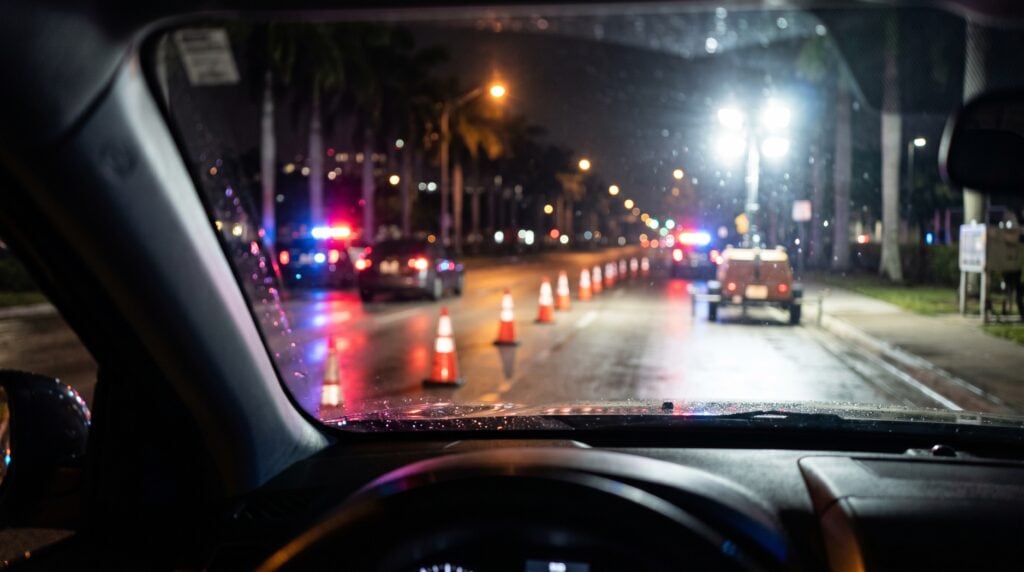
Yes. DUI checkpoints are legal in Florida if police write the plan before the checkpoint starts and follow it (State v. Jones, 483 So. 2d 433, 438 (Fla. 1986)). At a Miami-Dade checkpoint you must hand over your license, registration, and proof of insurance (Fla. Stat. §§ 322.15(1), 320.0605(1)(a), 316.646(2)). You do not have to answer questions about drinking.
At a glance: your rights at a Florida DUI checkpoint
- You must: stop, follow lawful directions, and hand over your license, registration, and proof of insurance.
- You do not have to: say where you were or what you drank.
- You can decline, but it can be used against you: field sobriety exercises.
- After a lawful DUI arrest: refusing a breath test brings a 1-year suspension and a misdemeanor charge, even the first time.
- Turning around: legal if the turn itself breaks no traffic law.
Are DUI Checkpoints Legal in Florida?
DUI checkpoints are legal under the U.S. and Florida Constitutions when they run under a written plan that limits what officers in the field can decide for themselves. In 1990, the U.S. Supreme Court upheld Michigan’s sobriety checkpoints, where the average delay was 25 seconds per car, because the state’s interest in stopping drunk driving outweighed the brief intrusion on drivers (Michigan Dep’t of State Police v. Sitz, 496 U.S. 444, 448, 455 (1990)). Holding a driver for more extensive sobriety testing “may require satisfaction of an individualized suspicion standard” (id. at 450-51). A checkpoint set up to look for ordinary crime, such as drugs, violates the Fourth Amendment (City of Indianapolis v. Edmond, 531 U.S. 32 (2000)).
Florida adds stricter rules through its Supreme Court. “It is essential that a written set of uniform guidelines be issued before a roadblock can be utilized,” and the guidelines should cover how cars are picked for a stop, how drivers are detained, which officer does what, and what happens to stopped cars (Jones, 483 So. 2d at 438). In the same decision, the court held that advance public announcement is not required when signs and lights at the site, placed under a written plan, give drivers notice. In 1996, the court held that a stop made without proper written guidelines was “fatally defective under the Fourth Amendment and article I, section 12 of the Florida Constitution” (Campbell v. State, 679 So. 2d 1168 (Fla. 1996)). Police “are not vested with the general authority to set up ‘routine’ roadblocks at any time or place,” and a checkpoint “requires particularized advance planning and direction and strict compliance thereafter” (id. at 1172).
In Guy v. State, 993 So. 2d 77 (Fla. 2d DCA 2008), the plan let a field officer change how cars were picked if traffic backed up, and officers did not stick to their assigned duties. The court reversed the denial of the driver’s motion to suppress. When the written plan is missing, too vague to limit the officers, or was not followed at the scene, a Miami DUI lawyer can ask the court to throw out the evidence from the stop.
What Do You Have to Do at a DUI Checkpoint?
At a Florida DUI checkpoint, you must stop and hand over your driver license, vehicle registration, and proof of insurance when an officer asks. A driver must “present or submit” a license “upon the demand of a law enforcement officer,” and a digital license works unless the officer cannot verify it on the spot, in which case you must hand over the printed card (Fla. Stat. § 322.15(1)). The registration must be “exhibited upon demand” (§ 320.0605(1)(a)), and the driver must “display proper proof of maintenance of security,” meaning proof of insurance (§ 316.646(2)).
Some flyers tell drivers to hold documents against a closed window. The City of Coral Gables’ police legal advisor has told officers that “present or submit” requires a driver to hand the license over (City of Coral Gables, CAO 2022-008 (Sept. 2, 2022)). We found no Florida appeals decision on window display itself, but a Florida appeals court has said that a driver lawfully stopped at a checkpoint must respond to an officer’s requests for documents, and that refusing may be the misdemeanor of obstructing or opposing an officer (Rinaldo v. State, 787 So. 2d 208 (Fla. 4th DCA 2001); Fla. Stat. § 843.02). In that case, a driver who would not roll down his tinted window or open his door gave the officer reasonable suspicion to hold him. Lowering the window enough to pass your documents through avoids the argument.
It is also unlawful to “willfully to fail or refuse to comply with any lawful order or direction of any law enforcement officer” (§ 316.072(3)), so pull into a side area when directed.
Do You Have to Answer Questions or Do Field Sobriety Exercises?
You do not have to answer questions about where you were or what you drank, and you can decline field sobriety exercises, though declining the exercises can be used as evidence. The Florida Supreme Court has held that the State may not use a defendant’s silence before arrest and before Miranda warnings as evidence of guilt when the defendant does not testify (State v. Horwitz, 191 So. 3d 429 (Fla. 2016)). A polite “I’m not going to answer questions” is enough.
Field sobriety exercises are voluntary in the sense that no Florida statute makes declining them a crime or a reason to suspend your license. Declining still carries a cost. The Florida Supreme Court held that a driver’s refusal to do the exercises was admissible at trial and “probative of the issue of consciousness of guilt” (State v. Taylor, 648 So. 2d 701 (Fla. 1995)). In 2023, a Florida appeals court went further and held that once an officer has reasonable suspicion of DUI, “the defendant can be required to perform FSE’s and consent is immaterial” (State v. Johnson, No. 5D21-2866 (Fla. 5th DCA May 5, 2023)). See what happens when you are pulled over for DUI in Florida.
What Happens If You Refuse a Breath Test?
Refusing a breath or urine test after a lawful DUI arrest suspends your license for 1 year and, since October 1, 2025, is a second-degree misdemeanor even on a first refusal (Fla. Stat. §§ 316.1939(1), 322.2615(1)(b)1.a.). Under the implied consent law, a driver is “deemed to have given his or her consent” to an approved breath test “if the person is lawfully arrested” for DUI, and the test “must be incidental to a lawful arrest” (§ 316.1932(1)(a)1.a.). The officer must tell you that refusing will suspend your license and that refusing is a misdemeanor (§ 316.1939(1)(c), (d)).
- First refusal: up to 60 days in jail and a fine of up to $500 (§§ 775.082(4)(b), 775.083(1)(e)), plus a 1-year suspension.
- Second or later refusal: a first-degree misdemeanor (§ 316.1939(1)(e)), and an 18-month suspension if your license was suspended before for a refusal (§ 322.2615(1)(b)1.a.).
- At trial: the refusal “is admissible into evidence in any criminal proceeding” (§ 316.1932(1)(a)1.a.).
The criminal refusal case and the license suspension run on separate tracks, and the outcome of one does not decide the other (§ 316.1939(2), (3)). See our post on Trenton’s Law and breath test refusal.
What Are the Penalties for a First DUI in Florida?
A first DUI conviction in Florida carries a fine of $500 to $1,000, up to 6 months in jail, and a court-ordered license revocation of 180 days to 1 year (Fla. Stat. §§ 316.193(2)(a), 322.28(2)(a)1.). The court must also order probation of up to 1 year with at least 50 hours of community service, a 10-day impoundment or immobilization of the vehicle, and a substance abuse course at a licensed DUI program (§ 316.193(5), (6)(a)).
- Breath or blood alcohol of 0.15 or higher, or a minor in the car: a fine of $1,000 to $2,000 and up to 9 months in jail (§ 316.193(4)).
- A crash that damages property or injures someone: a first-degree misdemeanor, and serious bodily injury makes it a third-degree felony (§ 316.193(3)(c)1., 2.).
- A breath test refusal: a separate criminal charge in addition to the DUI (§ 316.1939(1)).
Some first-time DUI cases in Miami-Dade qualify for Back on Track, a diversion program run by the State Attorney’s Office. A person who completes it has a chance at a withhold of adjudication, meaning the court does not enter a formal conviction, on a reduced charge of reckless driving. Many first DUI cases do not qualify. Prosecutors decide, based on the criminal history, the driving history, and the facts of the arrest. See our guide to Miami-Dade diversion programs.
Can You Turn Around Before a DUI Checkpoint?
Yes. No Florida statute makes it illegal to avoid a DUI checkpoint, as long as the turn itself follows traffic law. A U-turn is a moving violation when it cannot be made safely, interferes with other traffic, or is barred by a posted sign (Fla. Stat. § 316.1515). A turn without a signal for the last 100 feet is a moving violation when another vehicle may be affected (§ 316.155(1), (2), (5)). An officer who sees a traffic violation may stop you for it, whatever the officer’s reason for watching (Whren v. United States, 517 U.S. 806 (1996); Beahan v. State, 41 So. 3d 1000 (Fla. 1st DCA 2010)).
In Beahan, a U-turn that put the car’s wheels a few feet onto the grass did not give the officer reasonable suspicion that the driver was impaired. We found no Florida appeals decision on whether a legal turn away from a checkpoint, standing alone, gives reasonable suspicion for a stop, so that question is open.
What Happens at First Appearance After a Miami-Dade DUI Arrest?
After a DUI arrest in Miami-Dade, a person still in custody sees a judge within 24 hours at a first appearance hearing (Fla. R. Crim. P. 3.130(a)), held at the Richard E. Gerstein Justice Building, 1351 NW 12th Street, where DUI cases are heard. The Miami-Dade Public Defender says most people can post the standard bond after booking and leave. A DUI arrest adds a hold: the person may not be released until no longer impaired, until his or her breath or blood alcohol level is below 0.05, or until 8 hours have passed since the arrest (Fla. Stat. § 316.193(9)).
- Where: misdemeanor and criminal traffic hearings, which include a first DUI, are in Gerstein Courtroom 5-3 on weekdays at 9 a.m. and 1:30 p.m. Felony hearings are in Courtroom 1-5. On weekends and holidays, hearings are in Courtroom 1-5 at 9 a.m. and 1:30 p.m., according to the Eleventh Judicial Circuit. A DUI that causes serious bodily injury is a third-degree felony (§ 316.193(3)(c)2.).
- What the judge does: states the charge, advises that “the defendant is not required to say anything,” addresses appointment of a lawyer (Fla. R. Crim. P. 3.130(b)), reviews probable cause (Fla. R. Crim. P. 3.133(a)), and sets release conditions after weighing factors such as the charge, the evidence, family ties, and past record (Fla. Stat. § 903.046(2)).
- Your license: after a test result of 0.08 or higher or a refusal, the officer takes your license and issues a 10-day temporary permit. The suspension is 6 months for a first 0.08 result and 1 year for a first refusal. You have 10 days from the notice of suspension to request a formal or informal review, or to ask for a review of eligibility for a restricted license (Fla. Stat. § 322.2615(1)(a), (1)(b)1., 3.). Do not wait until after the holiday weekend.
Our guides to first appearance hearings in Miami-Dade, bail and bond in Miami-Dade, and what happens after a first DUI in Florida cover the next steps.
Will There Be DUI Checkpoints in Miami-Dade Over Thanksgiving 2026?
As of this post, we found no public announcement of a Miami-Dade checkpoint location for Thanksgiving 2026, which falls on Thursday, November 26. Florida law does not require police to announce a checkpoint in advance, so plan as if one could be anywhere.
The Florida Department of Highway Safety and Motor Vehicles and the Florida Highway Patrol announced on November 10, 2026, that troopers will be on patrol through the holiday season, and reported 7,331 crashes and 45 deaths on Florida roads during the five-day Thanksgiving travel period in 2025. The most crashes that year came on the Wednesday before Thanksgiving, which falls on November 25 in 2026. The agency also reported more than 1,000 crashes in November and December 2025 involving alcohol, drugs, or both.
The announcement lists no checkpoint locations, and Florida law does not require police to announce one in advance. Local departments run checkpoints too. A 2015 Coral Gables legal opinion, attached to CAO 2022-008, describes a multi-agency checkpoint sponsored by the City of Miami Police Department.
Facing a DUI charge? See what to ask a DUI lawyer before you hire one, our Coral Gables DUI lawyer page, and our criminal defense page.
This post reflects the 2026 Florida Statutes, the Florida Rules of Criminal Procedure, and court decisions through November 2026. It is general information, not a prediction of any result.
Quick Answers
Are DUI checkpoints legal in Florida?
Yes. The U.S. Supreme Court upheld sobriety checkpoints in 1990, and the Florida Supreme Court requires a written plan, issued before the checkpoint starts, that limits officer discretion and is strictly followed. A checkpoint run without one, or in violation of it, can be challenged.
What do I have to give police at a DUI checkpoint?
Your driver license, vehicle registration, and proof of insurance. Florida law requires you to present or submit your license on an officer’s demand, and a digital license works unless the officer cannot verify it on the spot. Lowering your window enough to pass the documents through is the safe course.
Do I have to answer questions at a DUI checkpoint?
No. You do not have to say where you were or whether you drank, and you can politely say you will not answer questions. The Florida Supreme Court has held that the State may not use your silence before arrest and before Miranda warnings as evidence of guilt if you do not testify.
Are field sobriety exercises voluntary in Florida?
You can decline them, and no Florida statute makes declining a crime or a reason to suspend your license. But the refusal can be used at trial, and a Florida appeals court held in 2023 that once an officer has reasonable suspicion of DUI, consent is immaterial.
What happens if I refuse a breath test at a Florida checkpoint?
After a lawful DUI arrest, a first refusal brings a 1-year license suspension and, since October 1, 2025, a second-degree misdemeanor carrying up to 60 days in jail and a fine of up to $500. A second or later refusal is a first-degree misdemeanor, and the suspension is 18 months if your license was suspended before for a refusal.
What is the penalty for a first DUI in Florida?
A first DUI conviction carries a fine of $500 to $1,000, up to 6 months in jail, up to 1 year of probation with at least 50 hours of community service, a 10-day vehicle impoundment, and a license revocation of 180 days to 1 year. A breath or blood alcohol level of 0.15 or higher, or a minor in the car, raises the fine to $1,000 to $2,000 and the jail limit to 9 months.
Is it illegal to turn around before a DUI checkpoint in Florida?
No Florida statute makes it illegal, as long as the turn follows traffic law. An illegal U-turn or a turn without a required signal is a traffic violation, and an officer may stop you for it. We found no Florida appeals decision on whether a legal turn away from a checkpoint, by itself, justifies a stop.
Where is first appearance after a DUI arrest in Miami-Dade?
At the Richard E. Gerstein Justice Building, within 24 hours of arrest for anyone not already released. Misdemeanor and criminal traffic hearings are in Courtroom 5-3, felony hearings in Courtroom 1-5, and weekend and holiday hearings are in Courtroom 1-5 at 9 a.m. and 1:30 p.m.
How long do I have to save my license after a DUI arrest over Thanksgiving?
Ten days from the date the notice of suspension is issued to request a formal or informal review with the Department of Highway Safety and Motor Vehicles. The temporary permit expires at midnight on the 10th day. A holiday arrest runs on the same clock, so call a lawyer before the Thanksgiving weekend ends.
If you or someone in your family was arrested at a checkpoint over Thanksgiving, the 10-day license deadline is already running. Call Andre Rouviere at (305) 774-7000. The first consultation is free and confidential, with no obligation to retain.
Sources
- Fla. Stat. §§ 316.072, 316.1515, 316.155, 316.193, 316.1932, 316.1939, 316.646, 320.0605, 322.15, 322.2615, 322.28, 775.082, 775.083, 843.02, 903.046 (2026)
- Fla. R. Crim. P. 3.130, 3.133 (Oct. 1, 2026)
- Michigan Dep’t of State Police v. Sitz, 496 U.S. 444 (1990)
- City of Indianapolis v. Edmond, 531 U.S. 32 (2000)
- Whren v. United States, 517 U.S. 806 (1996)
- State v. Jones, 483 So. 2d 433 (Fla. 1986)
- Campbell v. State, 679 So. 2d 1168 (Fla. 1996)
- Guy v. State, 993 So. 2d 77 (Fla. 2d DCA 2008), summarized in Florida Courts, Traffic-Related Appellate Opinions (July to Sept. 2008)
- State v. Taylor, 648 So. 2d 701 (Fla. 1995)
- State v. Johnson, No. 5D21-2866 (Fla. 5th DCA May 5, 2023)
- State v. Horwitz, 191 So. 3d 429 (Fla. 2016)
- Beahan v. State, 41 So. 3d 1000 (Fla. 1st DCA 2010)
- Rinaldo v. State, 787 So. 2d 208 (Fla. 4th DCA 2001)
- Florida Department of Highway Safety and Motor Vehicles, holiday safety release (Nov. 10, 2026)
- Miami-Dade State Attorney’s Office, Diversion Programs (Back on Track)
- Miami-Dade Public Defender, Adult Case Process
- City of Coral Gables, CAO 2022-008, DUI checkpoint license opinion (Sept. 2, 2022), with the attached 2015 legal opinion
Last updated: November 15, 2026.