
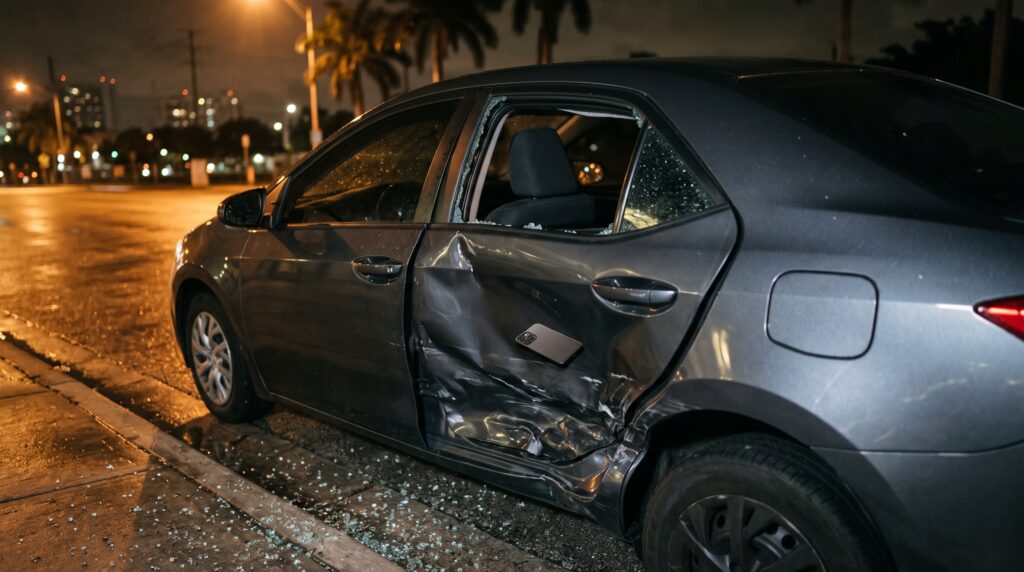
After an Uber or Lyft accident in Florida, your personal injury protection (PIP) insurance pays first for medical bills and lost income, up to $10,000, if you or a relative you live with owns a car and you get medical care within 14 days (Fla. Stat. § 627.736(1), (4)(e)). When the rideshare driver caused the crash, the rest is paid by insurance tied to what the driver’s app was doing: $50,000 per person while the driver waits for a request, and $1 million from the moment a ride is accepted until the last rider gets out (Fla. Stat. § 627.748(7)). If the app was off, the driver’s personal policy applies.
PIP pays no matter who caused the crash. The $50,000 and $1 million amounts are bodily injury coverage, which pays for injuries the driver causes to others. Florida law blocks most injury claims against Uber and Lyft themselves (§ 627.748(18)), but you can still claim against the rideshare driver, and the required coverage stays in place. If the driver who caused the crash had no insurance or too little, your uninsured motorist coverage may pay.
At a glance: which insurance covers a Florida rideshare crash
| Situation | Who pays | Law |
|---|---|---|
| App off | The driver’s personal auto policy, at whatever limits the driver carries. Florida requires most drivers to carry PIP and $10,000 in property damage coverage, but not bodily injury coverage, so the driver may have none. | § 627.748(7)(a)2., (8)(b)1.; §§ 324.022, 627.733 |
| Logged on, waiting for a ride request | At least $50,000 per person, $100,000 per crash, and $25,000 for property damage, primary | § 627.748(7)(b) |
| Ride accepted, driving to pick up, or carrying a rider | At least $1 million for death, bodily injury, and property damage, primary | § 627.748(7)(c) |
| App on, and the driver’s policy lapsed or excludes the crash | The rideshare company’s insurance pays “beginning with the first dollar of a claim” | § 627.748(7)(d) |
| Your medical bills and lost income | Your PIP first, if you or a relative you live with owns a car | § 627.736(4)(e) |
| Another driver caused the crash and is uninsured or underinsured | Your uninsured motorist coverage, or a household relative’s; Uber’s and Lyft’s current Florida certificates list none | § 627.727 |
Who Pays a Passenger Hurt in an Uber or Lyft?
A passenger hurt in an Uber or Lyft in Florida has medical bills and lost income paid first by the PIP on a car the passenger or a relative in the same household owns, and the claim for injuries beyond PIP goes against the at-fault driver’s liability coverage (§ 627.736(4)(e)). Your PIP insurer pays 80% of reasonable medical bills and 60% of lost income, up to $10,000 in total (§ 627.736(1)). You must get first medical care within 14 days of the crash, and medical benefits stop at $2,500 if a doctor finds no emergency medical condition (§ 627.736(1)(a)). The insurer of a car owner pays PIP for the owner and for “a relative of the owner residing in the same household” who is not a car owner (§ 627.736(4)(e)1., 3.). The rideshare vehicle’s PIP covers “any other person while occupying the owner’s motor vehicle” when that person does not have a car that needs PIP and cannot get PIP from a household policy (§ 627.736(4)(e)4.).
That means the PIP on your car, or on a car in Florida owned by a relative you live with, pays first, even when you were a paying passenger. The rideshare car’s PIP is a fallback for passengers who have no PIP.
For the period from ride acceptance to drop-off, the statute requires PIP that meets “the minimum coverage amounts required of a limousine” (§ 627.748(7)(c)1.b.), but Florida exempts limousines from its PIP requirement (§ 627.733(1)(a)), so the law may require no PIP at all during a ride. Uber’s and Lyft’s current Florida insurance certificates list PIP with their $50,000 policies and none with their $1 million policies. We found no Florida appeals decision on this gap, so a passenger with no PIP should talk to a lawyer about where medical bills will come from.
For injuries beyond PIP, the passenger has a claim against whichever driver caused the crash: the rideshare driver, the other driver, or both. When the rideshare driver is at fault, the $1 million coverage applies, because a ride was in progress. Uber’s and Lyft’s Florida certificates show that $1 million as one combined limit for everyone with a claim from the crash.
How Much Insurance Do Uber and Lyft Drivers Have to Carry?
Florida requires at least $50,000 per person, $100,000 per crash, and $25,000 for property damage while an Uber or Lyft driver is logged on and waiting for a request, and $1 million from the moment the driver accepts a ride until the last rider gets out (§ 627.748(7)(b), (c)). The statute calls Uber and Lyft “transportation network companies,” or TNCs, and calls their drivers “TNC drivers.” It sets coverage by what the driver’s app is doing. “Primary” coverage pays first, before any other policy.
- Logged on but not on a ride: “A primary automobile liability coverage of at least $50,000 for death and bodily injury per person, $100,000 for death and bodily injury per incident, and $25,000 for property damage,” plus PIP and uninsured motorist coverage “as required by s. 627.727” (§ 627.748(7)(b)).
- On a ride: “A primary automobile liability coverage of at least $1 million for death, bodily injury, and property damage” (§ 627.748(7)(c)). A ride starts “when a TNC driver accepts a ride requested by a rider” and ends “when the last rider exits from and is no longer occupying the TNC vehicle” (§ 627.748(1)(b)). The $1 million covers the driver’s trip to pick you up as well as the ride itself.
The coverage can come from the driver, the company, or both (§ 627.748(7)(b)2., (c)2.). If the driver’s insurance “has lapsed or does not provide the required coverage,” the company’s insurance must cover the claim “beginning with the first dollar,” and it cannot wait for the driver’s personal insurer to deny the claim first (§ 627.748(7)(d), (e)).
Many personal auto policies exclude rideshare driving. Florida lets an insurer “exclude any and all coverage” under a personal policy “while a TNC driver is logged on to a digital network or while a TNC driver provides a prearranged ride,” including liability, uninsured motorist, collision, and PIP coverage (§ 627.748(8)(b)1.).
The first consultation is free and confidential. Call (305) 774-7000.
An Uber or Lyft Driver Hit My Car. Whose Insurance Pays?
Your PIP pays first for your medical bills and lost income, up to $10,000 (§ 627.736(1), (4)(e)1.). A pedestrian or cyclist hit by a rideshare car gets PIP first from a car that the injured person or a household relative owns. If there is no such car and the injured person lives in Florida, the PIP on the car that hit them pays (§ 627.736(4)(e)1., 3., 4.). During a ride, that last fallback may not exist, because neither Uber’s nor Lyft’s Florida certificate lists PIP with its $1 million policy.
For injuries beyond PIP, and for damage to your car, your claim is against the rideshare driver’s coverage at the level that matches the app status, as shown in the table above (§ 627.748(7)(b), (c)).
How Do You Prove the Driver Was on the App?
You prove the driver was on the app with the driver’s disclosure at the scene, the company’s log-on and log-off records, which Florida law requires it to provide on request (§ 627.748(7)(h), (8)(d)), and your screenshots. App status decides which coverage applies, so get it in writing early:
- At the scene: a rideshare driver must give “this insurance coverage information to any party directly involved in the accident,” and on request must disclose whether the driver was logged on or on a ride at the time (§ 627.748(7)(h)).
- From the company: in a claims coverage investigation, the company “shall immediately provide, upon request by a directly involved party or any insurer of the TNC driver, if applicable, the precise times that the TNC driver logged on and off the digital network in the 12-hour period immediately preceding and in the 12-hour period immediately following the accident” (§ 627.748(8)(d)).
- Act within a year: the company must keep “Individual ride records for at least 1 year after the date on which each ride is provided” (§ 627.748(15)(a)). Send a written request to preserve the records soon after the crash.
- Keep your proof: screenshots of the ride receipt, the driver’s name and car shown in the app, photos of the cars and the rideshare sticker on the windshield, and the police report.
What If the Driver Who Caused the Crash Had No Insurance?
If an uninsured or underinsured driver caused your rideshare crash, your uninsured motorist coverage, or a household relative’s, may pay, because Uber’s and Lyft’s Florida insurance certificates list no uninsured motorist coverage. The rideshare statute requires uninsured motorist coverage “as required by s. 627.727,” and that law lets a policyholder reject the coverage in writing. Both of Uber’s 2026 Florida insurance certificates state: “Uninsured Motorist (UM) / Underinsured Motorist (UIM) coverage is not included in any amount.” Lyft’s Florida certificate of insurance, dated October 1, 2026, lists no uninsured motorist coverage on any of its three policies.
A passenger who has no uninsured motorist coverage and no household relative with it may have nothing to claim against when an uninsured third driver causes the crash. If you do have it, follow the settlement steps below before you accept any offer from the at-fault driver’s insurer.
What If an Uber Eats or DoorDash Driver Hit Me?
After a crash with an Uber Eats or DoorDash driver in Florida, your PIP pays first, and the rest of the claim goes against the delivery driver’s personal policy and the delivery company’s insurance program. Florida’s rideshare insurance law covers rides for riders: it defines a ride as transportation “by a TNC driver to a rider,” so a food or package delivery is not a ride under § 627.748(1)(b). If the driver also had the app open for ride requests at that moment, the statute’s coverage for a logged-on driver may apply; we found no Florida court decision on that overlap. DoorDash, for example, says its liability insurance “may cover” up to $1 million in most states while a driver is on a delivery, and says it may apply as excess, meaning it pays after the driver’s insurance.
Can I Sue Uber or Lyft in Florida?
In most cases, no. Since June 23, 2020, Florida law has shielded Uber and Lyft from injury claims tied to a rideshare car whose driver is logged on, unless the company broke a duty in the rideshare statute, committed a crime, or owned or held the car. The statute says a rideshare company “is not liable under general law” for harm arising from the use of a car while the driver is logged on (§ 627.748(18)(a)). That protection applies when all three of these are true. There was “no negligence under this section or criminal wrongdoing” by the company. It “has fulfilled all of its obligations under this section with respect to the TNC driver.” And it “is not the owner or bailee of the motor vehicle.” A bailee is someone holding another person’s property, such as a company that rents a car from another business and hands it to the driver.
Florida appeals courts have ruled for Lyft in recent cases:
- In Haddad v. Lyft Florida, Inc., No. 4D2025-0117 (Fla. 4th DCA Nov. 4, 2026), a rider who said her Lyft driver assaulted her sued Lyft for misrepresenting the safety of its rides. On rehearing, the court replaced its May 2026 opinion and again ruled for Lyft. It wrote that the protection’s scope “is very broad” and “appears to sweep in practically any claim against Lyft (or a similar rideshare network operator) for injury that arises out of the use, operation, or possession of a motor vehicle operating as a rideshare.” The claim failed because the complaint did not allege facts that fit one of the statute’s three exceptions. The court declined to send the question to the Florida Supreme Court. The opinion states it is not final until any timely rehearing motion is decided. As of November 15, 2026, the court’s docket showed no later filing and no mandate.
- In Harrell v. Martinez, No. 3D25-1167 (Fla. 3d DCA Dec. 3, 2025), a Miami-Dade crash case, the Third District affirmed the dismissal of claims against Lyft without a written opinion, citing the shield (§ 627.748(18)).
- Abner v. Lyft Florida, Inc., No. 3D24-0479 (Fla. 3d DCA Oct. 22, 2025), was a Miami-Dade case from a 2017 crash, before the 2020 protection took effect. The court held the driver was an independent contractor under § 627.748(9), meaning a self-employed worker rather than a Lyft employee, so Lyft was not responsible for his driving. It also rejected a negligent hiring claim. The driver’s record did not disqualify him under the statute’s background check rules, and the court found the evidence of careless hiring too thin to go to trial.
A claim against the company can go forward when any one of those conditions is not met, such as when the company broke a duty the statute sets: background checks (§ 627.748(12)), the zero-tolerance drug and alcohol policy (§ 627.748(10)), or the insurance rules.
Uber’s and Lyft’s rider terms also send injury claims against the company to arbitration, a private hearing before a paid decision-maker with no jury. Both carve out small claims and individual claims of sexual assault or sexual harassment. The arbitration terms cover claims against the company, not the claim against the rideshare driver. We found no Florida appeals decision on enforcing these clauses against a rider hurt in a crash.
The shield does not cover the driver. You can bring a claim against the rideshare driver, and the coverage in § 627.748(7) stays in place: the statute says the protection “does not alter or reduce the coverage or policy limits of the insurance requirements” (§ 627.748(18)(b)).
What If My Uber or Lyft Driver Assaulted or Harassed Me?
A driver who assaults a rider is personally responsible for the harm. In Florida, a lawsuit for assault, battery, or another intentional tort must be filed within 4 years (§ 95.11(3)(n)), longer than the 2-year deadline for a negligence claim from a crash. A negligence claim against Uber or Lyft over the assault, such as a claim that the company skipped a required background check, falls under the 2-year deadline (§ 95.11(5)(a)). A claim for sexual battery of a victim under 16 has no deadline (§ 95.11(10)).
A claim against Uber or Lyft is harder, because Haddad applied the rideshare liability shield to an assault claim (§ 627.748(18)). To get past the shield, the rider must show facts that fit an exception, such as a background check duty the company failed to meet. Florida bars a company from letting a person drive if a background check shows a conviction within the past 5 years for a felony or for “A misdemeanor for a violent offense or sexual battery,” or a match on the national sex offender website (§ 627.748(12)(d)). The company must repeat the check “every 3 years” (§ 627.748(12)(b)).
Beyond the carve-out in Uber’s and Lyft’s rider terms, a 2022 federal law lets a person who alleges sexual assault or sexual harassment choose court over an arbitration clause signed in advance (9 U.S.C. § 402(a)).
Report an assault to police and in the app. Save screenshots of the driver’s photo and license plate, which the app must show “before the rider enters the TNC driver’s vehicle” (§ 627.748(5)).
Other Florida Rules That Apply to Rideshare Crashes
- Pain and suffering: you can recover it from the at-fault driver when the injury meets Florida’s permanent injury threshold: “[s]ignificant and permanent loss of an important bodily function,” a permanent injury, “[s]ignificant and permanent scarring or disfigurement,” or death (§ 627.737(2)). That threshold applies to a claim against the driver of any insured car, rideshare or not. See how much a car accident case is worth in Florida.
- Fault: your recovery goes down by your share of fault, and in lawsuits filed after March 24, 2023, you recover nothing if you are more than 50% at fault (§ 768.81(6)). A passenger seldom causes a crash, but the other side may argue that not wearing a seatbelt made your injuries worse, which can reduce your recovery.
- Deadline: 2 years to file a negligence lawsuit for a crash after March 24, 2023 (§ 95.11(5)(a)). Crashes before that date keep the earlier 4-year deadline. See Florida’s statute of limitations.
- Injured rideshare drivers: when the statute’s four conditions are met, a driver is “an independent contractor and not an employee of the TNC” (§ 627.748(9)), so the company does not provide workers’ compensation. The driver’s personal policy may exclude PIP and uninsured motorist coverage while the app is on (§ 627.748(8)(b)1.). If it does, the injured driver has to rely on the rideshare company’s coverage, any rideshare endorsement (an add-on to a personal policy that covers rideshare driving), and a claim against whoever caused the crash.
Will My Health Insurance, Medicare, or Medicaid Pay?
PIP pays before health insurance. Florida law says PIP benefits “are primary,” with a credit for workers’ compensation (§ 627.736(4)). Health insurance, Medicare, or Medicaid can pay bills beyond PIP, and each may have a right to be repaid from your recovery.
- Medicare: when an auto, liability, or no-fault policy is responsible, Medicare pays on the condition that it is repaid, and anyone who receives payment from that policy must pay Medicare back (42 U.S.C. § 1395y(b)(2)(B)).
- Medicaid: Florida’s Medicaid agency has “an automatic lien for the full amount of medical assistance provided by Medicaid” (§ 409.910(6)(c)).
- Health insurance and other benefits: in a Florida lawsuit, the court reduces a damages award by payments from “collateral sources,” meaning other sources that paid for you, but makes no reduction when that source has a right to be repaid (§ 768.76(1)).
Should I Accept a Settlement From Uber’s or Lyft’s Insurance Company?
Before you accept an offer from Uber’s or Lyft’s insurer, learn the policy limits, protect any underinsured motorist claim, and plan for repayments. Florida law gives you tools for each step before you sign a release, the paper that ends your claim:
- Learn the limits. An insurer that may cover the claim must give you, within 30 days of a written request, a sworn statement of its liability limits and a copy of the policy (§ 627.4137(1)). Uber’s 2026 Florida certificates name Progressive Express Insurance Company as the insurer, and Lyft’s Florida certificate names State Farm Fire and Casualty Company. See signs an insurance company is lowballing your claim.
- Protect your underinsured motorist claim. If the settlement would not fully pay for your injuries, send written notice of the proposed settlement by certified or registered mail to your underinsured motorist insurer, which then has 30 days to respond (§ 627.727(6)(a)). See what to tell your insurance company before you settle.
- Plan for repayment. Medicare, Medicaid, and some health plans can be repaid from a settlement, which affects what you take home.
- Watch the deadline. Negotiating does not stop the 2-year deadline for a negligence lawsuit.
What to Do After an Uber or Lyft Accident in Florida
- Call 911 if anyone is hurt, and get a police report. See when to call the police after a car accident in Florida.
- Screenshot the ride in the app: driver name, car, trip times, and route.
- Ask the rideshare driver for insurance information and whether the app was on or a ride was accepted.
- Get medical care within 14 days. PIP medical benefits depend on it.
- Report the crash in the app and to your auto insurer.
- Do not give a recorded statement to the other driver’s insurer before talking to a lawyer. See our post on recorded statements to insurance adjusters.
- Ask a lawyer to send a preservation request, a letter telling Uber or Lyft to save the trip and log-on records, before the 1-year retention period runs.
For more, see our guide on what to do after a car accident in Florida, our car accident practice page, and our Miami car accident lawyer page.
This post reflects the 2026 Florida Statutes and Florida appellate decisions as of November 2026. It is general information, not a prediction of any result.
Sources
- Fla. Stat. §§ 95.11, 324.022, 409.910, 627.4137, 627.727, 627.733, 627.736, 627.737, 627.748, 744.301, 744.3025, 744.387, 768.28, 768.76, 768.81 (2026)
- 9 U.S.C. § 402
- 42 U.S.C. § 1395y(b)(2)
- Haddad v. Lyft Florida, Inc., No. 4D2025-0117 (Fla. 4th DCA Nov. 4, 2026) (on rehearing)
- Harrell v. Martinez, No. 3D25-1167 (Fla. 3d DCA Dec. 3, 2025)
- Abner v. Lyft Florida, Inc., No. 3D24-0479 (Fla. 3d DCA Oct. 22, 2025)
- Campo v. Uber Technologies, Inc., 407 So. 3d 503 (Fla. 3d DCA 2025), cert. denied, No. 25-1292 (U.S. Oct. 5, 2026)
- Uber Technologies, Inc., Florida rideshare certificates of insurance (2026)
- Lyft, Inc., Florida certificate of liability insurance (Oct. 1, 2026)
- Uber U.S. Terms of Use (Nov. 4, 2026) and Lyft Terms of Service (Feb. 9, 2026)
- DoorDash, Insurance Basics for Dashers
Last updated: November 15, 2026.
Quick Answers
Who pays if I’m hurt as a passenger in an Uber or Lyft in Florida?
In Florida, your PIP pays first for medical bills and lost income if you or a relative you live with owns a car and you get medical care within 14 days. It pays up to $10,000, or $2,500 in medical benefits if a doctor finds no emergency medical condition. For injuries beyond PIP, you claim against the driver who caused the crash. If that was the rideshare driver, Florida requires $1 million in coverage once the ride is accepted.
How much insurance do Uber and Lyft carry in Florida?
While the driver is logged on and waiting for a ride, Florida requires at least $50,000 per person, $100,000 per crash, and $25,000 for property damage. From the moment a ride is accepted until the last rider gets out, the minimum is $1 million. When the app is off, the driver’s personal policy applies.
Does my PIP pay if I was in an Uber or Lyft?
Yes, if you or a relative you live with owns a car with Florida PIP. That policy pays first, no matter who caused the crash, if you get medical care within 14 days. It pays up to $10,000, or $2,500 in medical benefits without an emergency medical condition. A passenger with no PIP may face a gap, because Uber’s and Lyft’s Florida certificates list no PIP with their $1 million policies, so talk to a lawyer about medical bills.
Can I sue Uber or Lyft after an accident in Florida?
In most cases, no. Florida law (§ 627.748(18)) shields Uber and Lyft from liability for injuries arising from the use of a car while the driver is logged on. The shield falls away if the company broke a duty the rideshare statute sets, committed a crime, or owned or held the car. A Florida appeals court read the shield broadly in 2026. You can still claim against the driver, and the required insurance stays in place.
What if my Uber or Lyft driver was not at fault?
Your claim for injuries beyond PIP goes against the driver who caused the crash and that driver’s insurance. If that driver had no insurance or too little, your uninsured motorist coverage, or a household relative’s, may pay the rest up to its limit. Uber’s and Lyft’s current Florida certificates list no uninsured motorist coverage.
An Uber driver hit my car. Whose insurance pays?
Your PIP pays first, up to $10,000, if you get medical care within 14 days, and medical benefits stop at $2,500 if a doctor finds no emergency medical condition. For the rest, and for damage to your car, you claim against the rideshare driver’s coverage: the personal policy if the app was off, $50,000 per person and $25,000 for property damage while waiting for a ride, or $1 million during a ride.
What if the Uber or Lyft driver was off the app?
The driver’s personal auto policy applies, as with any other driver. The rideshare company’s coverage does not apply when the app is off. A Miami appeals court held Uber was not responsible for a crash where the driver had been logged off the app for nearly five months and was driving on personal business (Campo v. Uber Technologies, Inc., 407 So. 3d 503 (Fla. 3d DCA 2025)).
What if the driver who caused my rideshare crash had no insurance?
If an uninsured or underinsured driver caused your rideshare crash in Florida, your uninsured motorist coverage may pay, or a household relative’s if you have none. Uninsured motorist coverage is the part of your car insurance that pays when the at-fault driver has no insurance or too little. Uber’s 2026 Florida certificates state that uninsured and underinsured motorist coverage is not included in any amount, and Lyft’s Florida certificate lists none.
How do I prove the rideshare driver was on the app?
Ask the driver at the scene, and keep screenshots of your trip. Florida law requires the company to provide, on request from a directly involved party, the driver’s log-on and log-off times for 12 hours before and after the crash. The company must keep ride records for at least 1 year.
Who pays if an Uber Eats or DoorDash driver hits me?
In Florida, your PIP pays first if an Uber Eats or DoorDash driver hits you. Florida’s rideshare insurance law (§ 627.748) covers rides for riders, not food deliveries, though its coverage for a logged-on driver may apply if the driver also had the app open for ride requests. The rest of your claim goes against the delivery driver’s personal policy and the delivery company’s insurance program, which differs by company.
Can I get pain and suffering after an Uber or Lyft accident?
Yes, from the at-fault driver, if the crash caused “[s]ignificant and permanent loss of an important bodily function,” a permanent injury, “[s]ignificant and permanent scarring or disfigurement,” or death. Florida law (§ 627.737(2)) applies that threshold to a claim against the driver of any insured car, and the same threshold limits uninsured motorist claims (§ 627.727(7)).
Can I sue Uber or Lyft if my driver assaulted me in Florida?
You can sue the driver, and Florida allows 4 years to file a claim for assault or battery. A negligence claim against the company has a 2-year deadline and must fit an exception to Florida’s rideshare liability shield, such as a background check the statute required and the company failed to run. Uber’s and Lyft’s terms, and a 2022 federal law, let a person who alleges sexual assault or sexual harassment go to court instead of arbitration.
Will my health insurance pay after an Uber or Lyft accident?
In Florida, PIP pays first, because the law makes PIP benefits primary. Health insurance, Medicare, or Medicaid can pay bills beyond PIP, and each may have a right to be repaid from your settlement or award. Medicare must be repaid when an auto or liability policy pays, and Florida Medicaid has an automatic lien. Plan for these repayments before you settle, because they affect what you take home.
I drive for Uber or Lyft and got hurt in a crash. Who pays?
Florida treats rideshare drivers as independent contractors when the statute’s conditions are met, so the company does not provide workers’ compensation. Your personal policy may exclude PIP and uninsured motorist coverage while you are logged on or on a ride. If another driver caused the crash, your claim is against that driver’s liability insurance. Check whether your policy has a rideshare endorsement.
My child was hurt in an Uber or Lyft. What changes?
A child who lives with a parent who owns a car is covered by that parent’s PIP, but settling the claim takes added steps. Parents may settle a claim of $15,000 or less without being appointed guardian (§ 744.301(2)), and after a lawsuit is filed, the court must approve any settlement (§ 744.387(3)(a)). A net settlement over $15,000 requires a guardianship (§ 744.387(2)), and a gross settlement of $50,000 or more requires a guardian ad litem to protect the child (§ 744.3025(1)(b)).
Is an Uber or Lyft crash at Miami International Airport handled differently?
No. Florida law says rideshare companies and drivers “are governed exclusively by state law,” so an airport may charge pickup fees and set pickup areas but may not add separate operating rules (§ 627.748(17)). The same insurance tiers, PIP rules, and deadlines apply at the curb or on airport roads. A claim against the county that runs the airport, such as for a dangerous roadway, has added notice rules and damage caps (§ 768.28).
How long do I have to file a claim after a rideshare accident in Florida?
In Florida, you have 2 years to file a negligence lawsuit after an Uber or Lyft crash that happened after March 24, 2023; earlier crashes keep the 4-year deadline. A lawsuit for assault or battery by the driver has 4 years. Uber and Lyft must keep ride records for at least 1 year, so request them early.
Does Uber have uninsured motorist coverage in Florida?
No. Uber’s 2026 Florida insurance certificates state that uninsured and underinsured motorist coverage “is not included in any amount,” and Lyft’s Florida certificate lists none. If an uninsured or underinsured driver causes your rideshare crash, your uninsured motorist coverage, or a household relative’s, may pay if you have it.
What should I do after a Lyft or Uber accident in Miami?
After a Lyft or Uber accident in Miami or elsewhere in Florida, call 911 and get a police report, screenshot the ride in the app, and ask the driver for insurance information and whether the app was on. Get medical care within 14 days to keep PIP medical benefits. Report the crash in the app and to your insurer, and send a written request asking Lyft or Uber to preserve the trip records before the 1-year retention period ends.
Do I need a lawyer for an Uber or Lyft accident in Florida?
Florida does not require one, and you can file a PIP claim yourself. Several rideshare rules turn on written requests and deadlines: Uber and Lyft must keep ride records for at least 1 year, an insurer must disclose its policy limits within 30 days of a written request, and you must notify your underinsured motorist insurer by certified or registered mail before settling. A lawyer can handle these steps and the insurers for you.
Did Florida get rid of PIP in 2026?
No. Bills to repeal Florida’s no-fault law died in the 2025 session (HB 1181) and the 2026 session (SB 522 and HB 769). PIP remains Florida law as of November 2026, so the 14-day treatment rule and the $10,000 PIP benefit still apply after an Uber or Lyft crash.
Uber and Lyft have to keep ride records for 1 year, and the lawsuit deadline for a crash is 2 years, so it pays to call soon after a crash. The first consultation is free and confidential, with no obligation to retain. If there is no recovery, you owe no attorney fee and no case costs.