
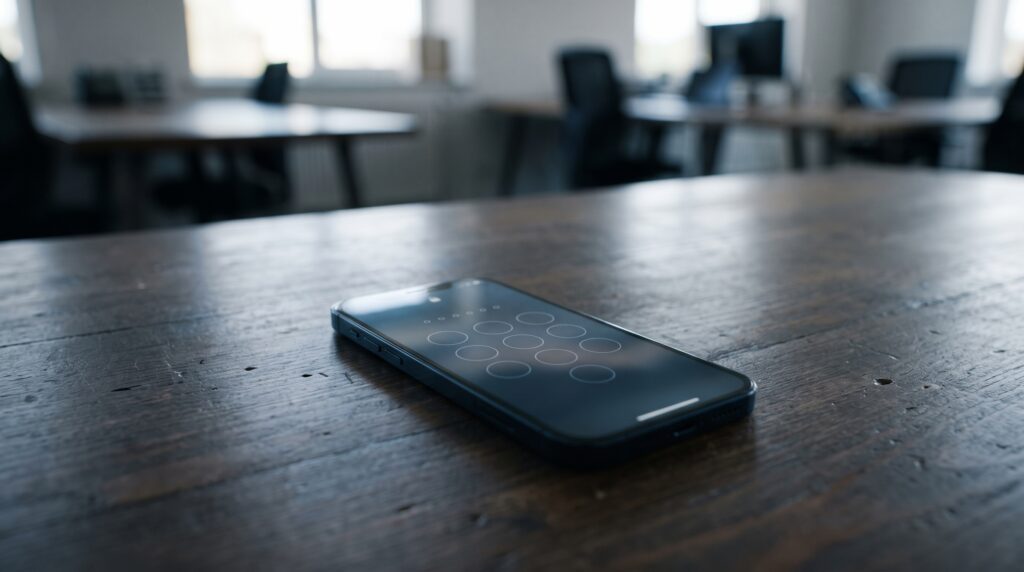
No. If Florida police ask for your passcode and have no warrant, you can refuse to give it, refuse to unlock the phone, and refuse to let them search it. A Florida appeals court has held that the prosecutor cannot use that refusal against you at trial. A search warrant lets police search the phone, but it does not order you to unlock it. For that, the State has to ask a judge, and Florida’s appeals courts disagree about whether a judge can force you to give a passcode. None has settled it for Miami-Dade.
What to Say and Do If Police Ask for Your Passcode
If you already unlocked the phone or gave the code, stop now, say nothing more, and call a lawyer.
- Say it clearly. “I do not consent to a search of my phone. I am invoking my right to remain silent, and I want a lawyer.” Then stop talking.
- Do not unlock the phone or type the code. Do not hand it over unlocked.
- Do not unlock it with your face or finger either. If police tell you to open the phone yourself, say you do not consent and that you want a lawyer. On an iPhone, Apple’s guide says that pressing and holding the side button and either volume button for 2 seconds turns Face ID off until the passcode is entered.
- Do not change or erase anything on the phone. Erasing or altering what is on it to keep it from police, once you know they are investigating, can be charged as tampering with evidence, a felony under Fla. Stat. § 918.13.
- If officers take the phone anyway, let them. Do not grab it back, pull away, or physically resist. Say again that you do not consent to a search, and stop there.
- Ask for a receipt. Ask for a property receipt that lists the phone, and keep it.
- Do not sign anything agreeing to a search. A signed consent form is consent.
- Do not lie about the phone. Saying nothing is protected. A false statement is not.
- Write it down as soon as you can. Note the officers’ names and badge numbers, the agency, the time and place, what they asked for, and what you said. Give it to your lawyer.
- Call a lawyer before any hearing. If the State asks a judge to force the passcode, you want a lawyer there.
If Police Ask Without a Warrant
Police need a warrant to search the data on your phone, even a phone taken during an arrest. The U.S. Supreme Court said officers must “get a warrant” first (Riley v. California, 2014). Officers can take the phone and hold it while they apply for one, but they cannot look through it on the spot without a warrant or a recognized emergency. Florida’s Constitution follows the U.S. Supreme Court’s Fourth Amendment rulings (Art. I, § 12).
You can say no when police ask to search or unlock your phone. In one Florida case, the prosecutor told the jury the defendant refused to give his PIN and refused a search. The appeals court reversed the conviction. It held that “a defendant has a constitutional right to refuse a request for a warrantless search” and that the State cannot present “evidence or argument that references a defendant’s invocation of either of these rights” (McRoberts v. State, Fla. 4th DCA 2022).
A DUI breath test is different. Florida law lets the State tell the jury you refused a breath test, and the Third District applied that rule in 2026. That law covers breath and chemical tests. It does not cover your phone.
If Police Have a Search Warrant
A search warrant lets police search the phone. It does not, by itself, order you to give the passcode or unlock the device. To force you, the State has to file a request, called a motion to compel, asking a judge to order you to give the passcode. The judge holds a hearing, and your lawyer can fight the request there.
The fight is over the Fifth Amendment privilege against self-incrimination, your right not to be a witness against yourself. Speaking or typing a passcode can count as testimony, because it shows you know the code and control the phone. The State’s main answer is a rule called the “foregone conclusion” doctrine. It says that if the government already knows what it would learn from you, making you hand it over adds “little or nothing,” so the Fifth Amendment does not protect it (Fisher v. United States, 1976). Florida’s appeals courts disagree about how that rule applies to a phone.
Face ID and Fingerprints
No Florida appeals court has decided whether police can force you to unlock a phone with your face or finger. The Stahl opinion suggested in passing that pressing a finger to a phone would not be protected, but that was not its holding.
Federal courts have started to draw a line. In one case, an officer pressed the defendant’s thumb to his phone, and the court held that act “required no cognitive exertion” and was not testimonial, meaning it did not count as testifying against himself (United States v. Payne, 9th Cir. 2024). In another, an FBI agent ordered one of the defendants, Peter Schwartz, to open his phone, and he did it with his thumb. The court held that this violated the Fifth Amendment because opening the phone “disclosed his control over the phone, his knowledge of how to access it” (United States v. Brown, D.C. Cir. 2025). The difference is who does the unlocking.
Where Florida’s Courts Stand
Florida’s district courts of appeal, the middle-level appeals courts, have split:
- Second District: the passcode can be forced. The court held that disclosing a passcode was not testimonial and that, in any event, the State had to show no more than that it knew “with reasonable particularity that the passcode exists, is within the accused’s possession or control, and is authentic” (State v. Stahl, 2016).
- Fourth District: the passcode is protected unless the State already knows what is on the phone. The court said “we disagree with the Second District’s Stahl opinion” and held that the State “must identify what evidence lies beyond the passcode wall with reasonable particularity” (G.A.Q.L. v. State, 2018).
- First District: the same as the Fourth. The court held that forced disclosure of a cellphone passcode is testimony the Fifth Amendment protects (Pollard v. State, 2019). In a later case, it left an order forcing the passcode in place because the State already knew in detail which files it was after (Varn v. State, 2020).
- Florida Supreme Court: no decision yet. The Court threw out a Fifth District ruling that had protected the passcode. It said the defendant had to wait and raise the issue on appeal after trial, and it said “it remains unsettled whether the Fifth Amendment protects a criminal defendant, subject to a duly-issued warrant, from being compelled to disclose a passcode to a smartphone” (State v. Garcia, 2022).
- Third District (Miami-Dade): no ruling. We have found no Third District decision on forced passcodes or on forced Face ID or fingerprint unlocking.
- Federal cases in Miami: these follow the Eleventh Circuit, which held in 2012 that forcing a suspect to decrypt files would be “tantamount to testimony,” meaning it counts as testifying about what he knows (In re Grand Jury Subpoena Duces Tecum Dated March 25, 2011, 11th Cir. 2012).
When Florida’s district courts of appeal agree, every trial judge in the state has to follow them. Here they disagree, and the Third District has not ruled, so a Miami-Dade judge can follow either side. The result depends on the judge and on how much the State already knows about what is on the phone (Pardo v. State, 1992).
If a Judge Orders You to Unlock Your Phone
The hearing on the State’s motion is where this is won or lost. If a judge orders you to give the passcode, you generally cannot appeal that order right away. You raise it on appeal after trial if you are convicted (Garcia). The State, by contrast, has asked an appeals court to review a trial judge’s refusal to force a passcode, as it did in Stahl. Refusing a court order can lead to a contempt charge. Decide with your lawyer whether to obey the order and how to keep your objection on the record for appeal.
Since July 1, 2026, police must return a Florida warrant for a phone within 365 days. If they seized the phone within 10 days after the warrant issued, they can keep reviewing its data after that deadline. See our post on Florida’s search warrant deadlines.
For more on your rights when police question you, see whether police must read you your rights and why to call a lawyer before an arrest. If you are recording police, see our post on whether you can record the police in Florida. Police can also get data without your phone at all; our post on whether AI chats can be used against you in court explains how warrants to providers work. If you were just arrested, our guide on what to do if you are arrested in Miami-Dade County covers the first steps. For help with a case, see our criminal defense page. If police come to your door, see whether you have to open the door for police in Florida.
Sources: Riley v. California, 573 U.S. 373 (2014); Fisher v. United States, 425 U.S. 391 (1976); State v. Garcia, No. SC20-1419 (Fla. Oct. 27, 2022); State v. Stahl, 206 So. 3d 124 (Fla. 2d DCA 2016); G.A.Q.L. v. State, 257 So. 3d 1058 (Fla. 4th DCA 2018); Pollard v. State, 287 So. 3d 649 (Fla. 1st DCA 2019); Varn v. State, No. 1D19-1967 (Fla. 1st DCA 2020); McRoberts v. State, No. 4D19-2060 (Fla. 4th DCA 2022); In re Grand Jury Subpoena Duces Tecum Dated March 25, 2011, 670 F.3d 1335 (11th Cir. 2012); United States v. Payne, No. 22-50262 (9th Cir. 2024); United States v. Brown, No. 23-3074 (D.C. Cir. 2025); Pardo v. State, 596 So. 2d 665 (Fla. 1992); Fla. Const. art. I, § 12; Fla. Stat. § 918.13; Apple iPhone User Guide, “Use Face ID on iPhone.”
Quick Answers
Do I have to give police my phone passcode in Florida?
No. Without a warrant, you can refuse to give the passcode, refuse to unlock the phone, and refuse to let police search it. Police need a court order to force a passcode, and no appeals court has settled for Miami-Dade whether a judge can issue one.
Can my refusal to unlock my phone be used against me?
No, under a Florida appeals court decision. The court reversed a conviction because the prosecutor told the jury the defendant refused to give his PIN and refused a search (McRoberts v. State, Fla. 4th DCA 2022). A DUI breath-test refusal is treated differently.
Can police search my phone without a warrant?
Generally no. Police need a warrant to search the data on a phone, even one taken during an arrest, unless there is an emergency. They can hold the phone while they apply for the warrant (Riley v. California).
Does a search warrant mean I have to unlock my phone?
No. A warrant allows police to search the phone but does not order you to unlock it. The State has to file a separate motion asking a judge to force the passcode, and the judge holds a hearing on that motion.
Can a Florida judge order me to give my passcode?
Florida courts disagree. The Second District has allowed it, the First and Fourth Districts protect the passcode unless the State already knows what is on the phone, the Florida Supreme Court has called the question unsettled, and the Third District, which covers Miami-Dade, has not ruled.
Can police make me unlock my phone with Face ID or my fingerprint?
No Florida appeals court has decided it. Federal courts have treated police pressing your thumb to the phone differently from ordering you to unlock it yourself, which one court held violated the Fifth Amendment. A passcode you have to speak or type has stronger protection.
What should I say if police ask for my passcode?
Say: “I do not consent to a search of my phone. I am invoking my right to remain silent, and I want a lawyer.” Then stop talking. Do not unlock the phone, do not grab it back if officers take it, ask for a receipt for it, and call a lawyer.
The first consultation is free and confidential, with no obligation to retain.
Last updated: November 14, 2026.