
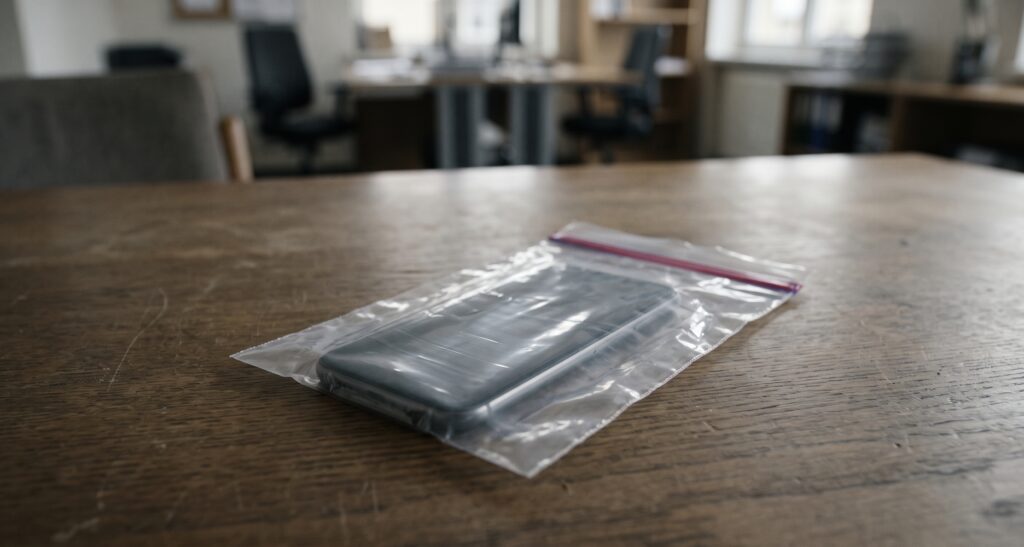
If police took your phone or computer under a search warrant in Florida, two dates now decide most timing challenges: the day the judge signed the warrant and the day police took the device. Since July 1, 2026, HB 359, now Chapter 2026-177, Laws of Florida, treats a device warrant as on time if police seized the device within 10 days after the judge signed it, gives them up to 365 days to return the warrant, and does not require the forensic review of the data to be finished within any deadline. A warrant to search a home, a car, or other physical property still has to be carried out within 10 days, and a search that starts after day 10 is invalid under long-standing Florida case law. The Legislature rewrote Fla. Stat. § 933.05 after a 2025 appeals court decision threw out a case because police searched seized devices after the 10-day window closed.
If Police Took Your Phone or Computer
HB 359 added two subsections for devices. Under § 933.05(3), a device warrant “is considered timely executed” if the device was seized “within 10 days of the issuance of the search warrant, not including the date of issuance.” Under § 933.05(4), police do not have to complete the analysis or review of the data within the return period if the device was seized on time.
For a device warrant issued on or after July 1, 2026, the question that decides a timing challenge is no longer when the forensic examiner opened the phone. It is when police seized the device, and whether the warrant was returned within 365 days. If the phone was seized within 10 days after the warrant was signed, § 933.05(4) does not require police to finish reviewing the data within the 365-day return period.
Several points remain open under the new text:
- A phone police already had. The 2025 version covered a device “in the actual possession of a law enforcement agency at the time such warrant is issued.” The 2026 version deletes that language. Subsection (3) speaks of a device seized within 10 days of the warrant, and it does not say how it applies to a phone taken at arrest, before any warrant existed. That was the situation in Moschella, and no Florida appeals court has decided it under the new text.
- Warrants signed before July 1, 2026. The act does not say whether the new periods reach warrants issued before its effective date.
- Weekends and holidays. The statute now excludes the day of issuance but does not say whether a deadline that falls on a weekend or holiday moves to the next business day, and no court has decided whether Rule of General Practice and Judicial Administration 2.514 fills that gap.
- Missing the new 20-, 30-, or 365-day deadlines. No court has yet addressed what follows when one of the new longer deadlines is missed.
HB 359 does not change the other grounds for challenging a device search: whether the affidavit showed probable cause, whether the warrant described the data to be searched with enough particularity, and whether the search stayed within what the warrant allowed.
Home and Car Searches: The 10-Day Rule Still Applies
For a warrant to search a house, an apartment, a car, or a business, nothing in HB 359 extends the 10 days. Florida courts have long read § 933.05 to require the warrant to be executed within that period. In Spera v. State, 467 So. 2d 329 (Fla. 2d DCA 1985), police searched a house 13 days after the warrant issued, and the court held that “a search warrant in Florida becomes stale ten days after its issuance” and that a stale warrant “requires suppression of any evidence seized.” Police who cannot search within the 10 days have to go back to the judge for a new warrant. State v. Lewis, 605 So. 2d 590 (Fla. 2d DCA 1992), applied the same reading.
Late paperwork is treated differently. In State v. Featherstone, 246 So. 2d 597 (Fla. 3d DCA 1971), a decision from the appeals court that covers Miami-Dade, police searched within the 10 days but filed the return late. The court held that “the warrant does not become void because of an improper or late return where there is no prejudice shown.” A search done on time survives a late return unless the defense shows the delay hurt the case.
The Deadlines and How the Days Are Counted
A warrant is issued when the judge signs it, under § 933.07(4), and the day of signing is not counted. A warrant signed on November 2 makes November 3 day 1 and November 12 day 10.
Under amended § 933.05(2), a search warrant “must be returned within 10 days after issuance, not including the date of issuance,” with three exceptions:
- 20 days for a warrant served on an out-of-state provider for electronic communications data under § 934.23, such as account records held by a technology company outside Florida.
- 30 days for a warrant to take DNA specimens, including blood and saliva samples.
- 365 days for a computer, a computer system, or an electronic device, “and any data or information contained” in it.
What to Do If Police Searched Your Home, Phone, or Car
- Keep the paperwork. Under § 933.11, the officer must give a copy of the warrant, a detailed written inventory of what was taken, and a receipt to the person named in the warrant or the person in charge of the premises, and must leave the receipt there if no one is present. Under § 933.13, the judge must give a copy of the inventory to the person whose property was taken on request.
- Write down the dates. Note when police came, what they took, and whether a phone or computer was taken that day or earlier. Your lawyer will compare those dates with the date the judge signed the warrant.
- Do not give passcodes or answer questions without a lawyer. A warrant authorizes the search it describes. It does not require you to help.
- Raise timing early. A challenge to an untimely search is made by a motion to suppress under Fla. R. Crim. P. 3.190(g), and it depends on dates that come from the warrant, the return, and the property records.
- Federal warrants follow federal rules. A federal search warrant is governed by Rule 41, which allows 14 days to execute and permits later off-site review of electronic data.
Why the Legislature Changed the Law
Before 2025, § 933.05 required a search warrant to be returned within 10 days after issuance. In April 2025, the Second District Court of Appeal decided Moschella v. State, 413 So. 3d 851 (Fla. 2d DCA 2025). Police there had seized a defendant’s phones, tablet, and laptop, obtained a warrant to search them, and did not run the forensic search until after the 10-day period. The trial court found no prejudice to the defendant. The appeals court held that the statute’s plain language controlled, that the warrant was stale, and that the search was invalid, and it reversed the judgment and sentences and sent the case back for dismissal of the charges. The Legislature responded that session by giving police 45 days to return a warrant for a device already in police custody when the warrant issued, effective July 1, 2025.
HB 359 goes further than the 2025 fix. The House staff analysis describes the model the bill follows: other states “generally require the initial seizure of an electronic device to occur within a specified time period, but authorize subsequent data extraction or analysis of the device to be conducted after the search warrant time limitation has lapsed.” Federal Rule of Criminal Procedure 41 works the same way for federal warrants.
The bill passed the House 115-0 and the Senate 37-0, was approved by the Governor on June 26, 2026, and took effect July 1, 2026.
Other Changes in HB 359
- Warrants by video. A judge may let an officer apply for a search warrant by audio-video link under new § 933.07(5) and § 934.025. The requirements of probable cause, a sworn affidavit, and particular description stay the same.
- Recovering a body. New § 933.02(6) allows a warrant “to recover a deceased body.”
- Drones. A drone warrant may now cover “an area or areas where evidence that a crime was committed might reasonably be found,” under § 934.50(4)(b). Evidence from drone surveillance outside the statute’s exceptions is still inadmissible under § 934.50(6).
See our posts on when police can search your car without a warrant and whether AI chats can be used against you in court, and our Miami-Dade criminal case timeline for where a motion to suppress fits in a case.
Sources: Chapter 2026-177, Laws of Florida (CS/HB 359); Fla. Stat. § 933.05 (2026); Fla. Stat. §§ 933.02, 933.07, 933.11, 933.13, 934.025, 934.50; House of Representatives Final Bill Analysis, CS/HB 359 (June 29, 2026); Moschella v. State, 413 So. 3d 851 (Fla. 2d DCA 2025); Spera v. State, 467 So. 2d 329 (Fla. 2d DCA 1985); State v. Lewis, 605 So. 2d 590 (Fla. 2d DCA 1992); State v. Featherstone, 246 So. 2d 597 (Fla. 3d DCA 1971).
Quick Answers
How long do Florida police have to execute a search warrant?
For a home, car, or other physical place or object, 10 days after the judge signs it, not counting the day it was signed. A search that starts after day 10 is invalid under Florida case law, and police need a new warrant. For a phone or computer, the device must be seized within 10 days, and the warrant can be returned up to 365 days after issuance.
When does the 10-day clock on a Florida search warrant start?
The day after the judge signs the warrant. The day of signing is not counted, so a warrant signed on November 2 reaches day 10 on November 12.
What did HB 359 change?
Effective July 1, 2026, it amended Fla. Stat. § 933.05 to exclude the day of issuance from the 10-day count and to add longer return periods: 20 days for out-of-state provider data, 30 days for DNA specimens, and 365 days for computers and electronic devices. It also lets police finish reviewing device data after the return period if the device was seized on time.
Can police search my phone months after taking it?
Under a warrant issued on or after July 1, 2026, if the phone was seized within 10 days after the warrant was signed, the statute does not require police to finish reviewing the data within the 365-day return period. How the new law applies to a phone police took before the warrant was signed has not been decided by a Florida appeals court.
What happens if police search my house after the warrant expired?
Under Spera v. State, a warrant becomes stale 10 days after issuance, and evidence from a search on a stale warrant must be suppressed. The defense raises it with a motion to suppress.
Does a late return of the warrant make the search illegal?
Not by itself. Under State v. Featherstone, a decision of the Third District Court of Appeal, a warrant executed on time does not become void because of a late return unless the defense shows prejudice.
Can a judge approve a search warrant by video?
Yes. Since July 1, 2026, a judge may allow an officer to apply remotely by audio-video communication. The warrant still requires probable cause supported by a sworn affidavit and a particular description of what will be searched and seized.
How do I get a copy of what police took?
The officer must give a copy of the warrant and a written inventory of the property taken to the person named in the warrant or the person in charge of the premises. Under Fla. Stat. § 933.13, the judge must also provide a copy of the inventory to the person whose property was taken on request.
Do these deadlines apply to federal search warrants?
No. Warrants issued by federal judges follow Federal Rule of Criminal Procedure 41, which allows up to 14 days to execute a warrant and permits later off-site review of seized electronic data.
The first consultation is free and confidential, with no obligation to retain.