
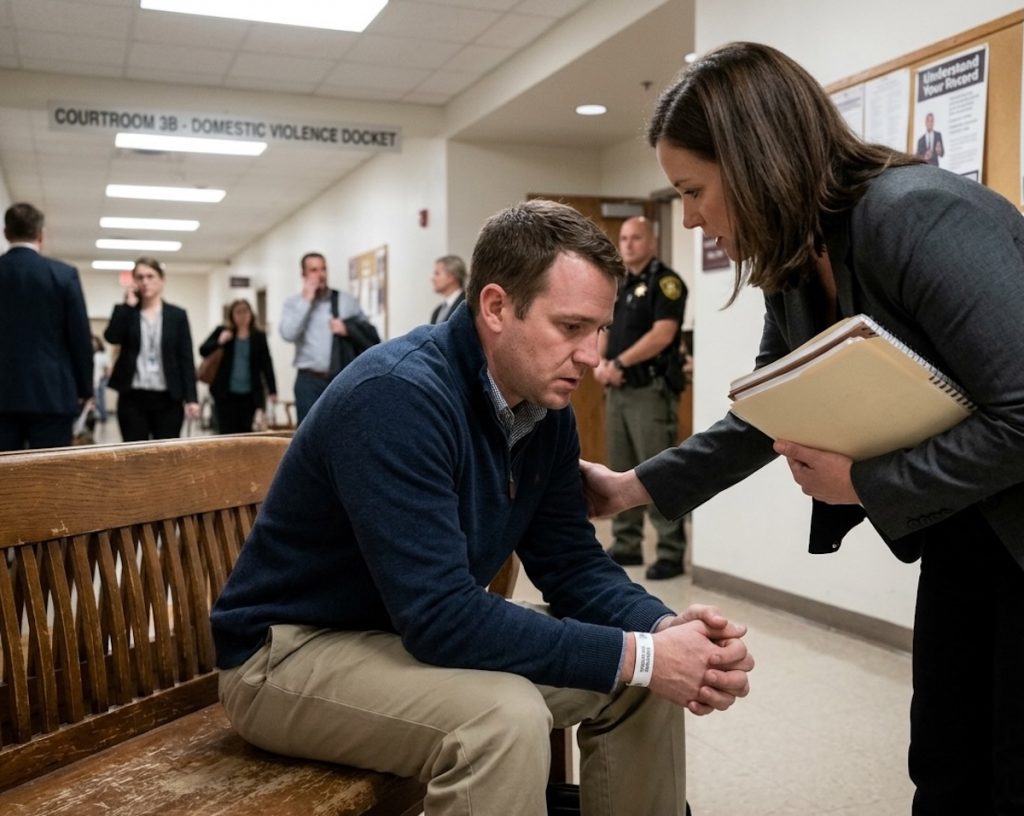
If you are falsely accused of domestic violence in Florida, do not contact the accuser, do not delete anything, and do not talk to police without a lawyer. Expect to be held in jail until a judge sets bail at first appearance (Fla. Stat. § 741.2901(3)) and to face a possible no-contact order as a release condition (§ 903.047(1)(b)). Before any plea, know that a guilty or no contest plea to domestic battery can never be sealed or expunged (§ 943.0584(2)(f)).
False accusations surface most in divorces, custody battles, breakups, and disputes between family members or roommates. Florida law requires every state attorney to adopt a pro-prosecution policy for domestic violence and lets prosecutors proceed over the alleged victim’s objection (Fla. Stat. § 741.2901(2)), so the work of sorting out what happened shifts to the courtroom after the arrest.
Answers to Your Questions
Why do false domestic violence accusations happen?
False domestic violence accusations tend to arise where someone has a strong reason to gain an advantage over the accused or to strike back. The most common patterns:
- Divorce proceedings, where an accusation can affect alimony, asset division, and access to the marital home
- Custody disputes, where an accusation can change parenting time and decision-making rights overnight
- Breakups, where anger or hurt drives retaliation
- Roommate or family conflicts that escalate into police involvement
- Mental health or substance issues that distort a person’s account of what happened
Florida arrests first and sorts out the facts later, so preserved evidence and careful early decisions carry great weight when an accusation is untrue.
What should I do in the first 24 hours after a false accusation?
In the first 24 hours, stay away from the accuser, preserve every message, find another place to stay if a no-contact order issues, do not retaliate, and call a lawyer before talking to police. These rules apply whether you have been arrested or just learned that an accusation has been made.
- Do not contact the accuser. That means no phone calls, texts, social media, email, or in-person contact, including through friends or family or under the guise of “just clearing things up.” If a no-contact order has been issued after an arrest for assault, battery, stalking, or another violent offense, willful contact is a separate crime under Fla. Stat. § 903.0472, even contact that seems harmless.
- Do not delete anything. Texts, voicemails, emails, photos, location data, social media history. Deleted evidence looks terrible to a judge and can become a separate charge. Even messages that seem damaging can have context that helps you.
- Find somewhere else to stay if a no-contact order is issued. Many no-contact orders prohibit returning to a shared residence, even if the home is in your name or you pay the rent. Violating that is a separate crime.
- Do not retaliate. Filing a counter-accusation, posting on social media, or speaking publicly about the case almost always hurts your defense. The place to make your case is the courtroom, not the internet or the neighborhood.
- Contact an attorney before talking to police. You have the right to remain silent. Use it. Detectives sometimes ask to “hear your side” before charges are filed. That conversation is rarely as helpful as it sounds.
What does a Florida no-contact order require?
A Florida no-contact order bars all contact with the alleged victim, in person or through anyone else, and keeps you 500 feet from the victim’s home (even a shared one), vehicle, and workplace unless the court orders otherwise (Fla. Stat. § 903.047(1)(b)). A person arrested for a domestic violence offense in Florida must be held in custody until brought before a judge for bail at first appearance (Fla. Stat. § 741.2901(3)). The judge there decides whether to enter a no-contact order as a condition of release; Florida law does not make the order automatic (Fla. Stat. § 903.047(1)(b)). See our full Bail and Bond Guide for how bond works differently in domestic violence cases. The order takes effect immediately and stays in place until a judge modifies or dismisses it.
What that means in practice:
- You cannot communicate with the alleged victim in any way, for any reason
- You cannot return to a shared residence to retrieve belongings without court permission
- You may be restricted from seeing your children if they are named in the order
- The judge can add a condition barring you from possessing firearms while you are on pretrial release (Fla. Stat. § 903.047(1)(c)6.)
- The order is part of the court file in your criminal case, which is a public record
These restrictions apply whether the underlying accusation is true or false. Fighting the order requires a separate motion and a hearing. Until the judge modifies or dismisses it, the order is the rule.
What evidence helps defend against a false accusation?
The evidence that helps most is anything recorded at the time: messages, call logs, photos, location data, and witnesses. Preserving evidence early is one of the most useful things you can do before an attorney is involved.
- Text messages and emails. Especially anything showing the relationship before the accusation, the accuser’s tone, indications of motive (custody, finances, jealousy), or contradictions between what the accuser is now saying and what they said before
- Voicemails and call logs. Back them up to a cloud drive your attorney can access. Phones break. Accounts get locked.
- Photos and videos. Of the residence, of yourself showing the absence of injuries an accuser may later claim you caused, of the accuser if their condition contradicts the allegation
- Witnesses. Anyone who was nearby. Even people who saw and heard nothing can support that nothing notable happened.
- Location data. Phone GPS, app history, work badge records, security cameras, anything that places you somewhere other than where the alleged incident happened
- Prior history. If the accuser has made similar allegations before and dropped them, or has made allegations against other people, that history counts and your attorney can pursue it
What mistakes hurt a false accusation defense?
The mistakes that hurt most are contacting the accuser through someone else, posting on social media, filing a counter-accusation, talking to police without a lawyer, and counting on a recantation to end the case.
- Contacting the accuser through a third party. “Just tell her I’m sorry” through a mutual friend can be charged the same as direct contact under a no-contact order.
- Posting on social media. Any post about the accuser, the case, or the situation becomes evidence. Posts from sympathetic friends and family members can also be subpoenaed.
- Filing a counter-accusation. Even when justified, a counter-accusation filed in the heat of the moment can look retaliatory and complicate the defense. Talk to an attorney before filing anything.
- Giving a statement to police without counsel. Officers are trained to ask questions in ways that produce admissions. There is no scenario where talking without an attorney is better than waiting for one.
- Assuming a recantation will end the case. Florida prosecutors can and commonly do proceed with domestic violence cases over the alleged victim’s objection. The state, not the accuser, decides whether to drop charges (Fla. Stat. § 741.2901(2)).
How do false domestic violence accusations get resolved?
False domestic violence accusations end through a motion to dismiss, pretrial diversion, a plea, or a trial:
- Motion to dismiss at an early stage, when the evidence is thin enough that the case cannot move forward. Less common than people hope, but possible in cases with weak physical evidence and credibility problems on the accuser’s side.
- Pretrial diversion in some jurisdictions for first-time accusations, where the charge is dismissed after completion of a program. Whether this is the right outcome for someone who was falsely accused is a separate strategic question.
- Plea negotiations to reduced charges. This can be the practical compromise even when the underlying accusation was false, because the alternative is trial risk. Before accepting any plea, know that a guilty or no contest plea to assault or battery of a family or household member can never be sealed or expunged by court order in Florida, even if adjudication is withheld (Fla. Stat. § 943.0584(1), (2)(f)). Under Missy’s Law, a plea or guilty verdict on any act of domestic violence also requires the judge to remand you to custody immediately, with no bond, until sentencing (Fla. Stat. §§ 903.04721, 907.041(5)(a)18.).
- Trial when the prosecution will not drop the case and the defendant is not willing to plead. Trials in domestic violence cases turn heavily on credibility, which is why preserved evidence and disciplined early decisions carry so much weight.
Are there consequences even if the charges are dismissed?
Yes, a domestic violence arrest stays on your Florida record even after the charges are dismissed, until a court seals or expunges it. Consequences that can follow the arrest:
- Background checks for employment, housing, and professional licensing will show the arrest unless the record is sealed or expunged
- A final injunction for protection against domestic violence, stalking, or cyberstalking bars possessing firearms or ammunition under Florida law (Fla. Stat. § 790.233). Federal law bars firearms for a person under a protective order entered after a hearing with notice that meets its other requirements (18 U.S.C. § 922(g)(8)) and for a person convicted of a misdemeanor crime of domestic violence (18 U.S.C. § 922(g)(9))
- Immigration consequences for non-citizens can include detention, denial of green card renewal, and deportation, sometimes even when charges are ultimately dismissed
- Family court judges in custody disputes can consider an arrest itself, not just a conviction
- Reputation damage in employment, social, and family settings that no court order can erase
For these reasons, fighting an unfounded accusation through to dismissal or acquittal, then pursuing expungement or record sealing, is the path that fully clears a record. An attorney experienced in both criminal defense and post-disposition relief can plan both stages from the start.
What should I do if I need help with a false accusation?
The Law Offices of Andre A. Rouviere has handled domestic violence cases in Miami-Dade County since 1992. The firm is a boutique practice by design, and Andre Rouviere is the attorney on the cases it accepts.* Initial consultations are free and confidential, with no obligation to retain.
If you or a family member has been accused of domestic violence, contact us at (305) 774-7000 or visit our contact page. The earlier we are involved, the more options exist.
Sources
- Fla. Stat. § 741.2901 (2026)
- Fla. Stat. § 903.047 (2026)
- Fla. Stat. § 903.04721 (2026)
- Fla. Stat. § 907.041 (2026)
- Fla. Stat. § 790.233 (2026)
- Fla. Stat. § 943.0584 (2026)
- 18 U.S.C. § 922
Last updated: .