
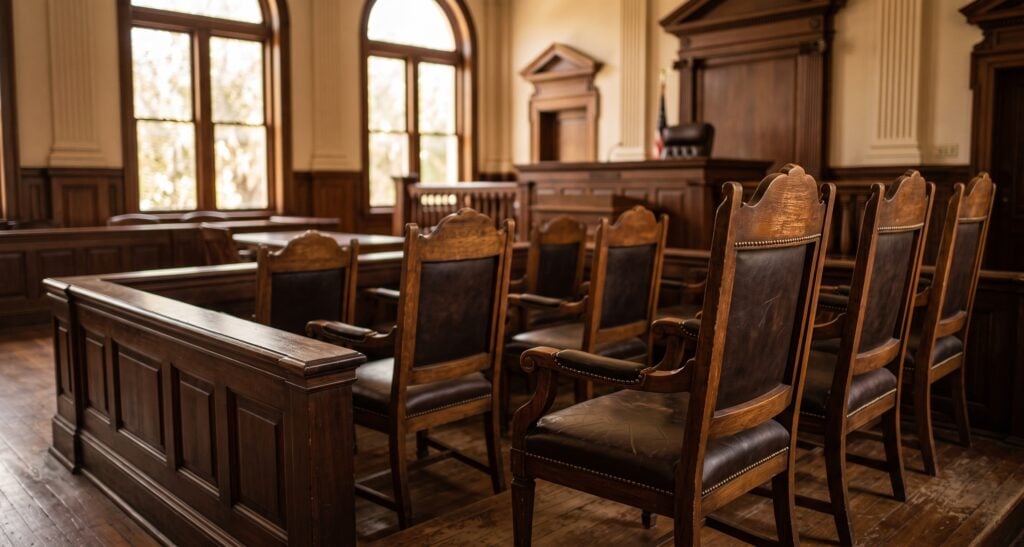
Every person charged with a serious crime in Florida has the right to a jury trial. Far fewer people know they can give that right up and have a judge alone decide the case instead, or that the decision between the two is not always theirs to make.
Questions About Jury Trials and Bench Trials in Florida
What’s the difference between a jury trial and a bench trial?
In a jury trial, a panel of citizens hears the evidence and decides whether the State proved its case beyond a reasonable doubt. In a bench trial, there is no jury at all. A single judge hears the evidence and decides both the facts and the law, taking on the role a jury would otherwise fill.
Does everyone charged with a crime in Florida have the right to a jury trial?
Not automatically for the most minor charges. Florida Statute § 918.0157 allows the court to remove the jury right for a misdemeanor punishable by six months or less, but solely if the judge announces before trial that a conviction will not be entered and jail time will not be imposed if the defendant is found guilty. When that certification is made, the case proceeds as a non-jury trial instead. This comes up most frequently with second-degree misdemeanors, which carry a maximum of 60 days in jail.
Can I choose a bench trial instead of a jury trial in Florida?
Solely with the State’s agreement. Under Florida Rule of Criminal Procedure 3.260, a defendant can waive the right to a jury trial in writing, but the State must consent to that waiver. If the prosecutor objects, the case proceeds to a jury regardless of what the defendant wants. There is no independent right to a bench trial in Florida, just a right to a jury trial that can be waived with the other side’s agreement. Capital cases are the exception: bench trials are generally not available at all when the death penalty is on the table.
How many jurors are in a Florida criminal trial?
Six, in cases where a jury trial applies. Under Florida Statute § 913.10 and Rule of Criminal Procedure 3.270, Florida uses six-person juries for felony and jury-eligible misdemeanor cases, with capital felonies as the exception that requires twelve. Florida is one of a small handful of states that uses six jurors as the standard, a practice the U.S. Supreme Court upheld in Williams v. Florida.
Does a jury verdict have to be unanimous in Florida?
Yes. All six or twelve jurors must agree on the verdict. The U.S. Supreme Court confirmed this requirement nationwide in Ramos v. Louisiana, striking down state laws that had allowed non-unanimous convictions.
Is a bench trial faster than a jury trial?
Generally, yes. A bench trial skips jury selection, which can take hours or days by itself, along with the formal jury instructions and deliberation process. That speed is one reason a defendant might request one, though speed alone is rarely the deciding factor in whether a bench trial is the right strategic choice. See our full Criminal Case Timeline for where trial fits into the overall process.
When would a bench trial make sense instead of a jury trial?
Bench trials tend to fit cases built around a narrow legal question rather than a factual dispute, or where a case is being tried to preserve an issue for appeal. Where the case turns on contested facts, disputed witness credibility, or circumstantial evidence a group of jurors would need to weigh, a jury trial is generally the stronger choice.
Can I change my mind after waiving a jury trial?
Not automatically. Once a jury trial waiver is made, Florida’s rule committee has noted that withdrawing it is left to the trial judge’s discretion rather than governed by an automatic right to reverse course. That makes the decision to waive a jury trial one to get right the first time, not one to treat as reversible if a case starts to look different once a bench trial is underway.
Why the Right to a Jury Trial Exists
The right to a jury trial in a criminal case comes from both the Florida Constitution and the U.S. Constitution. Article I, Sections 16 and 22 of the Florida Constitution guarantee it, alongside the Sixth Amendment. The U.S. Supreme Court has held that this right applies to any offense carrying a potential sentence of more than six months in jail, which covers the overwhelming majority of criminal charges in Florida.
The idea behind the right is simple. A jury places ordinary citizens, not a single government official, between the accused and the power of the State. That structure is built into the system so that one person’s judgment is not the sole thing standing between a defendant and a conviction.
How a Jury Waiver Works
Giving up a jury trial is not as simple as telling a judge you would rather skip it. Rule 3.260 requires the waiver to be in writing, and Florida courts have been direct about what has to happen before that waiver is valid. In Saini v. State, decided in 2025, Florida’s First District Court of Appeal confirmed the waiver must be made knowingly, intelligently, and voluntarily, on the record, with the defendant fully understanding what right is being given up and what the consequences are. A waiver made without that understanding, or made under pressure, does not hold up.
Even a properly executed waiver is not the end of the analysis. The prosecutor has to agree to it. If the State wants the case in front of a jury, it can object to the waiver, and the case goes to trial by jury regardless of the defendant’s preference. This works the same way in reverse for jury size in capital cases: a defendant can ask to be tried by a six-person jury instead of the twelve normally required, but the request needs both the defendant’s knowing waiver and the State’s agreement.
Why a Bench Trial Is a Legitimate Choice
A bench trial is a legitimate, established option that carries no signal about the strength of the case. The choice requires agreement: the path to a bench trial runs through a defined procedural process, and the State has a real say in whether that door is open at all. Which option fits a given case depends on the charge, the evidence, and the strategy behind the defense.
If You Are Deciding Between a Jury Trial and a Bench Trial
Whether a jury trial or a bench trial is the stronger path depends on the facts of the case, the charge, and what the evidence looks like. If you are facing this decision, call me directly. Calls reach me, Andre Rouviere, not an intake center, and the first consultation is free with no obligation to hire the firm. If it’s after hours or the weekend, the office keeps a 24-hour answering service. See our full Criminal Defense page for how the firm approaches cases headed toward trial.
Last reviewed: September 2026. Reflects Saini v. State (Fla. 1st DCA 2025) and current Fla. R. Crim. P. 3.260 and 3.270.