
Frequently Asked Questions
What does SB 212 restrict?
Florida’s SB 212, now Chapter 2026-17, Laws of Florida, amends Fla. Stat. § 775.215 to prohibit a person convicted of specified sexual offenses involving a victim younger than 16 from residing within 1,000 feet of a public swimming pool, effective July 1, 2026. That distance already applied to schools, child care facilities, parks, and playgrounds. Public swimming pools are now on that same list, and the definition of what counts as a pool is broader than most people would guess.
What counts as a “public swimming pool” under this law?
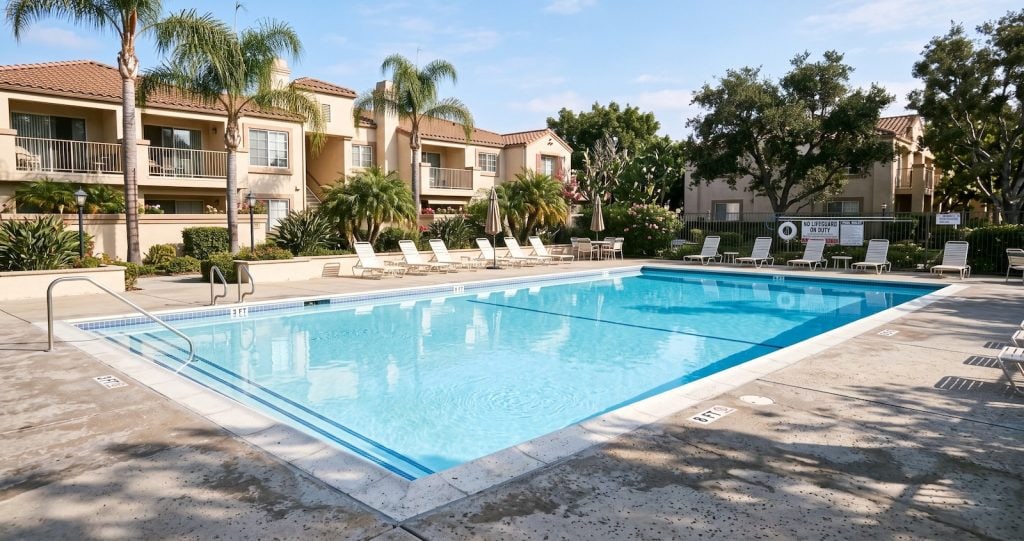
Far more than a community pool at a park. The law defines it to include conventional pools, spas, wading pools, splash pads, and other water recreation attractions used by the public, whether free or paid. That definition directly includes pools operated by or serving subdivisions, apartment complexes, condominiums, mobile home parks, and townhouses, not just government-run facilities. An apartment complex pool counts.
Does a withheld adjudication still count under this law?
Yes. The residency restriction applies regardless of whether adjudication was withheld on the underlying offense. A prior case resolved without a formal conviction on paper can still trigger this restriction. See our full Legal Terms Glossary for how a withhold of adjudication differs from a conviction in other contexts.
Does this apply to people already registered before July 1, 2026?
It can. The new pool restriction applies to offenses occurring on or after July 1, 2026, but it also applies to a person already subject to existing residency restrictions if that person changes their permanent residence on or after that date. Someone already on the registry who moves after July 1 now has to account for public pools when choosing a new address, even though their underlying offense predates this law.
Are people on probation or community control subject to additional restrictions?
Yes, and the age threshold is different. A person on probation, community control, or conditional release for a specified sexual offense involving a victim under 18 cannot live within 1,000 feet of a public swimming pool, work or volunteer at one, or visit one without prior approval from their supervising officer. This is separate from, and broader than, the residency restriction that applies based on conviction alone.
What changed for loitering and prowling near children?
The restricted distance increased from 300 feet to 500 feet of places where children congregate. This is a separate provision from the residency restriction and applies to the act of loitering or prowling, not just where someone lives.
What happens if I already live somewhere and a pool is built nearby later?
The law includes a grandfather protection. A person is not in violation, and cannot be forced to relocate, if they are already living in a residence that met the requirements at the time and a school, child care facility, park, playground, or public swimming pool is later established within 1,000 feet. The restriction looks at where someone establishes residency, not what gets built around them afterward.
If this affects you or someone you know
Violating this residency restriction carries a separate criminal penalty from the underlying offense, and the severity depends on how that original conviction was classified. If the underlying offense was a felony of the first degree or higher, a violation is a third-degree felony. If the underlying offense was a felony of the second or third degree, a violation is a first-degree misdemeanor. Anyone on the sexual offender or sexual predator registry who is considering a move should confirm a new address before signing a lease or closing on a home, not after. See our Sex Crimes Defense page for how these cases are handled in Miami-Dade.
The first consultation is free and confidential, with no obligation to retain.