
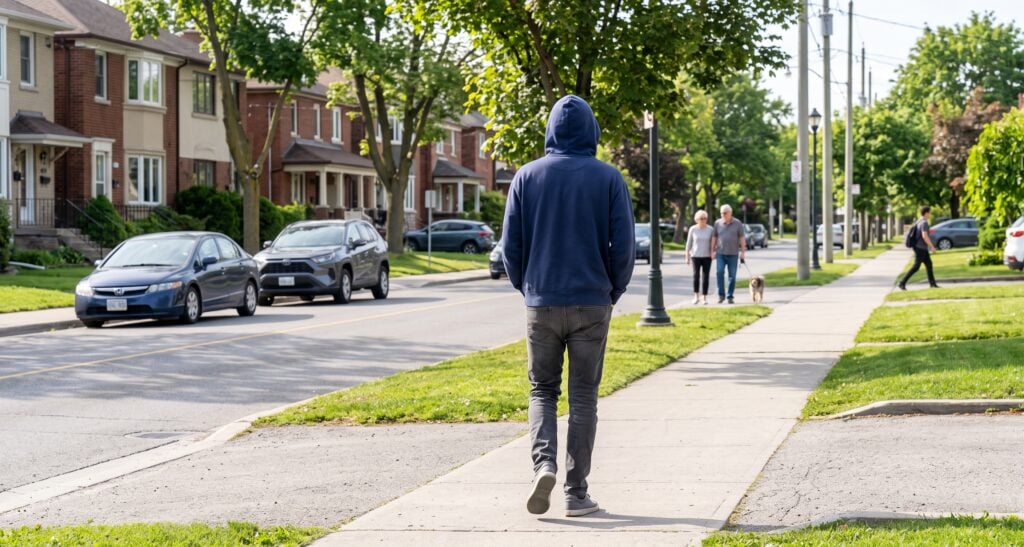
Florida has a law on the books making it illegal to wear a mask or hood in public: Fla. Stat. Section 876.12. Many people assume this means wearing a hoodie, a ski mask on a cold day, or a Halloween costume outside is against the law. It is not, at least not by itself. Another statute, Fla. Stat. Section 876.155, limits when Section 876.12 applies, and the limits carry as much weight as the underlying rule.
- Fla. Stat. Section 876.12 prohibits wearing a mask, hood, or device that conceals identity on a public way
- The law applies to people over 16 years of age alone
- Fla. Stat. Section 876.155 limits the statute to situations involving particular intent, not mere concealment
- The prohibited intents include depriving someone of equal protection, intimidating a person exercising a legal right, or harassing another person
- A related statute, Fla. Stat. Section 876.15, addresses wearing a mask or hood at a demonstration or meeting
- A person with a valid concealed weapons license can generally wear a mask while carrying, provided none of the prohibited intents apply
Frequently Asked Questions
What does Florida’s mask and hood law prohibit?
Fla. Stat. Section 876.12 states that no person over 16 years of age may wear any mask, hood, or device concealing their identity while on a public way, including a lane, walk, alley, street, road, or highway. Read on its own, the statute appears to ban any face covering in public. The statute dates to 1951 and was originally enacted in response to Ku Klux Klan activity, where the mask itself was part of an intimidation tactic.
Does wearing a hoodie or a mask in public violate this law?
Not by itself. Another statute, Fla. Stat. Section 876.155, added in 1981, directly limits when Section 876.12 can be enforced. The limitation applies if the person wore the mask, hood, or device with one of three particular intents alone. Those are: to deprive any person or class of persons of equal protection under the law, to injure, intimidate, or interfere with someone exercising a legal right, or to intimidate, threaten, abuse, or harass another person. Ordinary concealment, whether for warmth, privacy, costume, or health, does not fall within these categories.
Why was Fla. Stat. Section 876.155 added to the mask law?
Section 876.155 was added after a constitutional challenge to the original, broader mask prohibition. Read without limitation, a ban on all face coverings in public raises real free expression and due process concerns. The Legislature responded by narrowing the statute’s application to the particular intent-based circumstances described above, rather than repealing it outright.
How does this law interact with wearing a mask while carrying a concealed weapon?
Florida law generally allows a person with a valid concealed weapons or firearm license to carry while wearing a mask, hood, or other covering. See our full Weapon Charges Defense page for how Florida’s concealed carry rules work more broadly. This holds as long as none of the prohibited intents under Section 876.155 apply. The mask and the firearm are separate legal questions. What counts under this statute is the intent behind wearing the covering, not the fact of concealment itself or the presence of a weapon.
Is there a different law for wearing a mask at a demonstration or meeting?
Yes. Fla. Stat. Section 876.15 addresses wearing a mask, hood, or other device at a demonstration or meeting, distinct from the general public-way provision in Section 876.12. Both statutes are limited by the same intent-based framework in Section 876.155.
What does this mean if I am facing a charge under Florida’s mask law?
A charge under Section 876.12 turns almost entirely on intent, not on the simple fact of wearing a mask or hood. Whether the state can prove one of the particular, narrow intents defined in Section 876.155 is commonly the central question in the case. See our full Criminal Defense page for how the firm approaches cases built on proving intent.
The first consultation is free and confidential, with no obligation to retain. Calling early in a case tends to create more options than calling late. Call (305) 774-7000