
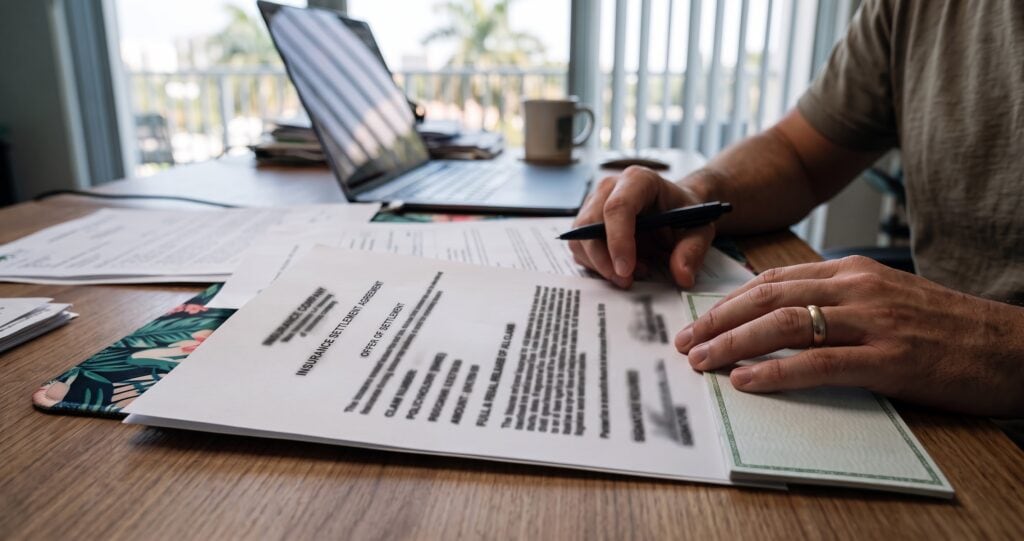
Insurance adjusters are not adversaries in the way a defense attorney is, but their job is to resolve claims for as little as the company can reasonably get away with. This applies whether the underlying claim involves a car accident, a slip and fall, or another injury covered by a liability policy. What follows is how to recognize when an offer or a tactic is working against you.
The first offer comes fast, before treatment is finished
An early offer, particularly one that arrives before you have finished medical treatment or even fully understand the extent of an injury, is rarely generous. Adjusters know that people under financial pressure are more prone to accept a quick number. A fast offer is a sign to slow down, not speed up.
They ask for a recorded statement right away
You are not required to give a recorded statement to the other driver’s insurance company. Adjusters are trained to ask questions in ways that produce answers useful to minimizing your claim, even when the questions sound routine or friendly.
They request your full medical history, not just records related to the accident
A request for your complete medical history, rather than records tied to the injury at issue, is commonly a search for a prior condition. Adjusters use that history to argue the current injury is not new, or not as serious as claimed.
The offer does not account for ongoing treatment or future care
A settlement that covers bills to date alone, without accounting for ongoing or reasonably anticipated treatment, can leave you responsible for costs that have not happened yet. Settlements are generally final. An offer that ignores future care is a notable gap, not a minor oversight.
They repeatedly ask you to sign something quickly
Pressure to sign a release or settlement quickly, especially paired with language suggesting the offer will disappear, is a negotiating tactic. A fair offer generally does not require rushing you into accepting it.
They dispute liability despite a clear police report
If a police report and the physical evidence point clearly to fault, but the insurance company keeps disputing liability without a real basis, that resistance is commonly strategic. It is not substantive.
Frequently Asked Questions
Is there an actual Florida law that prohibits these tactics, or is this just industry practice?
Florida’s Unfair Insurance Trade Practices Act, Fla. Stat. § 626.9541(1)(i), lists particular unfair claims settlement practices, including failing to properly investigate a claim and denying claims without a reasonable basis. A separate statute, Fla. Stat. § 624.155(4), gives a liability insurer a 90-day window after a well-documented demand to tender policy limits or the amount demanded before facing bad faith exposure. A well-documented demand with clear evidence is what starts that clock.
Does getting a lawyer involved make the insurance company angry or slow things down?
Involving an attorney generally speeds up a stalled claim rather than slowing it down, since adjusters know a represented claimant is more prone to pursue litigation if the offer stays unreasonable. It does not affect the underlying facts of the claim.
What if I already gave a recorded statement before realizing this could hurt my case?
A prior recorded statement does not end the claim. An attorney reviewing the statement alongside the rest of the case can address particular answers that need context or clarification as the claim moves forward.
Can I still negotiate after I have already received a settlement offer?
Yes. An initial offer is a starting point, not a final number. Countering a low offer with supporting documentation is a normal part of the claims process, not an unusual request.
What happens if I already accepted a lowball settlement?
Signed settlements and releases are generally final, which is why reviewing an offer before signing counts more than reviewing it after. In limited situations involving fraud or misrepresentation by the insurer, a signed release may be challenged, though this is the exception rather than the rule.
How long does it take to get a fair offer instead of a lowball one?
Timing depends on how much documentation exists and how the insurer responds to pushback. This is separate from Florida’s PIP rules, which require your own no-fault insurer to pay or deny PIP benefits within 30 days of receiving written notice of a covered loss under Fla. Stat. § 627.736; a liability settlement with the at-fault driver’s insurer follows no such fixed deadline. Claims with complete medical records and a clear liability picture generally resolve faster than ones still waiting on ongoing treatment to conclude.
Does it cost anything to have an attorney review an offer before I accept it?
No. Personal injury cases are handled on contingency, meaning there is no fee unless there is a recovery, and the initial consultation and offer review are free.
What to do if this sounds familiar
None of these tactics mean your claim lacks merit. They mean the process is adversarial even when it does not feel that way. Reviewing an offer with an attorney before accepting it costs nothing and can reveal whether the number reflects the value of the claim. See our full guide on insurance disputes for how coverage and denial issues get resolved after a claim is filed.
How I approach this
I represent injured clients in negotiations with insurance carriers and I am prepared to litigate when an offer does not reflect what the case is worth. Personal injury cases are handled on contingency, meaning no fee unless there is a recovery.
Initial consultations are free and confidential, with no obligation to retain. Calling early in a case tends to create more options than calling late.