
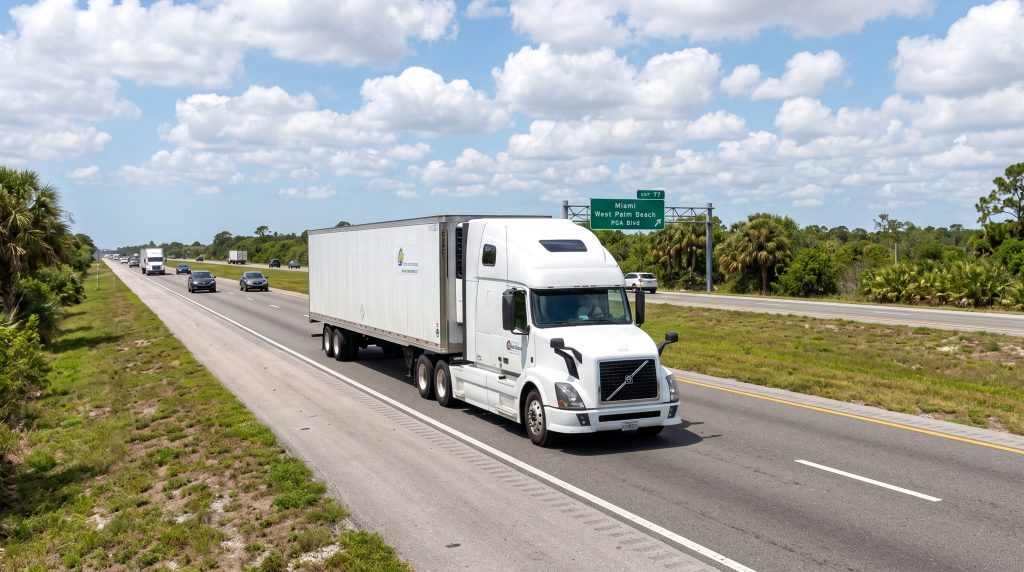
A commercial truck accident is rarely just a dispute between two drivers. The vehicle, its owner, the company operating it, and sometimes several other businesses connected to that one trip can all carry legal responsibility. Identifying every party who contributed carries weight, since a trucking company’s insurance coverage is commonly many times larger than what an individual driver carries alone.
- Dangerous Instrumentality Doctrine: Florida holds a vehicle’s owner responsible for how it was operated, not the driver alone.
- Vicarious liability: a trucking company is generally responsible for its driver’s actions while on the job.
- Direct negligence: a company can also be liable for hiring, training, or maintenance decisions, separate from the driver’s conduct.
- Other parties: a cargo loading company, a maintenance contractor, or a parts manufacturer can sometimes share responsibility too.
- FMCSA violations: a driver or company breaking federal safety regulations can establish negligence automatically.
- Evidence preservation: key records can be lost quickly unless an attorney requests they be kept early.
Frequently Asked Questions
What is Florida’s Dangerous Instrumentality Doctrine?
A distinctly Florida rule holding that the owner of a motor vehicle, including a commercial truck, is responsible for injuries caused by its negligent operation, as long as the vehicle was being driven with the owner’s knowledge and consent. Because a trucking company generally owns or leases the trucks its drivers operate, this doctrine commonly reaches the company directly, independent of any other theory of liability.
How does vicarious liability work for a trucking company?
Under the doctrine of respondeat superior, an employer is generally responsible for a driver’s negligent actions while the driver is performing job-related duties. This applies whether the driver is a direct employee or, in most situations, an independent contractor operating under the company’s authority. Labeling a driver as an independent contractor does not automatically shield the company from this kind of liability.
Can the trucking company be liable for its conduct, separate from the driver?
Yes, and this is a distinct theory from vicarious liability. A company can be directly liable for negligent hiring, negligent training, negligent supervision, or negligent retention, meaning it kept a driver with a known unsafe history on the road. A related theory, negligent entrustment, applies when a company knowingly dispatches an unqualified or disqualified driver, such as one who has exceeded federal hours-of-service limits, into hazardous conditions. This distinction carries weight for more than choosing the right defendant: it is generally what allows a case to reach gross negligence, the standard that can support a claim for punitive damages.
What role do FMCSA violations play in a Florida truck accident case?
Federal Motor Carrier Safety Administration regulations, which Florida has incorporated into state law under Fla. Stat. § 316.302, set safety standards covering driver qualifications, hours of service, drug and alcohol testing, vehicle maintenance, and cargo securement. A commercial driver’s legal blood alcohol limit is 0.04 percent, half the standard limit for other drivers. Violating one of these regulations can support a finding of negligence per se, a doctrine recognized under Florida law since deJesus v. Seaboard Coast Line Railroad Co., 281 So. 2d 198 (Fla. 1973), meaning the violation can establish a breach of duty without requiring separate proof that the conduct was careless.
Who else besides the driver and the company could be liable in a Florida truck accident?
Depending on the facts, several other parties can share responsibility. A cargo loading company can be liable if improperly secured or overweight freight contributed to the crash. A maintenance contractor can be liable if negligent repairs led to a mechanical failure. A parts or vehicle manufacturer can be liable if a defective component, such as brakes or a steering system, played a role. A complete case accounts for every contributing party, not the most obvious one alone.
Why does the timing of hiring an attorney carry weight in a truck accident case?
Key evidence in these cases is commonly temporary. Electronic logging device data, dispatch records, and driver qualification files are not always kept indefinitely, and some records can be routinely overwritten or discarded within weeks. A formal preservation letter sent to the trucking company early can require it to retain this evidence rather than let it disappear through normal business practice. Waiting to involve an attorney can mean losing access to the records that would otherwise establish precisely how the crash happened.
Why does insurance coverage carry more weight in a truck accident case?
Federal law requires most interstate trucking carriers to maintain at least $750,000 in liability coverage, with even higher minimums for trucks hauling hazardous materials. That is substantially more than a typical individual driver carries, which is part of why naming every liable party, beyond the driver, changes what a family can recover.
Can a truck driver face criminal charges in addition to a civil claim?
Yes. These two cases proceed separately. If a truck driver was impaired, reckless, or otherwise criminally negligent, the state can pursue charges such as DUI manslaughter or vehicular homicide, while the family separately pursues a civil wrongful death claim against the driver and the company. A criminal conviction is not required for the civil claim to succeed, and the two cases are decided under different standards of proof, but a criminal case can generate evidence, such as toxicology results or an accident reconstruction, that also becomes relevant to the civil claim.
If your family is facing this
Every truck accident case depends on the particular facts of what happened and which parties were involved, and that requires a real investigation, not a guess. These cases are handled locally, with claims arising in Miami-Dade County proceeding through the Eleventh Judicial Circuit. See our Truck Accidents page for how these cases are handled, and our page on wrongful death damages in Florida if the accident resulted in a death.
The first consultation is free and confidential, with no obligation to retain.