
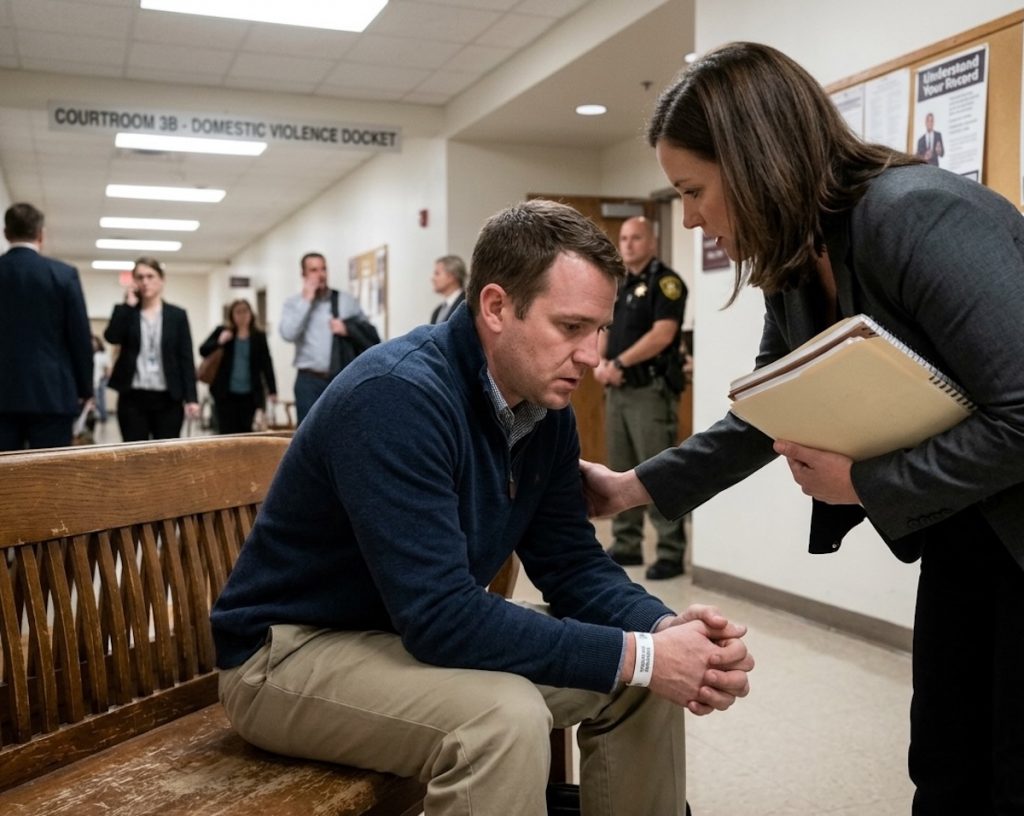
A police officer at the door. An accusation you know is not true. In Florida, that sequence commonly ends in an arrest, even when the facts are weaker than they sound.
False domestic violence accusations are more common than people realize. They surface most commonly in divorces, custody battles, breakups, and disputes between family members or roommates. Florida policy treats every domestic violence report seriously at the moment it is made, which means the work of sorting out what happened generally shifts to the courtroom after the arrest has already occurred. This guide walks through what to do, what to avoid, and what protects your case from the first hour forward.
Frequently Asked Questions
Why do false domestic violence accusations happen?
False accusations rarely come from nowhere. They generally emerge from situations where someone has a strong reason to gain an advantage or strike back at the accused. The most common patterns:
- Divorce proceedings, where an accusation can affect alimony, asset division, and access to the marital home
- Custody disputes, where an accusation can change parenting time and decision-making rights overnight
- Breakups, where anger or hurt drives retaliation
- Roommate or family conflicts that escalate into police involvement
- Mental health or substance issues that distort a person’s account of what happened
The Florida system is built to act first and sort the facts later, which is why preserved evidence and disciplined early decisions carry so much weight when an accusation is untrue.
What should I do in the first 24 hours after a false accusation?
What you do in the first day shapes the rest of the case. The rules below apply whether you have been arrested or just learned that an accusation has been made.
- Do not contact the accuser. That means no phone calls, texts, social media, email, or in-person contact, including through friends or family or under the guise of “just clearing things up.” If a no-contact order has been issued, any contact becomes a separate criminal charge, even contact that seems harmless.
- Do not delete anything. Texts, voicemails, emails, photos, location data, social media history. Deleted evidence looks terrible to a judge and can become its own charge. Even messages that seem damaging can have context that helps you.
- Find somewhere else to stay if a no-contact order is issued. Many no-contact orders prohibit returning to a shared residence, even if you own it or pay the rent. Violating that is a separate crime.
- Do not retaliate. Filing a counter-accusation, posting on social media, or speaking publicly about the case almost always hurts your defense. The place to make your case is the courtroom, not the internet or the neighborhood.
- Contact an attorney before talking to police. You have the right to remain silent. Use it. Detectives sometimes ask to “hear your side” before charges are filed. That conversation is rarely as helpful as it sounds.
What does a Florida no-contact order require?
An arrest for a domestic violence offense in Florida triggers an automatic no-contact order, generally issued at first appearance. See our full Bail and Bond Guide for how bond works differently in domestic violence cases. The order takes effect immediately and stays in place until a judge modifies or dismisses it.
What that means in practice:
- You cannot communicate with the alleged victim in any way, for any reason
- You cannot return to a shared residence to retrieve belongings without court permission
- You may be restricted from seeing your own children if they are named in the order
- You may have to surrender any firearms while the order is in effect
- The order appears on background checks for as long as it is active
These restrictions apply whether the underlying accusation is true or false. Fighting the order requires a separate motion and a hearing. Until the judge modifies or dismisses it, the order is the rule.
What evidence helps defend against a false accusation?
Most false accusations live or die based on what evidence each side can show. Preserving evidence early is one of the most useful things you can do before an attorney is involved.
- Text messages and emails. Especially anything showing the relationship before the accusation, the accuser’s tone, indications of motive (custody, finances, jealousy), or contradictions between what the accuser is now saying and what they said before
- Voicemails and call logs. Back them up to a cloud drive your attorney can access. Phones break. Accounts get locked.
- Photos and videos. Of the residence, of yourself showing the absence of injuries an accuser may later claim you caused, of the accuser if their condition contradicts the allegation
- Witnesses. Anyone who was nearby. Even people who saw and heard nothing can support that nothing notable happened.
- Location data. Phone GPS, app history, work badge records, security cameras, anything that places you somewhere other than where the alleged incident happened
- Prior history. If the accuser has made similar allegations before and dropped them, or has made allegations against other people, that history counts and your attorney can pursue it
What mistakes hurt a false accusation defense?
Several avoidable mistakes come up again and again in these cases, and each one can weaken an otherwise strong defense.
- Contacting the accuser through a third party. “Just tell her I’m sorry” through a mutual friend can be charged the same as direct contact under a no-contact order.
- Posting on social media. Any post about the accuser, the case, or the situation becomes evidence. Posts from sympathetic friends and family members can also be subpoenaed.
- Filing your own counter-accusation. Even when justified, a counter-accusation filed in the heat of the moment can look retaliatory and complicate the defense. Talk to an attorney before filing anything.
- Giving a statement to police without counsel. Officers are trained to ask questions in ways that produce admissions. There is no scenario where talking without an attorney is better than waiting for one.
- Assuming a recantation will end the case. Florida prosecutors can and commonly do proceed with domestic violence cases over the alleged victim’s objection. The state, not the accuser, decides whether to drop charges.
How do false domestic violence accusations get resolved?
False domestic violence accusations rarely fall apart on their own. They generally resolve through one of these paths:
- Motion to dismiss at an early stage, when the evidence is thin enough that the case cannot move forward. Less common than people hope, but possible in cases with weak physical evidence and credibility problems on the accuser’s side.
- Pretrial diversion in some jurisdictions for first-time accusations, where the charge is dismissed after completion of a program. Whether this is the right outcome for someone who was falsely accused is a separate strategic question.
- Plea negotiations to reduced charges. Commonly the practical compromise even when the underlying accusation was false, because the alternative is trial risk.
- Trial when the prosecution will not drop the case and the defendant is not willing to plead. Trials in domestic violence cases turn heavily on credibility, which is why preserved evidence and disciplined early decisions carry so much weight.
Are there consequences even if the charges are dismissed?
A domestic violence arrest creates a record even when the charges are dropped. Particular consequences that follow a Florida arrest:
- Background checks for employment, housing, and professional licensing will show the arrest unless the record is sealed or expunged
- Federal firearm restrictions apply during active no-contact orders and can apply to misdemeanor convictions
- Immigration consequences for non-citizens can include detention, denial of green card renewal, and deportation, sometimes even when charges are ultimately dismissed
- Family court judges in custody disputes can consider an arrest itself, not just a conviction
- Reputation damage in employment, social, and family settings that no court order can erase
For these reasons, fighting an unfounded accusation through to dismissal or acquittal, then pursuing expungement or record sealing, is commonly the single way to fully clear a record. An attorney experienced in both criminal defense and post-disposition relief can plan both stages from the start.
What should I do if I need help with a false accusation?
The Law Offices of Andre A. Rouviere has handled domestic violence cases in Miami-Dade County since 1992. Andre Rouviere personally reviews every case at the firm. Initial consultations are free and confidential, with no obligation to retain. Calling early in a case tends to create more options than calling late.
If you or a family member has been accused of domestic violence, contact us at (305) 774-7000 or visit our contact page. The earlier we are involved, the more options exist.